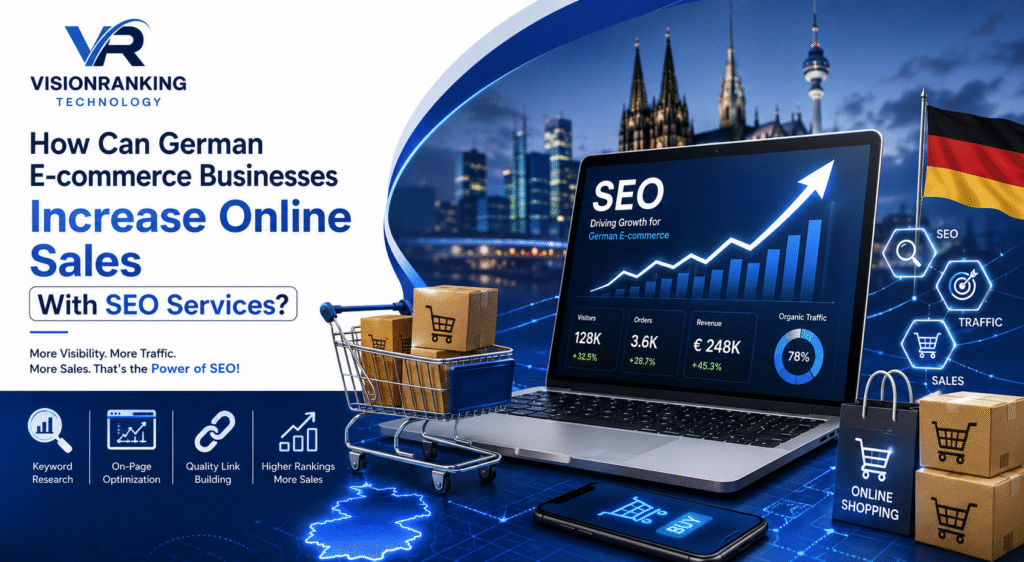
How Can German E-commerce Businesses Increase Online Sales With SEO Services?
📌 Key Takeaways
- SEO improves product visibility and helps German e-commerce businesses reach qualified buyers.
- Technical and on-page SEO can improve product, category, and website performance.
- Search-intent-focused content helps attract customers at different stages of the buying journey.
- AI search readiness can support visibility across Google AI Overviews and conversational search.
- Professional SEO services provide a long-term strategy focused on visibility, traffic, and business growth.
For an e-commerce business in Germany, getting more online sales is not simply about having a well-designed website or adding more products to an online store. Customers need to discover your products, trust your brand, understand what you offer, and have a smooth path from search to purchase.
This is where search engine optimisation becomes an important part of sustainable e-commerce growth.
German consumers often research products carefully before making a purchase. They may compare products, read reviews, check specifications, search for alternatives, and look for trustworthy suppliers before placing an order. If your online store does not appear when these searches happen, you may lose potential customers before they ever reach your website.
Professional SEO services in Germany can help e-commerce businesses improve their visibility across relevant searches, attract more qualified visitors, strengthen important product and category pages, and build a stronger organic acquisition channel.
However, effective e-commerce SEO is more than adding keywords to product descriptions. It requires technical expertise, search intent analysis, content optimisation, internal linking, structured data, authority building, conversion-focused improvements, and ongoing performance analysis.
For German online retailers looking to grow their organic sales, the right SEO strategy can become a long-term business asset.
Why SEO Matters for German E-commerce Businesses
Paid advertising can generate immediate visibility, but it requires continuous spending. SEO works differently.
When an e-commerce website earns stronger organic visibility for relevant searches, it can continue attracting potential customers without paying for every individual click.
SEO can support your business by helping you:
- Increase visibility for product-related searches
- Attract customers who are actively researching or buying
- Improve rankings for commercial keywords
- Strengthen category and product pages
- Increase qualified organic traffic
- Improve the discoverability of new products
- Build long-term search visibility
- Support brand credibility
- Reduce dependence on a single acquisition channel
- Create more opportunities for conversions
For example, consider a German online retailer selling professional equipment.
A potential customer may search for a specific product, compare different product categories, look for technical specifications, and then search for the company before making contact or completing a purchase.
A strong SEO strategy can help the retailer become visible at several stages of that journey.
The objective is not simply to generate more traffic. It is to attract the right traffic.
What Makes E-commerce SEO Different?
E-commerce websites have different SEO requirements from standard service websites.
An online store may contain hundreds, thousands, or even millions of URLs. Each product, category, filter, variation, brand page, informational page, and supporting resource can affect how search engines understand and crawl the website.
This creates opportunities, but it also creates technical risks.
Common e-commerce SEO challenges include:
- Duplicate product descriptions
- Thin category pages
- Poor internal linking
- Incorrect canonical tags
- Indexation of unnecessary filter URLs
- Out-of-stock product pages
- Duplicate title tags and meta descriptions
- Weak category-page content
- Poor product schema implementation
- Slow page performance
- Mobile usability issues
- Products buried several clicks deep
- Weak commercial landing pages
- Poor keyword targeting
- Content that does not match search intent
A business may have excellent products but still struggle to gain organic visibility if search engines cannot efficiently understand the website.
This is why professional SEO services in Germany should combine technical SEO with commercial strategy.
How SEO Can Increase Online Sales
SEO contributes to e-commerce growth through several connected areas.
1. Better Visibility for Commercial Searches
Ranking for informational searches can increase awareness, but commercial searches are particularly valuable for online retailers.
Examples include searches related to:
- Product categories
- Specific products
- Product specifications
- Product comparisons
- Pricing
- Suppliers
- Brands
- Applications
- Product alternatives
- Local or country-specific purchasing intent
A strong strategy identifies which searches have genuine business value and maps them to the right pages.
A product keyword should generally lead users toward a relevant product page, while a broader category search may be better served by a category or collection page.
Matching search intent with the correct landing page can make organic traffic significantly more valuable.
2. Stronger Product and Category Pages
Many e-commerce businesses focus heavily on their homepage while under-optimising their category and product pages.
This can be a major missed opportunity.
Category pages often target broader commercial searches, while product pages target highly specific queries.
A well-optimised category page should make it clear:
- What products are included
- Who the products are for
- What applications they support
- Which buying considerations matter
- How products differ
- Why customers should consider the business
Product pages should provide useful information rather than relying on manufacturer descriptions copied across multiple websites.
Depending on the product, useful information may include specifications, applications, compatibility, materials, dimensions, features, usage considerations, delivery information, and customer questions.
The goal is to make the page useful to both search engines and potential buyers.
3. Better Search Intent Matching
Not every visitor is ready to purchase immediately.
Some users are discovering a product category. Others are comparing options. Some already know exactly what they want.
SEO should account for these different stages.
A potential customer may progress through a journey such as:
Research → Comparison → Product Evaluation → Brand Evaluation → Purchase
Content and landing pages should support this journey.
For example, an e-commerce business could have:
- Category pages for broad commercial searches
- Product pages for specific product searches
- Buying guides for research-stage customers
- Comparison content for evaluation-stage users
- FAQs addressing common purchase concerns
- Trust and company pages supporting brand evaluation
This creates a stronger search ecosystem rather than relying on individual pages.
The Role of Technical SEO in E-commerce
Technical SEO is especially important for online stores because of the volume and complexity of their pages.
Even a strong content strategy can struggle if technical problems prevent search engines from efficiently crawling, indexing, and understanding important URLs.
A professional technical SEO assessment may examine areas such as:
- Crawlability
- Indexation
- XML sitemaps
- Robots.txt
- Canonicalisation
- Redirects
- HTTP status codes
- Page speed
- Core Web Vitals
- Mobile usability
- JavaScript rendering
- Internal linking
- Structured data
- Duplicate URLs
- Faceted navigation
- Pagination
- Product availability
- Site architecture
For large e-commerce websites, technical SEO is not a one-time task.
Products are added and removed. Categories change. URLs are updated. New filters are introduced. Platforms and templates may change.
Ongoing monitoring helps prevent technical changes from creating unexpected SEO problems.
How Content Supports E-commerce SEO
Content remains valuable for online retailers, but it needs to have a clear business purpose.
Publishing random blog posts simply to increase the number of pages on a website is unlikely to create meaningful commercial value.
Instead, content should support customer questions and product discovery.
Useful e-commerce content can include:
- Buying guides
- Product comparison articles
- Product application guides
- Industry-specific resources
- Product selection guides
- Technical explainers
- Frequently asked questions
- Maintenance and usage resources
- Category support content
For example, an online retailer selling industrial equipment could publish content addressing how buyers evaluate equipment for different applications.
That article can then naturally connect readers to relevant categories and products.
This approach creates a relationship between informational content and commercial pages.
Building Trust for German Online Shoppers
Visibility alone does not guarantee sales.
Customers also need confidence in the business.
For German e-commerce companies, trust can be particularly important when products are expensive, technical, specialised, or purchased for business purposes.
Your website should make important information easy to find.
Depending on the business, this can include:
- Clear company information
- Contact details
- Product specifications
- Shipping information
- Return policies
- Warranty information
- Secure payment information
- Customer reviews
- Certifications where applicable
- Delivery expectations
- Frequently asked questions
- Professional product photography
- Transparent business information
SEO can bring the customer to your website, but the website must then give them enough confidence to continue toward a purchase.
This is why SEO and conversion-focused website improvements should work together.
SEO and AI Search Readiness
Search behaviour continues to evolve.
Users increasingly ask conversational questions and expect search engines to provide direct answers rather than simply displaying traditional lists of websites.
Google AI Overviews and conversational search experiences are changing how some users discover information, products, and businesses.
For e-commerce businesses, this creates another reason to build strong, useful, well-structured content.
AI search visibility can be supported by:
- Clear answers to customer questions
- Well-structured product information
- Strong topical relevance
- Accurate business information
- Helpful supporting content
- Structured data where appropriate
- Strong website architecture
- Demonstrated expertise
- Consistent and trustworthy information
This does not mean chasing every new AI search trend.
The foundation remains the same: create a technically sound website with useful information and strong relevance to the searches your customers actually make.
Businesses should think beyond traditional rankings and consider how their products, categories, brand information, and expertise can be understood across modern search experiences.
Business Benefits of Professional SEO Services
Investing in professional SEO can create benefits that extend beyond rankings.
Increased Qualified Traffic
A successful strategy focuses on relevant searches rather than traffic volume alone.
More qualified visitors can create more opportunities for:
- Purchases
- Enquiries
- Account registrations
- Product demonstrations
- Distributor enquiries
- Repeat purchases
Stronger Organic Visibility
Consistent SEO work can improve the visibility of important commercial pages and help the business compete for a wider range of relevant searches.
Greater Brand Discovery
Customers who repeatedly see a business in search results may become more familiar with the brand.
This can be particularly useful in competitive e-commerce markets.
Reduced Dependence on Paid Traffic
SEO does not replace paid advertising, but it can diversify acquisition.
A balanced digital strategy may combine organic search, paid advertising, email marketing, social media, direct traffic, and other channels.
Better Website Structure
SEO projects often uncover website problems that also affect users.
Improving navigation, page structure, internal linking, content organisation, and performance can contribute to a better overall customer experience.
Common E-commerce SEO Mistakes
Even established online retailers can make SEO decisions that limit growth.
Mistake 1: Optimising Only the Homepage
The homepage is important, but customers often enter an e-commerce website through product and category pages.
Those pages deserve strategic attention.
Mistake 2: Using Manufacturer Descriptions Everywhere
Copied descriptions can make products difficult to differentiate from competing websites.
Unique, useful product information can provide a stronger experience.
Mistake 3: Creating Too Many Low-Value URLs
Filters and sorting features can generate large numbers of URLs.
Without proper technical controls, these pages may create crawl and indexation problems.
Mistake 4: Ignoring Category Pages
Category pages can target valuable commercial searches but are often left with minimal content.
Mistake 5: Chasing High-Volume Keywords
A high search volume does not automatically mean high commercial value.
A lower-volume keyword with strong buying intent can sometimes be much more relevant to revenue.
Mistake 6: Expecting Immediate Results
SEO is generally a long-term channel.
Technical improvements, content optimisation, authority development, and search visibility take time to establish.
Mistake 7: Measuring Only Rankings
Rankings matter, but they should not be the only performance indicator.
A stronger evaluation can include:
- Organic clicks
- Impressions
- Qualified traffic
- Conversions
- Revenue from organic search
- Landing-page performance
- Commercial keyword visibility
- Search Console trends
- Engagement behaviour
What Results Should an E-commerce Business Expect From SEO?
SEO results vary depending on factors such as:
- Website age
- Existing authority
- Competition
- Website quality
- Product demand
- Technical condition
- Number of products
- Search intent
- Content quality
- Link profile
- Market location
- SEO investment
- Previous SEO activity
For this reason, responsible SEO providers should avoid promising a fixed number of rankings or sales within a specific period.
A professional campaign normally begins by establishing a baseline.
The SEO team can then identify opportunities, prioritise improvements, implement changes, and measure progress over time.
Early improvements may involve technical fixes, indexation, page optimisation, or better targeting.
Over time, stronger organic visibility and increased qualified traffic can create opportunities for more conversions.
The important point is to measure progress against business objectives rather than unrealistic guarantees.
Our SEO Process for German E-commerce Businesses
At Vision Ranking, our approach starts with understanding the business rather than immediately making generic SEO recommendations.
Step 1: Website and Business Assessment
We review the website, business model, products, target customers, market, and existing search visibility.
Step 2: Keyword and Search Intent Research
We identify relevant commercial, transactional, informational, and product-focused searches.
The objective is to understand what potential customers are searching for and which pages should target those searches.
Step 3: Technical SEO Audit
We assess technical factors that can affect crawling, indexing, performance, and website accessibility for search engines.
Step 4: Competitor and Market Analysis
We examine the search landscape to understand the types of pages and content appearing for important queries.
The focus is on identifying opportunities and gaps rather than copying another business.
Step 5: On-Page Optimisation
Depending on the website, this may include recommendations for:
- Meta titles
- Meta descriptions
- H1 and H2 structure
- Product content
- Category content
- Internal links
- Image optimisation
- Alt text
- Canonical tags
- Schema markup
- FAQs
- Content structure
Step 6: Content Strategy
We develop content around customer questions, commercial opportunities, product categories, and relevant industry topics.
Step 7: Authority Development
A strong website also needs credibility.
Where appropriate, we work on relevant off-page SEO and authority-building activities designed around the business and its market.
Step 8: Performance Monitoring
SEO performance is monitored using relevant search and website data.
This helps identify what is improving, where additional work is needed, and which opportunities should be prioritised next.
Why Choose Vision Ranking for SEO Services in Germany?
Choosing an SEO agency is a long-term business decision.
At Vision Ranking, we focus on creating SEO strategies around business objectives rather than treating SEO as a checklist of isolated tasks.
Our approach focuses on:
- Business-focused keyword research
- Technical SEO
- On-page optimisation
- Content strategy
- E-commerce SEO
- Local and international SEO where relevant
- Search visibility analysis
- Authority development
- Ongoing performance monitoring
- AI search readiness
We also believe communication is an important part of a successful SEO partnership.
Business owners should understand what is being worked on, why it matters, and how progress is being evaluated.
Our objective is to become a long-term digital marketing partner, not simply an external provider delivering a monthly report.
Affordable SEO Services Germany: What Should Businesses Look For?
The word “affordable” should not mean choosing the cheapest SEO provider.
A lower monthly fee may appear attractive, but if the strategy does not address the website’s actual problems, the business may spend money without creating meaningful progress.
When evaluating affordable SEO services Germany, consider:
- What is included in the monthly service?
- Will the website receive technical SEO attention?
- Is keyword research based on business intent?
- Are product and category pages included?
- Is content part of the strategy?
- How is progress reported?
- Will recommendations be explained clearly?
- Is there a defined strategy?
- Does the agency understand e-commerce?
- Are expectations realistic?
The right question is not simply “How much does SEO cost?”
A better question is:
“What business value can this SEO investment create, and how will that value be measured?”
Red Flags When Choosing an SEO Agency
Businesses should be cautious when an SEO provider:
- Guarantees specific Google rankings
- Promises instant results
- Focuses only on keyword positions
- Cannot explain what work will be performed
- Uses unclear reporting
- Provides generic recommendations
- Creates large volumes of low-quality content
- Builds irrelevant links
- Avoids discussing technical SEO
- Does not ask about business goals
- Cannot explain how SEO supports conversions
Good SEO should be transparent enough for a business owner to understand the strategy and the reasoning behind major recommendations.
Questions to Ask Before Hiring an SEO Agency
Before selecting an SEO partner, ask:
What experience do you have with e-commerce websites?
E-commerce SEO involves different technical and commercial challenges from many other website types.
How will you select keywords?
The agency should consider search intent, relevance, competition, commercial value, and the business’s products.
How will you measure success?
Rankings can be useful, but meaningful performance measurement should also consider traffic, conversions, qualified visitors, and other relevant business metrics.
What happens during the first few months?
The agency should be able to explain the expected workflow without making unrealistic guarantees.
How will technical SEO be handled?
Technical issues can have a major effect on large e-commerce websites.
Will you optimise product and category pages?
These pages can represent some of the most important commercial opportunities on an online store.
How often will we receive updates?
Clear communication helps businesses understand what is happening with their investment.
SEO Services: Is Your Online Store Ready to Grow?
Your online store may already have good products, competitive pricing, and a professional website.
The next challenge is making sure potential customers can find you.
If important products are not appearing for relevant searches, category pages are attracting the wrong visitors, or technical problems are limiting organic visibility, SEO can provide a structured path toward improvement.
The right strategy is not about trying to rank for every possible keyword.
It is about understanding your customers, identifying valuable search opportunities, improving the website, creating useful content, strengthening authority, and measuring progress consistently.
For German e-commerce businesses, this can create a stronger foundation for sustainable online growth.
Talk to Vision Ranking About Your E-commerce SEO Strategy
If you are looking for SEO services in Germany and want a strategy focused on business growth rather than vanity metrics, Vision Ranking can help you evaluate your current organic search performance.
Our team can review your website, identify SEO opportunities, and explain where improvements could have the greatest business impact.
Whether you are launching a new e-commerce website, expanding your product range, entering new German markets, or trying to increase organic sales from an established store, a structured SEO strategy can help you make better decisions.
Book a Free Consultation with Vision Ranking to discuss your goals.
You can also Request a Free SEO Audit to understand the key opportunities and technical issues affecting your website.
Talk to Our Experts today and build a long-term SEO strategy for your German e-commerce business.
Frequently Asked Questions
1. What are SEO services for e-commerce businesses in Germany?
SEO services for German e-commerce businesses involve improving a website’s technical structure, product and category pages, content, search visibility, internal linking, authority, and overall organic search performance. The objective is to attract relevant users and support business growth through organic search.
2. How can SEO increase e-commerce sales?
SEO can increase sales by helping potential customers discover relevant products and categories through organic search. Better visibility, stronger landing pages, improved search intent matching, useful content, and a better website experience can create more qualified opportunities for conversions.
3. How long does e-commerce SEO take to show results?
SEO results vary by website, competition, market, technical condition, existing authority, and the scope of work. Some technical improvements may have relatively quick effects, while stronger organic visibility and authority generally require consistent work over time.
4. What should affordable SEO services Germany include?
Affordable SEO services should still provide a meaningful strategy. Depending on the business, this may include keyword research, technical SEO, on-page optimisation, content strategy, internal linking, authority development, performance monitoring, and regular reporting.
The cheapest package is not necessarily the most cost-effective option.
5. Does Vision Ranking provide SEO services for German businesses?
Yes. Vision Ranking provides SEO services for businesses targeting Germany, including strategies designed around commercial search visibility, technical SEO, content, on-page optimisation, authority development, and ongoing performance monitoring.
6. Should an e-commerce business focus on product pages or category pages?
Both can be important.
Category pages can target broader commercial searches, while product pages can target highly specific searches. The right balance depends on the website’s products, search demand, customer journey, and business objectives.
7. Can SEO help reduce dependence on paid advertising?
SEO can diversify an e-commerce company’s acquisition channels by increasing organic visibility. It does not necessarily replace paid advertising, but a strong organic channel can reduce reliance on any single source of website traffic.
8. Does SEO help with Google AI Overviews and conversational search?
A strong SEO foundation can support visibility across evolving search experiences, including Google AI Overviews and conversational search. Useful content, clear information, strong topical relevance, technical accessibility, and trustworthy business information remain important.
9. How do I choose the best SEO agency in Germany?
Instead of relying only on claims about being the “best SEO agency in Germany”, businesses should evaluate an agency’s experience, strategy, communication, reporting, technical capabilities, understanding of search intent, and approach to realistic business outcomes.
10. How can I get started with Vision Ranking?
You can contact Vision Ranking to discuss your e-commerce goals and request an SEO assessment. The team can review your current website and identify potential opportunities for improving organic visibility and generating more qualified traffic.
Conclusion
For German e-commerce businesses, SEO is more than a way to improve Google rankings.
It can support product discovery, increase qualified organic traffic, strengthen brand visibility, improve website structure, and create more opportunities for online sales.
The strongest SEO strategies connect technical performance with customer intent and commercial objectives.
That means optimising the pages that matter, creating useful content, improving the customer journey, building website authority, monitoring search performance, and adapting to changes in search behaviour.
If your online store has strong products but is not generating enough organic visibility or sales, it may be time to take a closer look at your SEO strategy.
Vision Ranking can help you identify the opportunities, prioritise the work, and build a sustainable SEO strategy designed around your business goals.
Book a Free Consultation or Request a Free SEO Audit today.