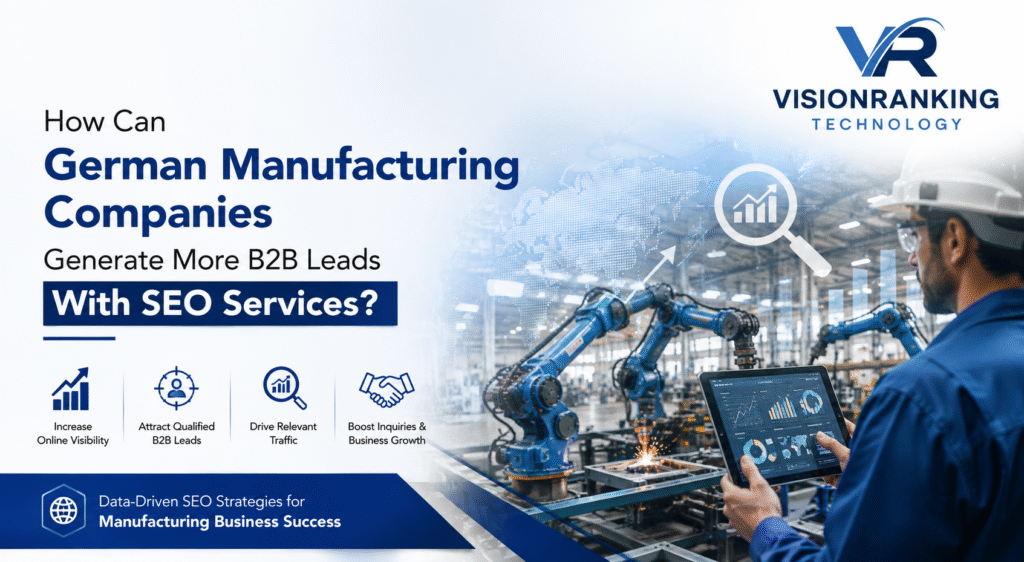
How Can German Manufacturing Companies Generate More B2B Leads With SEO Services?
📌 Key Takeaways
- Manufacturing SEO should focus on qualified B2B leads, not traffic alone.
- Product, service, application, and technical content should reflect the searches and questions of real buyers.
- Technical SEO is essential for large and complex manufacturing websites because poor structure can limit search visibility.
- AI Overviews and conversational search make authoritative, accurate, useful content increasingly important, but strong SEO fundamentals remain essential.
- A long-term SEO partnership should combine strategy, implementation, measurement, and continuous optimisation rather than isolated SEO tasks.
For German manufacturing and engineering companies, generating B2B leads is rarely about reaching the largest possible audience. It is about being visible to the right decision-makers at the right stage of their buying journey.
A procurement manager may search for a specific component. An engineer may look for a technical solution. A production manager may search for a manufacturing capability. A business owner may compare suppliers before requesting a quotation.
If your company does not appear when those searches happen, potential customers may never discover your business.
This is where professional SEO services in Germany can make a meaningful difference.
For manufacturing companies, SEO is not simply about increasing website traffic or achieving higher rankings for broad keywords. A well-planned B2B SEO strategy connects your products, services, applications, technical expertise, and commercial strengths with the searches your potential customers are already making.
It can help turn your website into a long-term digital lead-generation channel that supports your sales team, strengthens your market visibility, and attracts prospects beyond traditional networking, referrals, and trade shows.
Google’s current guidance also makes clear that established SEO fundamentals continue to matter as search evolves toward generative features such as AI Overviews and AI Mode.
For German manufacturers competing in technical and highly specialised markets, this creates an important opportunity.
1. Why SEO Matters for German Manufacturing Companies
Manufacturing businesses often have excellent products, experienced teams, advanced equipment, certifications, and strong customer relationships.
However, these strengths do not automatically translate into online visibility.
A potential customer may not search for your company name. Instead, they may search for:
- A specific manufacturing process
- A particular component
- An industrial supplier
- A technical specification
- A custom manufacturing solution
- A particular material or application
- A supplier serving a specific industry
- An engineering or production capability
- A solution to a manufacturing problem
This creates a gap between what a company offers and what its potential customers search for.
Professional SEO helps close that gap.
A strong strategy can make your website more visible across different stages of the B2B buying journey, from early research through supplier comparison and quotation requests.
For manufacturing businesses, this is particularly important because industrial purchasing is often research-heavy and involves multiple stakeholders.
The website therefore needs to answer both technical and commercial questions.
The objective is not simply more visitors
A manufacturing company does not necessarily need thousands of irrelevant visitors.
It needs the right visitors.
For example, 100 visitors looking for general manufacturing information may be less valuable than a smaller number of visitors searching for a specific industrial capability, component, service, or supplier.
That is why a qualified B2B lead should be one of the central objectives of an industrial SEO strategy.
2. Why B2B Manufacturing SEO Is Different From General SEO
Manufacturing websites have unique SEO requirements.
A typical industrial website may contain:
- Product categories
- Individual product pages
- Technical specifications
- Applications
- Industries served
- Manufacturing capabilities
- Certifications
- Materials
- Case studies
- Technical resources
- Service pages
- Locations
- International pages
This creates both opportunities and challenges.
A company may have hundreds of valuable products and capabilities, but if those pages are poorly structured, thin, difficult to navigate, or not aligned with real search behaviour, Google may struggle to understand their relevance.
At the same time, technical buyers expect accurate information.
They do not want vague marketing statements.
They want to know:
- What does the company manufacture?
- Which industries does it serve?
- What specifications are available?
- What materials can be used?
- What applications are supported?
- What certifications are available?
- Can the company handle custom requirements?
- What geographical markets does it serve?
- How can the buyer request further information?
This means industrial SEO requires a combination of technical SEO, search-intent research, useful content, website structure, authority building, and conversion optimisation.
3. How SEO Can Generate More Qualified B2B Leads
A professional SEO company in Germany should look beyond rankings and traffic.
The real question is:
Can organic search visibility contribute to your sales pipeline?
The process generally looks like this:
Search demand → Relevant visibility → Website visit → Trust → Enquiry → Sales opportunity
Each stage matters.
If the wrong keywords are targeted, the wrong people visit.
If the website does not provide useful information, visitors leave.
If the website lacks trust signals, potential buyers may hesitate.
If the enquiry process is unclear, qualified prospects may never contact the sales team.
SEO therefore needs to work together with the website and sales process.
High-intent searches are especially valuable
Consider the difference between these searches:
General:
manufacturing company Germany
More specific:
precision CNC machining supplier Germany
Commercial:
custom CNC machining services Germany
The latter searches can indicate a much clearer commercial requirement.
This is why keyword research for manufacturing companies should not focus solely on search volume.
Search intent, relevance, commercial value, competition, and the company’s actual capabilities all need to be considered.
4. Target the Searches Your Industrial Buyers Actually Use
One of the most common problems with manufacturing websites is that their content uses internal company terminology instead of customer search language.
A company may describe itself as:
“A leading provider of innovative engineering solutions.”
That may sound professional, but it does not necessarily tell search engines or buyers exactly what the business provides.
A better SEO strategy identifies the terminology used by:
- Engineers
- Procurement professionals
- Technical managers
- Operations teams
- Product developers
- OEM buyers
- Distributors
- Business owners
The keyword strategy can then be organised around different search themes.
Product-focused keywords
These describe what the company manufactures or supplies.
Service-focused keywords
These describe manufacturing and engineering capabilities.
Application-focused keywords
These connect products with their real-world use cases.
Industry-focused keywords
These identify sectors such as automotive, aerospace, energy, electronics, machinery, or industrial automation.
Problem-focused keywords
These represent the challenges buyers are trying to solve.
Location-focused keywords
These can be important for companies specifically targeting Germany, individual German regions, or international markets from Germany.
This broader approach creates more opportunities to reach potential customers throughout the buying journey.
5. Build Product and Service Pages Around Commercial Intent
Product and service pages are among the most important assets on a manufacturing website.
Yet many companies treat them like online brochures.
A strong SEO-focused product page should make it easy for both search engines and potential customers to understand:
- What the product or service is
- What it does
- Who it is designed for
- Key specifications
- Available options
- Applications
- Industries served
- Technical advantages
- Related products or services
- Frequently asked questions
- How to request information or a quotation
The objective is not to fill pages with keywords.
The objective is to provide the information a qualified buyer needs before contacting your company.
This can also help sales teams.
A prospect who has already reviewed detailed product information may have a more informed conversation with your sales department.
6. Use Technical Content to Demonstrate Expertise
Manufacturing companies have something many general businesses do not have: deep technical knowledge.
That knowledge can become a powerful SEO and trust asset.
For example, technical content may cover:
- Material selection
- Manufacturing methods
- Product specifications
- Industry applications
- Engineering considerations
- Maintenance considerations
- Performance factors
- Product comparisons
- Common technical problems
- Compliance considerations
- Selection criteria
- Application-specific requirements
The important point is that this content should be created around genuine expertise.
A manufacturing website should not publish generic articles simply because a keyword has search volume.
The content should demonstrate that the company understands the subject.
This supports the principles of experience, expertise, authoritativeness, and trustworthiness that are important when building a credible online presence.
Technical accuracy matters
A technically incorrect article can do more harm than good.
For manufacturing companies, content should ideally be reviewed by someone with appropriate subject knowledge before publication.
An SEO specialist can identify search opportunities, structure the content, improve visibility, and optimise the page.
The company’s technical experts provide the industry knowledge.
That combination creates much stronger content.
7. Technical SEO Is Critical for Large Manufacturing Websites
Manufacturing websites can become technically complicated.
Large websites may have hundreds or thousands of URLs.
Problems can include:
- Duplicate content
- Poor internal linking
- Missing metadata
- Indexation issues
- Broken links
- Incorrect canonicalisation
- Slow-loading pages
- Poor mobile usability
- Weak site architecture
- Orphan pages
- Incorrect redirects
- Unoptimised images
- Poor URL structures
- Inconsistent international targeting
These problems can make it harder for search engines to discover, crawl, understand, and rank important pages.
Technical SEO therefore needs to be treated as an ongoing part of the strategy rather than a one-time checklist.
A professional audit can examine:
- Crawlability
- Indexability
- Website architecture
- Internal linking
- Core technical issues
- Metadata
- Heading structure
- Canonical tags
- XML sitemap
- Robots directives
- Structured data
- Page performance
- Mobile experience
- International SEO implementation
Google also provides tools and documentation for understanding how its systems crawl, index, and display website content, making technical SEO an important foundation rather than an optional extra.
8. Strengthen Internal Linking Across Products, Services and Applications
Internal links are particularly valuable for manufacturing websites because there are often natural relationships between pages.
For example:
Product → Application → Industry → Service → Contact
A product page could link to relevant applications.
An application page could link to suitable products.
An industry page could connect visitors with relevant capabilities.
A technical article could link to the product or service discussed.
This helps users navigate the website while also helping search engines understand relationships between pages.
It can also create stronger commercial journeys.
A visitor may begin with an informational article and eventually reach a relevant service page.
That is much more valuable than treating every page as an isolated SEO asset.
9. Make the Website Useful for Different B2B Decision-Makers
A manufacturing purchase rarely involves only one person.
Different stakeholders may have different questions.
| Buyer or stakeholder | Typical concern |
| Procurement | Supplier capability, pricing, availability, reliability |
| Engineer | Specifications, performance, materials, compatibility |
| Technical manager | Quality, production capability, technical support |
| Operations manager | Reliability, efficiency, implementation |
| Business owner | Commercial value, risk, supplier credibility |
| Product manager | Applications, integration, product suitability |
A good B2B SEO strategy considers these different information needs.
The website should not speak only to search engines.
It should help real decision-makers evaluate the company.
This is one reason why SEO services Germany should be closely connected with content strategy and conversion optimisation.
10. Prepare Your Manufacturing Website for AI Search
Search behaviour is evolving.
Google has introduced AI Overviews and AI Mode, while conversational search experiences are becoming increasingly important. Google says its guidance for generative AI search features builds on established SEO best practices and emphasises useful, original, non-commodity content.
For manufacturers, this creates another reason to build strong, authoritative content.
Potential buyers may ask conversational questions such as:
- Which manufacturers provide this type of component?
- What should I consider when selecting this material?
- What manufacturing process is suitable for this application?
- Which specifications matter for this industrial product?
- What are the differences between these solutions?
- Which suppliers serve this industry?
Your website should provide clear, factual and useful information that helps establish your company as a relevant source.
AI search does not replace SEO
AI search readiness should not be treated as a completely separate activity.
Strong fundamentals still matter.
That includes:
- Technically accessible pages
- Clear website architecture
- High-quality content
- First-hand expertise
- Accurate information
- Strong internal linking
- Clear business identity
- Relevant authority signals
- Useful product and service information
Google’s documentation specifically notes that SEO best practices remain relevant for visibility in generative AI features.
The goal should therefore be to build a website that is useful for people and understandable to modern search systems.
11. Common SEO Mistakes Made by Manufacturing Companies
Many industrial businesses have strong offline reputations but underperform online because of avoidable SEO issues.
Mistake 1: Targeting only broad keywords
Broad terms can attract traffic but may not generate qualified enquiries.
Mistake 2: Using the same content across multiple product pages
Similar pages can struggle to establish clear relevance.
Mistake 3: Writing only about the company
Customers generally care about their problem, requirement, application, and solution.
Mistake 4: Ignoring technical SEO
Excellent content cannot perform as expected if important pages cannot be properly crawled or indexed.
Mistake 5: Treating SEO as a one-time project
Search behaviour, competitors, products, content, and website requirements change over time.
Mistake 6: Measuring only rankings
Rankings matter, but businesses should also monitor organic traffic quality, enquiries, conversions, relevant landing pages, and commercial search visibility.
Mistake 7: Publishing generic AI-generated content
Large volumes of generic content do not automatically create authority.
For industrial companies, accuracy, originality, experience, and technical relevance matter far more.
Mistake 8: Forgetting conversion optimisation
A visitor who cannot quickly understand what the company offers or how to contact the business may never become a lead.
12. What Should You Look For in an SEO Specialist in Germany?
Choosing an SEO specialist Germany businesses can trust requires more than checking whether an agency promises higher rankings.
Manufacturing SEO requires an understanding of:
- B2B search behaviour
- Technical industries
- Commercial search intent
- Website architecture
- Technical SEO
- Content strategy
- Lead generation
- Conversion optimisation
- International SEO where relevant
- Search performance measurement
A suitable SEO partner should also be able to explain why particular recommendations are being made.
You should understand:
What is being changed?
Why is it being changed?
What business objective does it support?
How will progress be measured?
Google’s own guidance recommends that businesses evaluating third-party SEO services should understand the recommendations and be able to assess whether the proposed work makes sense for their website and business.
13. Red Flags When Choosing an SEO Agency
Manufacturing companies should be cautious about SEO providers that focus heavily on promises instead of process.
Watch for:
- Guaranteed rankings
- Guaranteed lead numbers
- Extremely broad promises without an audit
- No explanation of keyword strategy
- Reporting focused only on vanity metrics
- Large volumes of low-quality backlinks
- Generic content with little technical relevance
- No technical SEO assessment
- No conversion strategy
- Long contracts without clear deliverables
- Recommendations that cannot be explained clearly
SEO is a long-term marketing investment.
A trustworthy agency should set realistic expectations and explain the factors that can influence results.
14. Questions to Ask Before Hiring an SEO Company in Germany
Before selecting an SEO partner, ask:
1. How will you identify our most valuable keywords?
The answer should involve search intent, business relevance, competition, products, services, and target customers.
2. How will you connect SEO with lead generation?
The agency should be able to explain how search visibility connects with landing pages, enquiries, conversions, and sales opportunities.
3. Will you review our technical SEO?
Technical issues should not be ignored simply because the website already receives traffic.
4. How will you approach our technical content?
Manufacturing content requires accuracy and subject understanding.
5. How will you measure progress?
Look for meaningful metrics rather than rankings alone.
6. How often will we receive reports?
Regular reporting creates transparency and helps both sides understand progress.
7. How will you approach AI search?
The answer should involve strong SEO fundamentals, useful content, expertise, clear information architecture, and modern search visibility rather than promises of guaranteed AI citations.
8. What happens after the initial optimisation?
SEO should have a roadmap for continuous improvement.
15. How Vision Ranking Helps German Manufacturing Companies
At Vision Ranking, our approach to SEO is built around business objectives rather than isolated SEO metrics.
We understand that a manufacturing company needs more than website traffic.
It needs visibility that can support commercial growth.
Our approach can include:
Comprehensive SEO Audit
We examine the website to identify technical, on-page, content, structural, and visibility opportunities.
Keyword Research
We identify relevant search terms based on products, services, industries, applications, locations, and buyer intent.
On-Page SEO
We optimise important pages to improve relevance, structure, metadata, headings, internal linking, and search intent alignment.
Technical SEO
We identify technical barriers that may affect crawling, indexing, performance, and overall search visibility.
Content Strategy
We develop content around the questions, problems, applications, and requirements that matter to potential customers.
Authority Building
We work on relevant off-page SEO activities designed to strengthen the website’s authority and credibility.
AI Search Readiness
We consider how your website can provide clear, useful and authoritative information for modern search experiences, including Google AI Overviews and conversational search.
Performance Reporting
We monitor meaningful SEO data to understand progress and identify further opportunities.
The objective is to create a structured SEO programme that develops over time.
16. Our SEO Process for German Manufacturing Companies
A structured process helps ensure that SEO activities support business priorities.
Step 1: Website and Business Analysis
We first understand your company, products, services, markets, customers, competitors, and existing website performance.
Step 2: SEO Audit
We review technical and on-page factors to identify areas requiring attention.
Step 3: Keyword and Search Intent Research
We identify the searches that are relevant to your commercial objectives.
Step 4: Strategy Development
We prioritise pages, keywords, technical improvements, content opportunities, and authority-building activities.
Step 5: On-Page Optimisation
Important pages are optimised around their intended search and business purpose.
Step 6: Content Development
We create or improve content designed to answer genuine customer questions and support commercial visibility.
Step 7: Technical Improvements
Technical issues are addressed based on their impact and priority.
Step 8: Authority Development
Relevant off-page activities support the growth of website authority.
Step 9: Performance Monitoring
Search performance, organic traffic, landing pages, conversions, and other meaningful indicators are reviewed.
Step 10: Continuous Optimisation
SEO is refined based on performance data, search trends, business priorities, and new opportunities.
17. What Results Should a Manufacturing Company Expect From SEO?
SEO should be viewed as a long-term investment rather than an instant lead-generation shortcut.
Results can vary considerably depending on:
- Existing website authority
- Industry competition
- Target market
- Current rankings
- Website quality
- Technical condition
- Content depth
- Keyword difficulty
- Search demand
- Link authority
- Conversion experience
- Implementation speed
Early improvements may include better visibility for relevant search terms and increased organic impressions.
Over time, stronger rankings can generate more qualified visits to important product and service pages.
The ultimate commercial objective is to increase the number and quality of relevant enquiries.
However, responsible SEO providers should not guarantee a fixed number of leads or rankings because search performance depends on factors outside an agency’s complete control.
Measure the right things
A manufacturing company should consider tracking:
- Relevant keyword visibility
- Organic impressions
- Organic clicks
- Non-branded search traffic
- Important landing pages
- Enquiry submissions
- Contact requests
- Quote requests
- Phone calls where trackable
- Organic conversion rates
- Search visibility across priority products and services
This gives management a clearer picture of whether SEO is contributing to business growth.
18. Business Benefits of Professional SEO Services in Germany
A well-executed SEO strategy can provide several long-term business benefits.
More relevant website visibility
Your company can become easier to discover for searches related to its products and capabilities.
Better-quality traffic
Targeting commercial and problem-specific search intent can improve visitor relevance.
More qualified enquiries
Potential buyers who find pages matching their requirements may be more likely to contact the company.
Stronger brand credibility
A company that consistently appears for relevant technical searches can strengthen its digital presence.
Support for the sales team
Useful website content can answer common questions before a prospect speaks with sales.
Long-term marketing value
Unlike campaigns that stop generating traffic when advertising spend stops, organic visibility can continue developing through ongoing optimisation.
Better market intelligence
Search data can also reveal what customers are looking for, which products receive attention, and where new content opportunities exist.
19. Why Choose Vision Ranking for SEO Services in Germany?
Choosing an SEO partner is an important business decision.
Vision Ranking focuses on building SEO strategies around the company’s actual commercial objectives.
Our approach combines:
- Technical SEO
- Keyword research
- On-page optimisation
- Content strategy
- Local and international SEO where relevant
- Authority building
- Search performance analysis
- Conversion-focused thinking
- Modern search and AI search readiness
We do not believe that every manufacturing company should follow the same SEO plan.
A specialised engineering supplier, component manufacturer, industrial service provider, and machinery company can have completely different customers and search behaviour.
That is why strategy should begin with understanding the business.
Our objective is to build a long-term digital marketing partnership where SEO activities are connected to measurable business priorities.
If your German manufacturing company is struggling to generate qualified leads from organic search, Book a Free Consultation with Vision Ranking and discuss where your website currently stands and where the strongest SEO opportunities may be.
Conclusion: Turn Your Manufacturing Website Into a B2B Lead Channel
German manufacturing companies have a significant opportunity to use organic search as a stronger part of their B2B marketing and sales strategy.
Your potential customers are searching for products, technical solutions, suppliers, applications, specifications, and manufacturing capabilities.
The question is whether they can find your company when they search.
Professional SEO services in Germany can help close that visibility gap by combining technical optimisation, search-intent research, useful content, authority development, conversion-focused website improvements, and preparation for modern search experiences.
The goal should not be to chase every keyword.
It should be to build sustainable visibility around the searches that matter to your business.
If your manufacturing or engineering company wants to attract more relevant B2B opportunities through organic search, Vision Ranking can help you identify the strongest opportunities and develop a practical SEO strategy around them.
Request a Free SEO Audit or Talk to Our Experts today!
Frequently Asked Questions
1. Why do German manufacturing companies need SEO?
SEO helps manufacturing companies become more visible when potential customers search for products, services, technical solutions, suppliers, and applications. It can support long-term organic lead generation and complement traditional channels such as sales teams, referrals, and trade shows.
2. What are SEO services in Germany?
SEO services in Germany typically include keyword research, technical SEO, on-page optimisation, content strategy, website optimisation, authority building, performance monitoring, and ongoing search optimisation tailored to the German market.
3. How can SEO generate B2B leads for manufacturing companies?
SEO can attract potential buyers who are actively researching relevant products, services, manufacturing capabilities, and technical solutions. When these visitors reach well-optimised commercial pages with clear calls to action, they can become enquiries, quote requests, or sales opportunities.
4. Should manufacturing companies focus on product keywords?
Product keywords can be highly valuable, but they should not be the only focus. A strong strategy can also target service, application, industry, problem-based, technical, and commercial searches.
5. Does technical SEO matter for manufacturing websites?
Yes. Manufacturing websites can contain large numbers of product, service, application, and technical pages. Technical issues involving crawling, indexing, internal linking, duplicate content, redirects, performance, and website architecture can affect how effectively search engines understand and access those pages.
6. How does AI search affect manufacturing SEO?
AI-powered search experiences can change how users discover information and evaluate potential suppliers. Manufacturing companies should therefore provide accurate, useful, well-structured content that demonstrates genuine expertise. Google states that established SEO practices continue to be relevant for its generative AI search features.
7. How long does SEO take to generate B2B leads?
There is no universal timeframe. Results depend on the website’s existing authority, technical condition, competition, search demand, content quality, implementation speed, and other factors. SEO should generally be viewed as an ongoing investment rather than an immediate source of guaranteed leads.
8. How should a manufacturing company measure SEO success?
Important metrics can include relevant search visibility, organic impressions, clicks, non-branded traffic, landing-page performance, enquiry submissions, quote requests, calls where trackable, and organic conversion rates. Rankings alone do not provide a complete picture.
9. How can I choose an SEO company in Germany?
Look for an SEO partner that can explain its strategy clearly, understands your business and customers, evaluates technical and content issues, connects SEO with lead generation, provides transparent reporting, and sets realistic expectations rather than guaranteeing specific rankings or lead volumes.
10. Can Vision Ranking help with SEO for German manufacturing companies?
Yes. Vision Ranking can develop a tailored SEO strategy covering technical SEO, keyword research, on-page optimisation, content, authority development, performance monitoring, and modern search visibility. The strategy can be aligned with your products, services, target customers, and business objectives.