How to optimize product pages for AI search results globally?
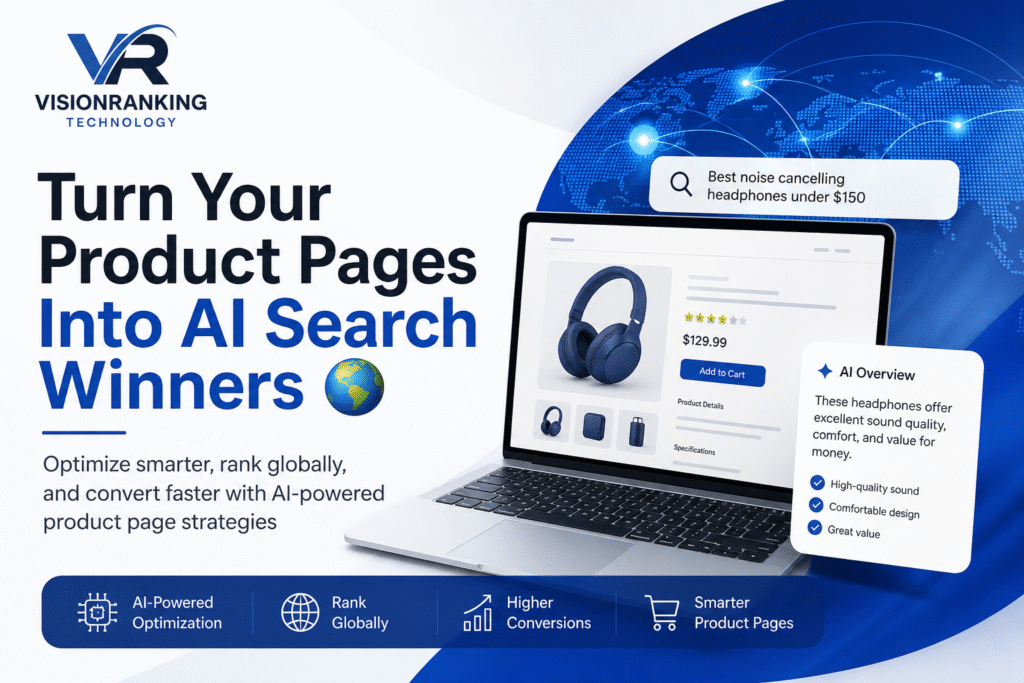
In today’s evolving digital landscape, traditional SEO is no longer enough. With AI-driven search systems reshaping how users discover products, businesses must rethink how their product pages are structured, written, and optimized. From conversational queries to AI-generated summaries, search engines are becoming more intuitive, and your product pages must align with this shift.
At Vision Ranking, we help brands across the UK, Singapore, UAE, Australia, London, and the Netherlands stay ahead of these changes by building product pages that not only rank but also convert in AI-powered environments.
This guide will walk you through exactly how to optimize product pages for AI search results globally, using strategies that work across multiple markets and user behaviors.
Understanding AI Search and Its Impact on Product Pages
AI search is transforming platforms like Google Search and Bing into intelligent assistants. Instead of simply showing links, these systems now:
- Summarize product information
- Answer user queries directly
- Highlight key features from web pages
- Predict user intent
This means your product page is no longer just competing for clicks. It is competing to be selected as the source of truth by AI.
Why Traditional Product Page SEO Is Not Enough
Previously, ranking depended heavily on keywords, backlinks, and metadata. While these still matter, AI search focuses more on:
- Context and meaning
- User intent
- Content clarity
- Structured data
- Trust signals
If your product page is keyword-stuffed but lacks clarity or real value, AI systems may ignore it entirely.
Step 1: Focus on Intent Driven Content
AI prioritizes content that directly answers user questions. Your product page should go beyond listing features.
What to Do:
- Identify real user queries
- Add natural language descriptions
- Include problem solving sections
For example, instead of just saying:
“High quality running shoes”
Say:
“These running shoes are designed for long distance comfort, reducing foot fatigue and improving performance on uneven surfaces.”
This approach aligns with how users search and how AI interprets content.
Step 2: Structure Content for Easy AI Extraction
AI systems scan your page to extract key information quickly. If your content is messy or unstructured, it reduces your chances of being featured.
Best Practices:
- Use clear headings and subheadings
- Break content into short paragraphs
- Add bullet points for features
- Include product specifications in a clean format
A well structured page increases the likelihood that AI will pull your content into summaries or featured answers.
Step 3: Optimize Product Descriptions for Conversational Search
With the rise of voice search and AI assistants, users are asking full questions instead of typing short keywords.
Example Queries:
- “What is the best eco friendly water bottle for travel?”
- “Which laptop is good for video editing under budget?”
Optimization Tips:
- Write in a conversational tone
- Include question based subheadings
- Answer queries directly within the content
At Vision Ranking, we create product descriptions that feel like helpful answers, not just sales text.
Step 4: Implement Structured Data Markup
Structured data helps search engines understand your product in detail.
Important Schema Types:
- Product schema
- Review schema
- FAQ schema
These elements allow AI systems to display:
- Price
- Ratings
- Availability
- Key features
Without structured data, your product page is less visible in rich results.
Step 5: Add High Quality and Contextual Content
Thin content does not perform well in AI search. Your product page should include:
- Detailed descriptions
- Use cases
- Benefits
- Comparisons
- FAQs
Example Additions:
- “Who is this product for?”
- “How does it compare to similar products?”
- “What problem does it solve?”
This depth helps AI understand the relevance and usefulness of your page.
Step 6: Build Trust Signals for Global Audiences
When targeting multiple locations like the UK, Singapore, UAE, Australia, London, and the Netherlands, trust becomes even more important.
Include:
- Customer reviews
- Testimonials
- Secure payment badges
- Clear return policies
- Localized content
AI systems prioritize content from trusted and authoritative sources. The more signals you provide, the better your chances.
Step 7: Optimize for Mobile and Page Speed
AI search heavily favors user experience. A slow or poorly designed page can hurt your visibility.
Focus On:
- Fast loading times
- Mobile friendly design
- Clean navigation
- Minimal popups
Users in regions like Singapore and the UAE expect fast, seamless browsing. Meeting these expectations improves both rankings and conversions.
Step 8: Use Semantic Keywords Instead of Repetition
AI understands meaning, not just keywords.
Instead of repeating:
“Best laptop”
Use variations like:
- High performance laptop
- Laptop for professionals
- Powerful computing device
This improves readability and helps AI understand the broader context.
Step 9: Localize Product Pages for Each Market
Global optimization does not mean one size fits all.
Customize for:
- Language preferences
- Currency
- Cultural context
- Buying behavior
For example:
- UK users may prefer detailed specs
- UAE users may focus on luxury and brand value
- Australian users may prioritize durability
Vision Ranking helps businesses tailor product pages for each region while maintaining consistency.
Step 10: Add FAQ Sections for AI Visibility
FAQs are extremely valuable for AI search because they directly answer user questions.
Example Questions:
- What makes this product unique?
- Is this product suitable for beginners?
- How long does shipping take?
Each answer should be clear, concise, and helpful.
Step 11: Leverage User Generated Content
Reviews, ratings, and user feedback provide real world insights that AI values.
Benefits:
- Builds trust
- Adds fresh content
- Improves engagement
- Enhances credibility
Encourage customers to leave detailed reviews that describe their experience.
Step 12: Optimize Images and Visual Content
AI also analyzes images to understand products better.
Tips:
- Use high quality images
- Add descriptive alt text
- Include multiple angles
- Show product usage
Visual clarity improves both user experience and AI interpretation.
Step 13: Monitor Performance and Adapt
AI search is constantly evolving. Regular monitoring is essential.
Track:
- Organic traffic
- Click through rates
- Conversion rates
- Featured snippets
Use this data to refine your product pages continuously.
How Vision Ranking Helps You Dominate AI Search
At Vision Ranking, we specialize in creating AI-optimized product pages that perform globally. Our approach includes:
- Deep keyword and intent research
- Structured content creation
- Technical SEO implementation
- Localization strategies
- Continuous performance optimization
Whether your target market is the UK, Singapore, UAE, Australia, London, or the Netherlands, we ensure your product pages are built for the future of search.
Frequently Asked Questions
What is AI search optimization?
AI search optimization focuses on structuring and writing content so that AI powered search engines can easily understand, extract, and present it to users.
Why are product pages important for AI search?
Product pages provide detailed information that AI systems use to answer user queries, making them critical for visibility and conversions.
How is AI SEO different from traditional SEO?
AI SEO emphasizes context, user intent, and structured data, while traditional SEO focuses more on keywords and backlinks.
Do I need separate product pages for each country?
Not always, but localization improves relevance and user experience, especially in diverse markets.
How long does it take to see results?
Results vary depending on competition and optimization quality, but consistent improvements typically lead to better visibility over time.
Final Thoughts
Optimizing product pages for AI search is no longer optional. It is a necessity for businesses that want to stay competitive in global markets. By focusing on clarity, structure, user intent, and trust, you can create product pages that not only rank but also convert.
Vision Ranking is here to help you navigate this transformation with strategies that deliver real results.
Ready to make your product pages AI-friendly and globally competitive? Let Vision Ranking turn your traffic into conversions today.