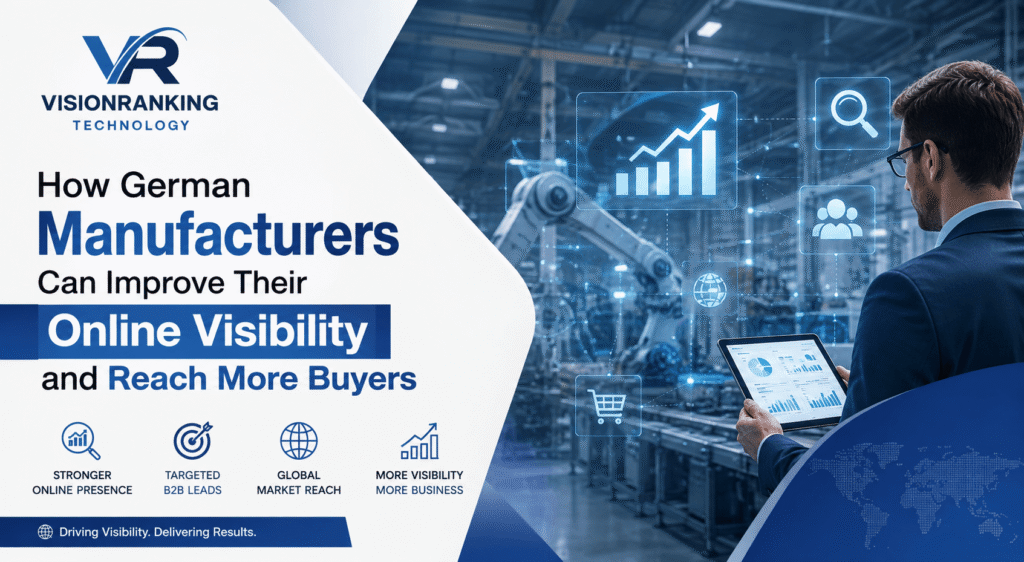
How German Manufacturers Can Improve Their Online Visibility and Reach More Buyers?
📌 Key Takeaways
- SEO Helps Manufacturers Reach the Right Buyers: Professional SEO services help German manufacturers improve online visibility and connect with relevant B2B buyers, procurement teams, and industrial customers.
- Targeted Keywords Drive Relevant Enquiries: Focusing on product-specific, service-related, and commercial search terms can help attract potential customers who are actively looking for manufacturing solutions.
- Technical SEO and Quality Content Matter: A well-structured, fast, accessible website with accurate product information helps search engines understand your business and enables buyers to evaluate your capabilities.
- AI Search Readiness Supports Future Visibility: Optimising content for clear answers, factual accuracy, and genuine expertise can support visibility across Google AI Overviews and evolving conversational search experiences, without guaranteeing placement.
- Long-Term SEO Supports Sustainable Business Growth: Consistent optimisation, performance monitoring, and a focus on qualified leads can help manufacturing companies strengthen their digital presence and create more opportunities over time.
Germany has a strong manufacturing sector, serving businesses across automotive, industrial machinery, engineering, electronics, chemicals, metal fabrication, medical equipment, and other industries. For manufacturers operating in this competitive environment, a strong reputation and quality products remain essential. However, potential buyers also need to find the right suppliers online before they make contact.
Today, procurement teams, purchasing managers, engineers, distributors, and business owners frequently use search engines to research manufacturers, compare capabilities, evaluate technical specifications, and identify potential suppliers. If a manufacturing company’s website does not appear for relevant searches, it may miss valuable opportunities, even when its products and production capabilities are excellent.
This is where a well-planned search engine optimisation strategy can make a meaningful difference.
With professional SEO services for manufacturing, companies can improve their search visibility, attract relevant business enquiries, strengthen their digital credibility, and reach potential buyers in Germany and international markets. The objective is not simply to increase website traffic. It is to help the right people discover the business when they are actively searching for its products, services, or manufacturing capabilities.
At Vision Ranking, we understand that manufacturing businesses have different marketing requirements from retail stores or consumer-facing brands. Industrial SEO needs to account for technical terminology, specialised products, long B2B sales cycles, and the information buyers require before requesting a quotation.
This guide explains how German manufacturers can improve their online visibility, overcome common SEO challenges, and build a stronger digital presence that supports long-term business growth.
If your manufacturing company wants to attract more relevant enquiries through search, explore Vision Ranking’s manufacturing SEO services to understand how a tailored strategy can support your business goals.
1. Why Online Visibility Matters for German Manufacturing Companies
Manufacturing buyers rarely make significant purchasing decisions after viewing a single webpage. They often research several suppliers, review product specifications, check certifications, assess production capabilities, and discuss shortlisted companies internally.
A manufacturer’s website therefore needs to do more than introduce the company. It should help potential buyers understand what the business produces, which industries it serves, what makes its capabilities relevant, and how they can start a commercial conversation.
Search visibility matters because it helps manufacturers become discoverable during this research process.
A well-optimised website can support business objectives such as:
- Reaching purchasing managers looking for specialised components or equipment.
- Connecting with distributors and wholesale buyers.
- Generating enquiries for custom manufacturing and OEM services.
- Promoting industrial products to buyers in different German regions.
- Supporting international expansion through relevant non-branded searches.
- Building credibility before a prospective customer contacts the sales team.
Consider a company that manufactures precision-machined components for industrial equipment. Its existing customers may know the company through long-standing relationships, but new buyers might search for a particular component, material, tolerance, or manufacturing capability.
If the company’s website does not clearly communicate these offerings, potential customers may never discover it through organic search.
SEO helps close that visibility gap by connecting the company’s actual capabilities with the terms its prospective customers use.
2. What Do SEO Services for Manufacturing Actually Include?
Manufacturing SEO is a specialised approach to improving a company’s visibility in search results for relevant industrial products, technical capabilities, and B2B services.
Unlike broad marketing campaigns that focus mainly on general brand awareness, manufacturing SEO should attract visitors who have a realistic reason to consider the company as a supplier.
A comprehensive strategy typically includes several connected activities.
| SEO area | What it involves | Business value |
| Keyword research | Identifying searches related to products, components, materials, and services | Reaches relevant buyers |
| Technical SEO | Improving crawlability, indexing, website structure, and technical performance | Helps search engines understand the website |
| On-page SEO | Improving titles, headings, page content, and internal links | Makes product and service pages more relevant |
| Content strategy | Developing useful industrial and commercial content | Supports buyer research |
| International SEO | Structuring content for target countries and languages | Supports international expansion |
| Conversion optimisation | Improving enquiry forms, quotation requests, and contact paths | Makes it easier for buyers to get in touch |
| AI search readiness | Making content clear, accurate, and well organised for search experiences | Improves discoverability across evolving search formats |
| Performance reporting | Evaluating rankings, relevant traffic, and enquiries | Helps guide future decisions |
These activities work best when they follow a unified strategy.
For example, publishing a new page for a specialised industrial component will have limited value if search engines cannot index it, the content does not explain the product properly, or buyers cannot find a clear way to request pricing.
Vision Ranking approaches manufacturing SEO as a business growth activity, connecting technical improvements, relevant content, search intent, and lead generation.
3. Understand How Industrial Buyers Search for Suppliers
One of the most important parts of manufacturing SEO is understanding the difference between general searches and searches that indicate commercial intent.
A person searching for information about metal fabrication may be conducting research. Someone searching for a precision metal fabrication company in Germany may be actively evaluating potential suppliers. Both searches can be valuable, but they serve different purposes.
Manufacturing companies should build their SEO strategy around the complete buyer journey.
Different types of manufacturing search intent
Product-specific searches
Buyers use these searches when they know which product or component they need. Examples include industrial valves, stainless steel fasteners, CNC-machined parts, and hydraulic components.
Capability-based searches
These searches focus on what a manufacturer can produce or deliver. Examples include precision machining services, custom metal fabrication, plastic injection moulding, and contract manufacturing.
Supplier-focused searches
These indicate that the buyer is evaluating companies. Examples include industrial component manufacturers in Germany, OEM manufacturing companies, and German machinery suppliers.
Problem-focused searches
Buyers may first look for information about a technical or operational challenge. They might research material selection, component durability, production tolerances, or equipment compatibility before approaching a supplier.
A well-planned website addresses these different needs through relevant service pages, product pages, industry pages, and supporting articles.
For example, a manufacturer offering CNC machining could have a dedicated service page explaining its capabilities, a product page covering relevant components, and supporting content addressing material options or typical industrial applications.
Each page should have a clear purpose and direct interested visitors towards an appropriate next step.
The goal is not to target every possible keyword. It is to prioritise searches that align with the company’s capabilities, target customers, commercial objectives, and ability to fulfil demand.
4. Build a Website Structure That Makes Products and Capabilities Easy to Find
A manufacturing website often contains a large catalogue of products, technical documents, industry solutions, and specialised services. Without a clear structure, visitors may struggle to find the information they need.
Search engines can also have difficulty understanding how different pages relate to one another.
A logical website structure helps address both problems.
For many manufacturing businesses, the website should make it easy to navigate between:
- Main manufacturing services.
- Individual products and product categories.
- Materials, processes, and technical capabilities.
- Industries served.
- Quality assurance and certification information.
- Case studies and relevant project experience.
- Company information and contact details.
The precise structure depends on the company’s product range and business model. A component manufacturer may need detailed product pages, while an industrial engineering firm may need stronger service and application pages.
Why individual product pages matter
A single page listing every product may be convenient for the business, but it may not provide enough detail for buyers or search engines.
Where commercially appropriate, individual product pages can explain:
- Product specifications and available variations.
- Materials, dimensions, and manufacturing methods.
- Intended applications and compatible systems.
- Relevant standards or certifications, where applicable.
- Customisation and OEM possibilities.
- Minimum order requirements, if relevant.
- How to request technical information or a quotation.
Manufacturers should avoid creating hundreds of nearly identical pages simply to target more keywords. Each page needs a distinct purpose and useful information.
Vision Ranking can evaluate a manufacturer’s existing website structure and identify opportunities to improve navigation, page organisation, internal linking, and search relevance.
A manufacturing SEO consultation can help determine which pages deserve priority based on commercial value and realistic search opportunities.
5. Target the Right Keywords Instead of Chasing Traffic Alone
Keyword research is a foundation of effective SEO for manufacturing companies. However, search volume alone should not determine which keywords receive attention.
A keyword that generates thousands of general visitors may deliver fewer business opportunities than a specialised search used by a small number of qualified procurement professionals.
The right strategy considers search intent, relevance, competition, buyer requirements, and the company’s ability to serve the demand.
Examples of keyword opportunities
| Keyword category | Illustrative search terms | Primary objective |
| Core services | Manufacturing services Germany, contract manufacturing services | Promote the company’s overall capabilities |
| Technical services | CNC machining services, precision metal fabrication | Attract buyers seeking specialised processes |
| Product-related | Industrial pump components, custom metal brackets | Reach product-specific buyers |
| Industry-related | Automotive component manufacturing, medical device contract manufacturing | Connect with relevant industries |
| Supplier searches | Industrial parts manufacturer Germany, OEM manufacturer Germany | Reach potential business customers |
| Location-related | CNC machining company Stuttgart, metal fabrication company Munich | Target relevant regional demand |
| Informational | Materials for precision components, industrial component manufacturing processes | Support early-stage research |
These are examples for planning, not claims about actual search volumes or current rankings. Keyword priorities should be validated through research and aligned with the manufacturer’s offering.
Account for German and international search behaviour
Manufacturers targeting customers in Germany should consider the language their buyers use.
German-language searches may be important for businesses serving domestic purchasing teams. English-language searches can also be relevant, particularly for international procurement, export markets, and technical industries that commonly use English terminology.
The correct language strategy depends on the audience rather than a blanket assumption that every manufacturer needs two versions of every page.
If both German and English pages are required, the content should be professionally localised rather than translated mechanically. Technical terms, industry conventions, product descriptions, and calls to action must remain accurate.
Where separate language URLs are used, appropriate international SEO implementation, including hreflang where applicable, can help search engines understand the intended audience for each version.
The key is to build a search strategy around real buying opportunities, not merely to increase the number of keywords on a website.
6. Improve Technical SEO to Make Your Website Easier to Discover
A manufacturing website may look professional and contain valuable technical information but still struggle in search because of underlying technical issues.
Technical SEO helps search engines discover, crawl, interpret, and index the pages that matter.
Common areas requiring attention include:
- Important product or service pages blocked from crawling or indexing.
- Incorrect canonical tags that point search engines towards the wrong URLs.
- Broken internal links and unnecessary redirect chains.
- Duplicate or near-duplicate product descriptions.
- Slow page loading or poor mobile usability.
- Incorrect robots.txt directives or XML sitemap configuration.
- Poor navigation across large product catalogues.
- Missing or inconsistent structured data where relevant.
- Unnecessary URL variations created by filters or product parameters.
These issues can be particularly important for manufacturers with extensive catalogues or websites that have undergone redesigns, platform migrations, or changes to product categories.
Website speed and usability
Buyers may access technical documentation, product specifications, and quotation forms from desktop computers, tablets, or mobile devices. A website that is difficult to navigate or slow to respond can make research unnecessarily frustrating.
Improving website performance does not guarantee higher rankings, but it can support a better user experience and reduce barriers to enquiries.
Technical SEO requires prioritisation
Not every technical warning carries the same business impact.
For instance, an indexing problem affecting a high-value product category may deserve immediate attention, while a minor issue on an unimportant page may have little commercial significance.
A professional SEO audit should distinguish critical problems from lower-priority recommendations and explain why each change matters.
Vision Ranking can help manufacturing businesses identify technical weaknesses, assess their likely impact, and create a prioritised roadmap for improvement.
7. Create Content That Builds Confidence With B2B Buyers
Manufacturing buyers need reliable information before they commit to a supplier. Generic marketing statements are rarely enough to establish confidence in a company that produces specialised components or provides industrial services.
Content should demonstrate what the business can actually deliver.
For example, instead of relying on a statement such as “We offer high-quality manufacturing solutions,” a company could explain the processes it supports, the materials it works with, the industries it serves, and the types of production requirements it can accommodate.
The information must reflect the manufacturer’s real capabilities. Claims about certifications, production capacity, tolerances, quality systems, and delivery times should be verified before publication.
Content opportunities for manufacturing websites
A useful content strategy may include:
- Service pages: Explain manufacturing processes, capabilities, and the types of projects the company accepts.
- Product pages: Describe specifications, applications, variations, and relevant technical details.
- Industry pages: Explain how the company’s capabilities support specific industrial sectors.
- Technical articles: Address common product, material, and manufacturing questions.
- Case studies: Describe actual projects, the client’s requirements, and the work completed, with appropriate permission.
- Quality pages: Present verified quality processes, certifications, and compliance information.
- Frequently asked questions: Answer practical questions about customisation, production, ordering, and technical support.
Why expertise matters more than publishing volume
Manufacturers do not necessarily need to publish articles every week. They need content that supports the buyer’s decision-making process and reflects genuine subject knowledge.
A detailed, accurate page about a specialised manufacturing process may be more valuable than several broad articles that repeat common industry information.
Where possible, content should incorporate input from technical specialists, production managers, engineers, or sales teams. Their knowledge can help the website answer questions that generic marketing copy often misses.
This approach supports stronger content quality and helps demonstrate experience and expertise, important considerations within Google’s broader people-first content guidance.
Vision Ranking’s content strategy can help manufacturing businesses turn their technical knowledge into clear, search-friendly information that supports both discoverability and qualified enquiries.
8. Prepare Your Manufacturing Website for AI Search
Search behaviour is evolving. Alongside traditional search listings, users increasingly encounter AI-supported search experiences, including Google AI Overviews and conversational search tools.
Manufacturers should consider these experiences as part of their broader organic search strategy rather than treating them as a replacement for SEO.
A buyer may ask a conversational question about a manufacturing process, compare supplier capabilities, or seek an explanation of a technical requirement. Websites that provide clear, specific, trustworthy information can be better positioned to contribute useful information to these research journeys, although inclusion in AI-generated results is never guaranteed.
What AI search readiness means for manufacturers
Answer important questions clearly. Explain manufacturing capabilities, product applications, material choices, and service limitations in language that technical and non-technical buyers can understand.
Use descriptive headings. Organise content into meaningful sections so readers can quickly locate relevant information.
Demonstrate real expertise. Provide accurate technical details, verified company information, genuine project examples, and clearly attributed expertise where appropriate.
Maintain accessible website content. Ensure important information is available in crawlable text and that relevant pages can be accessed by search engines.
Keep business information consistent. Company details, service descriptions, product information, and relevant contact information should be accurate across the website and appropriate business profiles.
Use structured data correctly. Relevant schema markup can help search engines interpret information about an organisation, products, and other eligible content. Structured data does not guarantee AI citations or enhanced search appearances.
SEO, AEO, and GEO work together
For manufacturing companies, these approaches can complement one another:
- SEO: Improves the website’s relevance and discoverability in organic search.
- Answer Engine Optimisation (AEO): Helps present clear, direct responses to useful buyer questions.
- Generative Engine Optimisation (GEO): Focuses on improving the clarity, credibility, and usefulness of content for generative search experiences.
These terms describe related optimisation approaches, not guaranteed placements in specific platforms.
Manufacturers should continue to prioritise technically sound websites, useful content, accurate information, and genuine business expertise. There is no reliable shortcut that guarantees a position in Google AI Overviews.
Vision Ranking can incorporate AI search readiness into a wider SEO strategy, helping businesses build a digital presence that can adapt as search experiences develop.
9. Strengthen Your Digital Credibility and Build Trust
For industrial buyers, choosing a supplier can involve significant financial, operational, and quality considerations. A manufacturer’s website should therefore provide enough credible information to help potential customers evaluate whether the company is suitable for their requirements.
SEO can help bring buyers to the website, but trust-building information helps them decide whether to make contact.
Manufacturing companies can strengthen their online credibility by presenting:
- A clear company profile and manufacturing specialisation.
- Accurate descriptions of production facilities and capabilities.
- Relevant quality certifications and standards, where verified.
- Genuine case studies and customer testimonials, with permission.
- Technical documentation and product specifications.
- Information about quality control and inspection processes.
- Clear contact details and a straightforward enquiry process.
- Evidence of relevant experience in the industries they serve.
For example, a business supplying components for industrial machinery may need to demonstrate its technical capabilities and quality processes before a procurement team considers requesting a quotation.
A generic website with limited product information may leave important questions unanswered. A well-organised website can make the evaluation process easier by presenting relevant information in a professional, accessible format.
Local SEO and business visibility
Local SEO can also be valuable for manufacturers that serve particular industrial regions, operate physical facilities, or want to attract nearby businesses.
Depending on the business model, relevant local optimisation may include accurate business information, appropriate location pages, a properly maintained Google Business Profile, and genuine customer reviews.
However, not every manufacturer needs to prioritise local SEO equally. Companies selling nationally or internationally may benefit more from product-led and capability-led search strategies, while businesses serving regional customers may require a stronger local focus.
The right approach depends on where the company operates, how it delivers its products, and which customers it wants to reach.
10. Business Benefits of Investing in Manufacturing SEO
SEO should support measurable commercial objectives. For a manufacturing company, success is not simply about attracting more visitors. It is about becoming visible to relevant buyers and creating opportunities that fit the business.
Here are some of the main benefits a well-planned strategy can deliver.
Reach buyers who are actively researching suppliers
Relevant organic visibility can help a manufacturer appear when potential customers search for its products, services, or technical capabilities.
This creates opportunities to connect with buyers who may not already know the company’s name.
Generate more relevant business enquiries
A website that targets appropriate commercial searches and provides clear enquiry options can support quotation requests, technical consultations, and discussions about custom manufacturing projects.
The quality of enquiries depends on many factors, including the company’s offering, market demand, competition, and the relevance of its website.
Support international expansion
Manufacturers looking beyond their immediate market can use carefully planned content and international SEO to reach audiences in other countries.
This requires accurate language targeting, appropriate technical implementation, and content that reflects the needs of the intended market.
Reduce dependence on a single acquisition channel
A stronger organic search presence can complement referrals, trade shows, distributor relationships, paid advertising, and direct sales outreach.
SEO does not eliminate the need for these channels. Instead, it can become another source of qualified opportunities over time.
Strengthen long-term brand visibility
Useful product pages, technical resources, and industry-specific content can continue attracting relevant visitors after publication, provided they remain useful and competitive.
Organic visibility requires ongoing maintenance, especially when products, market conditions, search behaviour, or competitors change.
Improve marketing and sales alignment
Search data can help businesses understand which products attract interest, which topics prospective customers research, and which landing pages contribute to enquiries.
When combined with sales feedback, this information can help manufacturers refine their website content and prioritise commercially valuable opportunities.
The most useful measurement framework connects search performance with business outcomes rather than reporting rankings in isolation.
11. Our Process: How Vision Ranking Approaches Manufacturing SEO
Every manufacturing business has different products, target markets, technical requirements, and growth objectives. Vision Ranking’s approach should reflect these differences rather than applying an identical keyword list and content plan to every client.
Our manufacturing SEO service is designed around understanding the business, identifying opportunities, improving website performance, and supporting sustainable organic growth.
Step 1: Business and website assessment
We review the website, business offering, target audience, existing search visibility, and key commercial priorities. This provides the foundation for identifying relevant opportunities and potential barriers to growth.
Step 2: Keyword and competitor research
We identify relevant product, service, industry, and supplier-related search terms. We also evaluate competing search results to understand how the website can provide more useful and relevant information.
Step 3: Technical SEO and on-page improvements
We identify technical issues and opportunities involving indexing, website structure, metadata, headings, internal links, content relevance, and user experience. Recommendations are prioritised according to their importance.
We plan relevant service pages, product content, industry information, and supporting articles. Where appropriate, the strategy also considers reputable link acquisition, digital PR opportunities, and AI search readiness.
Step 5: Monitoring and continuous improvement
We monitor agreed performance indicators, assess changes in organic visibility, review relevant traffic and enquiries, and identify areas that require further attention. The strategy evolves as results and business priorities develop.
The process should remain collaborative. Manufacturing clients can provide technical information, confirm product details, review proposed content, and share feedback about lead quality.
This helps keep the website aligned with the company’s actual capabilities and commercial objectives.
Interested in understanding what your website needs? Contact Vision Ranking to discuss your manufacturing SEO requirements and potential next steps.
12. Common Manufacturing SEO Mistakes That Can Limit Growth
Even companies with established websites can miss valuable opportunities because of avoidable SEO problems.
Recognising these issues helps businesses make better decisions about their digital investment.
Targeting broad keywords without commercial relevance
A manufacturer may attract general visitors through broad industry terms without reaching buyers interested in its actual products or services.
Keyword targeting should reflect the company’s specialisation and customer requirements.
Using identical content across product pages
Replacing only the product name while keeping every other sentence identical often produces weak pages that offer little additional value.
Product pages should communicate meaningful differences in specifications, applications, materials, or manufacturing capabilities.
Ignoring technical website problems
An attractive design cannot compensate for important pages that are inaccessible, incorrectly indexed, or difficult to navigate.
Technical SEO should be assessed alongside content and keyword targeting.
Publishing content without technical input
Incorrect specifications, vague capability descriptions, and unsupported claims can undermine credibility.
Manufacturing content should be checked by someone familiar with the products or processes being discussed.
Neglecting enquiry conversion paths
Visitors may leave without contacting the company if quotation forms are difficult to find, contact options are unclear, or the next step is not explained.
Relevant pages should make it straightforward to request pricing, discuss specifications, or contact the appropriate team.
Expecting immediate results
SEO requires time for implementation, crawling, indexing, and the development of competitive visibility. The timeframe varies depending on the website, industry, competition, and scope of work.
A strategy built around short-term ranking promises can lead to poor decisions and unrealistic expectations.
Treating AI search optimisation as a separate shortcut
Creating content solely to target AI-generated answers while neglecting website quality, accuracy, and search fundamentals is unlikely to provide a reliable foundation.
AI search readiness should complement a comprehensive SEO strategy.
13. Red Flags to Watch for When Choosing an SEO Agency
Selecting an SEO partner is an important business decision. Manufacturing companies should look for an agency that understands their commercial objectives and can explain how its work supports those objectives.
Be cautious if an agency:
- Guarantees specific Google rankings or assured AI Overview placements.
- Promises a large number of backlinks without explaining their relevance or quality.
- Recommends mass-producing low-value pages to target every keyword variation.
- Cannot explain its technical findings or proposed priorities.
- Focuses only on keyword positions without discussing relevant enquiries.
- Uses unclear reporting or cannot explain what work has been completed.
- Suggests tactics that violate search engine spam policies.
- Makes unsupported claims about experience, results, or industry expertise.
- Requests access without explaining why it is needed or how it will be handled.
A professional agency should explain what it recommends, why the work matters, what the limitations are, and how progress will be evaluated.
Manufacturing SEO often requires cooperation between marketing, web development, and technical teams. An agency should be comfortable working within this environment and obtaining the information necessary to represent the business accurately.
14. Questions to Ask Before Hiring a Manufacturing SEO Agency
Before committing to an SEO partnership, business owners and marketing managers should understand the proposed scope, responsibilities, reporting arrangements, and expectations.
Useful questions include:
1. How will you identify the most commercially relevant keywords for our products and services? The agency should explain how search intent, product relevance, and business objectives influence its research.
2. How will you assess our website’s technical SEO? Ask how the agency will identify indexing problems, structural issues, and other barriers to organic performance.
3. How will you develop content for specialised manufacturing services? The agency should explain how it will collect technical information and validate important claims.
4. Can you support our target markets and languages? This is especially important if the company serves both German-speaking and international buyers.
5. How will you measure qualified leads? Rankings and traffic matter, but the reporting framework should also consider enquiry quality and conversion performance where tracking is available.
6. What work will be completed each month? Understand the deliverables, responsibilities, approval process, and expected collaboration.
7. How will you approach link building and authority development? Look for an emphasis on relevance, editorial quality, and sustainable practices rather than link volume alone.
8. How will you handle AI search readiness? The agency should explain its approach to content quality, technical accessibility, and answer-focused information without promising guaranteed inclusion.
9. How often will we receive reports and strategic recommendations? Reporting should explain progress, challenges, completed work, and upcoming priorities.
10. What should we realistically expect from the campaign? A credible agency should discuss uncertainty, implementation dependencies, and the factors that influence results.
The answers can help determine whether an agency is offering a considered business strategy or simply selling a standard package.
15. Why Choose Vision Ranking for Manufacturing SEO?
Manufacturing businesses need an SEO partner that understands the relationship between search visibility, technical accuracy, and commercial growth.
Vision Ranking focuses on building SEO strategies around a company’s services, target audience, website requirements, and growth priorities. Rather than treating rankings as the only objective, the aim is to develop a digital presence that helps relevant buyers discover the business and understand its capabilities.
Our approach can support manufacturing companies through:
- Business-focused keyword planning: Prioritising search opportunities that align with the products and services the company actually offers.
- Technical SEO recommendations: Identifying website issues and helping establish a practical improvement plan.
- On-page optimisation: Improving page structure, metadata, content relevance, and internal linking.
- Content strategy: Planning useful manufacturing and industry-specific content that supports buyer research.
- International search considerations: Addressing language and market requirements where international growth is a priority.
- AI search readiness: Integrating relevant considerations for Google AI Overviews and conversational search into the wider SEO strategy.
- Performance monitoring: Evaluating progress through agreed SEO metrics and available enquiry data.
- Long-term strategic support: Refining the campaign as business priorities, search performance, and market requirements evolve.
No two manufacturing businesses have exactly the same needs. A company selling standard industrial components may require a different approach from a manufacturer offering customised OEM production or specialised engineering services.
That is why understanding the business should come before deciding which pages to optimise, which keywords to target, or how content should be developed.
For manufacturers seeking a long-term digital marketing partner, the focus should be on transparent communication, relevant recommendations, measurable progress, and work that supports wider business goals.
Let’s discuss your growth opportunities. Visit Vision Ranking’s manufacturing SEO service page to explore how our team can support your company’s online visibility.
16. What Results Can German Manufacturers Realistically Expect From SEO?
SEO can help manufacturing companies build a stronger online presence, but results depend on the starting condition of the website, competition, product demand, the quality of implementation, and the resources available for ongoing improvements.
It is important to establish realistic expectations from the beginning.
In the early stages, the focus may be on resolving technical issues, improving important product pages, and establishing a clear keyword and content strategy. As changes are implemented and search engines process them, the campaign can begin evaluating which pages and topics show encouraging progress.
Over time, the strategy may expand to cover additional product categories, new target markets, stronger content, and improvements to enquiry conversion.
A practical reporting framework can include:
| Performance area | What to monitor |
| Organic visibility | Search impressions, relevant keyword positions, and visibility trends |
| Website traffic | Organic visits to priority product and service pages |
| Engagement | Relevant page visits, navigation, and interactions |
| Lead generation | Quotation requests, contact form submissions, and qualified enquiries |
| Commercial value | Lead quality, sales opportunities, and attributable conversions where measurable |
| Technical health | Indexing status, important technical issues, and page performance |
| AI search visibility | Available evidence of brand mentions, citations, or referral activity from AI-supported search experiences |
Not every metric will be equally important for every manufacturer. Reporting should reflect the business’s actual objectives and available tracking capabilities.
It is also important to distinguish SEO’s contribution from other sales and marketing activities. A new enquiry may result from a combination of organic search, referrals, paid advertising, existing relationships, and other touchpoints.
A good SEO partner helps the business interpret performance accurately rather than attributing every improvement to one activity.
How long does manufacturing SEO take?
There is no universal timeline for achieving specific rankings or enquiry volumes. Some technical improvements can be implemented relatively quickly, while competitive keyword growth and meaningful commercial outcomes may take several months or longer.
Companies should evaluate progress through a combination of implementation milestones, search performance, and lead quality.
The objective is to establish a sustainable source of relevant visibility rather than pursue short-lived gains.
Conclusion: Help the Right Buyers Discover Your Manufacturing Business
For German manufacturers, online visibility is an important part of building new business relationships in an increasingly digital purchasing environment. Buyers need to find relevant suppliers, understand their capabilities, and assess whether they are suitable for a particular requirement.
A strong manufacturing SEO strategy helps connect these needs with the right website content.
By improving technical SEO, targeting relevant commercial keywords, developing useful product and service pages, strengthening digital credibility, and preparing content for evolving search experiences, manufacturers can create a more effective online presence.
However, sustainable growth requires more than rankings. It requires an understanding of the business, accurate technical information, consistent implementation, and a clear connection between digital marketing and commercial objectives.
Vision Ranking helps manufacturing businesses approach SEO as a long-term growth investment. Our approach brings together keyword research, technical optimisation, content strategy, on-page SEO, and AI search readiness to support stronger online discoverability and relevant business enquiries.
Whether your company wants to promote specialised products, attract more B2B buyers, expand into international markets, or improve an underperforming website, the first step is understanding where the best opportunities lie.
Ready to explore the possibilities for your manufacturing company?
- Book a Free Consultation
- Request a website SEO audit.
- Talk to our experts about your target markets, products, and lead generation goals.
Let’s build a search strategy around your manufacturing capabilities and the buyers you want to reach.
Frequently Asked Questions
1. What are SEO services for manufacturing companies?
SEO services for manufacturing companies help improve a manufacturer’s visibility in organic search results. They typically include keyword research, technical SEO, product and service page optimisation, content development, website structure improvements, and performance monitoring. The objective is to attract relevant buyers and support business enquiries.
2. Why is SEO important for German manufacturers?
SEO helps German manufacturers become more discoverable when potential customers search for industrial products, technical capabilities, and manufacturing suppliers. It can support domestic visibility, international expansion, brand awareness, and qualified B2B enquiries.
3. How can a manufacturing company generate more leads through SEO?
Manufacturers can improve lead generation by targeting commercially relevant keywords, presenting clear product information, demonstrating their capabilities, resolving technical website issues, and making quotation requests easy to complete. Lead quality should be evaluated alongside traffic and rankings.
4. Which keywords should manufacturing companies target?
Relevant keywords depend on the company’s products, services, industries, and target markets. Opportunities may include product names, manufacturing processes, technical capabilities, supplier-related terms, and location-specific searches. Keyword research should consider commercial intent and business relevance rather than search volume alone.
5. Is local SEO useful for manufacturing businesses in Germany?
Yes, local SEO can help manufacturers that serve particular regions, operate physical facilities, or target nearby commercial customers. Businesses serving national or international markets may also need broader product-led and service-led SEO strategies.
6. How can German manufacturers improve visibility in Google AI Overviews?
Manufacturers can strengthen their overall search readiness by publishing accurate, useful content, explaining technical topics clearly, maintaining an accessible website, and demonstrating genuine expertise. Good SEO practices can support discoverability, but no agency can guarantee inclusion in Google AI Overviews.
7. Should manufacturing companies have separate pages for every product?
Separate product pages can be useful when products have distinct specifications, applications, or buyer requirements. However, creating large numbers of nearly identical pages is not advisable. Each page should provide meaningful information and serve a clear purpose.
8. How long does SEO take to deliver results for manufacturers?
Timelines vary according to website condition, competition, industry demand, and the scope of work. Some technical improvements may show effects sooner, while stronger organic visibility and qualified lead generation can take several months or longer. Results should be monitored consistently without guaranteeing a fixed outcome.
9. What should manufacturers look for when choosing an SEO agency?
Manufacturers should look for transparent reporting, sound technical knowledge, relevant keyword research, an effective content strategy, realistic expectations, and a clear approach to measuring business outcomes. The agency should understand the company’s commercial priorities and accurately represent its technical capabilities.
10. How can Vision Ranking help manufacturing companies improve online visibility?
Vision Ranking provides manufacturing-focused SEO support covering keyword research, technical SEO, on-page optimisation, content strategy, and search performance monitoring. The approach can also incorporate international SEO and AI search readiness according to the company’s objectives. The recommended scope depends on the website and business requirements.