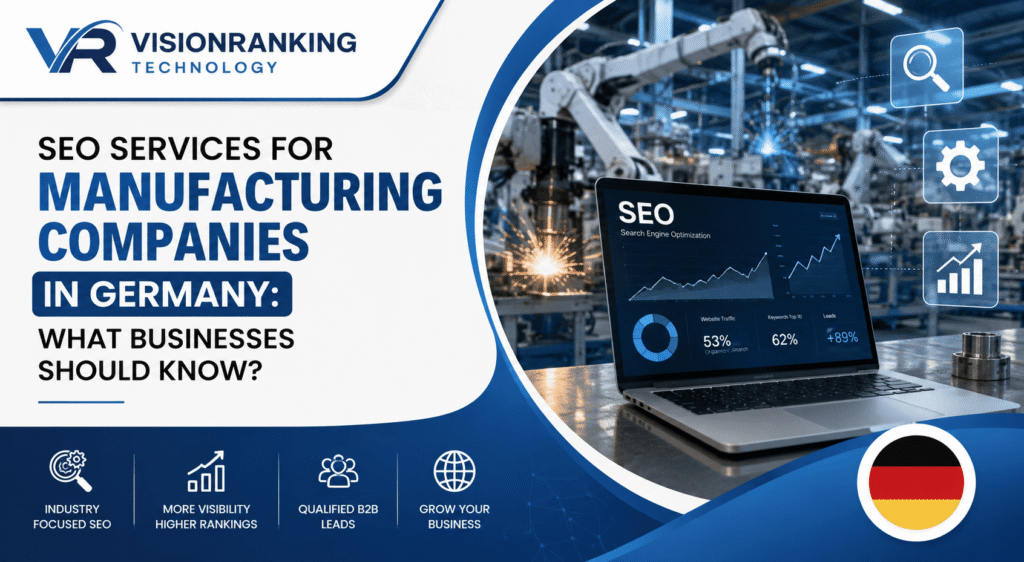
SEO Services for Manufacturing Companies in Germany: What Businesses Should Know?
📌 Key Takeaways
- SEO Improves Manufacturing Visibility: SEO services help manufacturing companies in Germany reach relevant buyers searching for industrial products, components, and manufacturing solutions.
- Targeted Keywords Attract Qualified Leads: Focusing on product-specific, industry-related, and commercial-intent keywords can connect manufacturers with potential B2B customers.
- Technical SEO Strengthens Website Performance: A well-structured, accessible, and user-friendly website helps search engines discover important pages and enables buyers to evaluate products more easily.
- Content and AI Search Readiness Matter: Accurate product information, useful technical content, and clear explanations can support traditional search visibility and readiness for Google AI Overviews and conversational search.
- Long-Term SEO Supports Business Growth: Consistent optimisation, relevant content, and performance tracking can help manufacturers improve online visibility and generate qualified enquiries over time, without guaranteed rankings or leads.
Introduction
Germany is known for its strong manufacturing sector, with businesses operating across automotive components, industrial machinery, electrical equipment, chemicals, metal fabrication, packaging, and precision engineering. For manufacturers, business growth often depends on reaching the right buyers, building reliable partnerships, and maintaining a consistent pipeline of qualified enquiries.
However, even a manufacturer with excellent products and years of industry experience can struggle to attract new customers if its website does not appear when potential buyers search online.
Consider a German industrial equipment manufacturer that supplies specialised components to businesses across Europe. Its products meet demanding quality requirements, but its website receives few enquiries from new customers. Potential buyers may be finding other suppliers because those businesses have stronger search visibility, clearer product pages, and more useful information online.
This is where SEO services for manufacturing companies become valuable.
Search engine optimisation helps manufacturing businesses improve their visibility in relevant searches, communicate their technical capabilities, and attract potential customers who are actively researching suppliers. A well-planned SEO strategy can support both domestic and international growth by connecting a manufacturer’s expertise with the businesses looking for its products.
At Vision Ranking, we understand that manufacturing SEO is not simply about increasing website traffic. The objective is to help businesses reach relevant decision-makers, generate qualified B2B leads, and build a stronger digital presence over time.
In this guide, we explain what German manufacturing businesses should know before investing in SEO services, which challenges matter most, how to evaluate an agency, and how a structured SEO strategy can support long-term business development.
1. Why SEO Matters for Manufacturing Companies in Germany
Manufacturing sales often involve longer decision-making cycles than everyday consumer purchases. Buyers may compare several suppliers, review technical specifications, assess production capabilities, and request quotations before choosing a business partner.
Your website can influence that evaluation long before a prospect contacts your sales team.
If your business is difficult to find in search results, potential customers may never discover your capabilities. Even when your website attracts visitors, unclear product information or weak enquiry options can prevent those visitors from becoming leads.
Professional SEO services help address these challenges by improving how your website appears, communicates, and performs in organic search.
For German manufacturers, an effective strategy can support several business objectives:
- Increase supplier visibility: Help potential buyers discover your company when searching for relevant products, components, or manufacturing services.
- Reach international markets: Improve visibility among buyers searching for suppliers from Germany and manufacturers serving European or global markets.
- Generate qualified enquiries: Attract visitors whose needs align with your products, production capabilities, and commercial terms.
- Strengthen credibility: Present technical expertise, quality processes, certifications, and industry experience clearly.
- Support long-term growth: Build an organic acquisition channel that can complement sales outreach, trade fairs, referrals, and paid advertising.
SEO is particularly valuable when a manufacturer wants to reduce its dependence on a small number of acquisition channels.
However, rankings alone are not the objective. The real value comes from connecting relevant search demand with pages that help potential buyers understand why your company may be the right supplier.
2. What Are SEO Services for Manufacturing?
SEO services for manufacturing involve improving a manufacturer’s website so that search engines can understand its products and services and relevant buyers can discover the business through organic search.
Unlike a general SEO campaign, manufacturing SEO must account for technical product information, specialised terminology, industrial buying processes, and business-to-business lead generation.
A company producing precision-engineered components has different search requirements from a business selling finished consumer products. Its website may need dedicated pages for individual components, manufacturing processes, material capabilities, industries served, and custom production services.
A comprehensive manufacturing SEO strategy may include the following activities.
| SEO service | Purpose for a manufacturing business |
| Keyword research | Identify searches related to products, manufacturing processes, supplier requirements, and commercial intent. |
| Technical SEO | Help search engines crawl, render, and index important website pages. |
| On-page SEO | Improve page titles, headings, descriptions, content, and internal links. |
| Product and service page optimisation | Explain specifications, applications, materials, and manufacturing capabilities clearly. |
| Content strategy | Address buyer questions and demonstrate relevant industrial knowledge. |
| International SEO | Help businesses target suitable markets and language audiences. |
| Authority development | Earn relevant industry mentions and links that support website credibility. |
| Conversion optimisation | Make it easier for potential buyers to request quotations or discuss projects. |
| Performance reporting | Track visibility, relevant traffic, enquiries, and progress against business goals. |
The appropriate mix depends on the manufacturer’s existing website, target markets, competition, and commercial priorities.
For example, a company with hundreds of product URLs may need a different technical and content strategy from a specialised manufacturer with only a few high-value services.
At Vision Ranking, our manufacturing SEO services are intended to help businesses build a more discoverable and commercially useful online presence.
3. Understanding the German Manufacturing Buyer’s Search Journey
One of the most important parts of manufacturing SEO is understanding how potential customers search before they contact a supplier.
A procurement manager looking for a precision metal component may begin with a broad search. After identifying possible suppliers, the same person might search for a particular material, production process, tolerance, or application.
Different searches indicate different levels of buying intent.
Early research
At this stage, a buyer is exploring options or trying to understand a technical requirement.
Possible searches include:
- Industrial manufacturing services
- Custom metal fabrication
- Plastic injection moulding applications
- Precision engineering capabilities
Informational pages and educational content can help your company become visible during this research stage.
Supplier evaluation
The buyer now has a clearer requirement and wants to identify suitable manufacturers.
Examples include:
- Precision component manufacturer Germany
- Custom CNC machining supplier
- Industrial equipment manufacturer
- Contract manufacturing services Germany
These searches often provide a stronger commercial opportunity because the user is looking for a potential supplier rather than general information.
Purchase consideration
At this stage, the buyer may be ready to discuss specifications, pricing, delivery requirements, or a production project.
Relevant searches may include:
- Custom component manufacturing quotation
- OEM manufacturing partner Germany
- Low-volume CNC machining supplier
- Industrial parts manufacturer for bulk orders
The precise terms depend on the industry, product, and purchasing process.
A well-planned SEO campaign should support all three stages. It should help potential customers discover your expertise, evaluate your capabilities, and take the next step towards a business conversation.
Business insight: A page attracting fewer visitors can still be commercially valuable if it reaches buyers looking for a specialised product with a high order value. This is why manufacturing SEO should evaluate lead relevance alongside traffic.
4. Keyword Research for Manufacturing SEO in Germany
Keyword research provides the foundation for deciding which pages to optimise and what information those pages should contain.
Manufacturers often make the mistake of targeting broad terms such as “manufacturing company” without considering the specific language their buyers use. Broad keywords may have limited commercial relevance, while highly specific searches can indicate a much clearer requirement.
An effective keyword strategy considers four factors:
- Relevance to the products or services offered.
- Search intent and the buyer’s likely next step.
- Geographic relevance to Germany or another target market.
- Commercial value of the potential enquiry.
For a German manufacturer, keyword research may include English-language searches from international buyers and German-language searches from local procurement teams. The right language mix depends on the company’s actual customer base.
Potential keyword themes include:
| Keyword category | Illustrative search terms |
| Manufacturing services | SEO services for manufacturing, manufacturing SEO agency |
| Industrial products | Industrial component manufacturer Germany, precision parts supplier |
| Production processes | CNC machining services, custom metal fabrication |
| Industry-specific services | Automotive component manufacturer, medical equipment manufacturing |
| Commercial searches | OEM supplier Germany, contract manufacturing services |
| International targeting | German industrial suppliers, manufacturing partner in Germany |
These are illustrative keyword ideas, not verified search-volume or ranking opportunities. Actual targets should be selected after researching the business, competitors in the search market, and available search data.
Keyword mapping is equally important. Each major product or service should have a suitable destination page rather than forcing every keyword onto the homepage.
This makes the website easier to navigate and gives potential customers more relevant information.
For help identifying suitable opportunities, manufacturers can contact Vision Ranking for an assessment of their existing website and target audience.
5. Technical SEO: Building a Reliable Website Foundation
A manufacturing website can contain complex navigation, product catalogues, downloadable specifications, technical drawings, and hundreds of URLs. These elements may create SEO challenges when the website is poorly structured or important pages are difficult to access.
Technical SEO helps search engines discover and understand the content that matters to the business.
Important technical considerations
Crawlability and indexation: Important product and service pages should be accessible to search engines. Unintended noindex directives, blocked resources, and incorrect canonical tags can interfere with visibility.
Website architecture: Products, services, applications, and industry pages should follow a logical hierarchy. Clear navigation helps users locate relevant information and supports internal linking.
Page performance: Slow-loading pages can frustrate potential buyers, particularly when they are comparing suppliers or accessing technical information on mobile devices.
Mobile usability: Procurement professionals and engineers may research suppliers on different devices. Important content and enquiry forms should remain usable on smaller screens.
Duplicate content: Similar product pages, filter URLs, and outdated versions can create unnecessary complexity. Each page should have a clear purpose and provide value.
Redirect management: When a manufacturer redesigns its website or changes URL structures, appropriate redirects help preserve useful access to existing pages.
XML sitemap and robots directives: These should be configured correctly to help search engines discover intended URLs while respecting access restrictions.
Technical SEO does not guarantee rankings, but unresolved issues can undermine the value of content and other optimisation work. Google’s SEO Starter Guide provides an overview of the principles involved.
For manufacturers planning a website migration, product catalogue expansion, or redesign, a technical review before launch can be especially useful.
6. Product Pages and Content That Support B2B Enquiries
For manufacturing businesses, product pages are often among the most commercially important pages on the website.
A page that only contains a product name, a short description, and a generic enquiry button may not answer the questions a serious buyer needs to resolve.
Potential customers may want to understand:
- What the product does and where it is used.
- Available materials, dimensions, and configurations.
- Manufacturing methods and customisation options.
- Applicable quality certifications, where genuinely held.
- Production capacity and order requirements.
- Relevant industries and applications.
- Whether technical documentation is available.
- How to discuss specifications or request a quotation.
Not every page needs to contain every detail. The information should reflect the product and what the company can accurately confirm.
For example, a manufacturer producing specialised industrial enclosures could create a dedicated page explaining its enclosure types, material options, applications, customisation capabilities, and quotation process.
That page can target relevant commercial searches while helping buyers determine whether the company is a suitable fit.
Supporting content builds confidence
Manufacturing websites can also benefit from useful content covering topics such as:
- Material selection and industrial applications.
- Manufacturing process capabilities.
- Quality assurance and inspection procedures.
- Product maintenance and expected operating conditions.
- Industry-specific component requirements.
- Factors businesses should consider when selecting a supplier.
The purpose is not to publish articles simply to increase the number of indexed pages. Each piece should answer a genuine buyer question and connect naturally to a relevant product or service page.
7. International SEO for German Manufacturers
Germany-based manufacturers may serve domestic customers, European distributors, international OEMs, or buyers across several continents. Their SEO strategy should reflect the markets they actually want to reach.
International SEO is not simply a matter of adding country names to existing pages. It requires a clear understanding of audience needs, language preferences, product availability, and the company’s commercial reach.
English and German website content
A manufacturer serving German procurement teams may benefit from German-language pages. If it also targets international buyers, English content may be important.
The decision should be based on buyer demand, sales priorities, and the language in which the company can provide reliable information.
Professional translations are particularly valuable when product specifications, certifications, legal statements, or safety-related details are involved.
Country-specific targeting
A business targeting several markets should assess whether dedicated country or language pages offer meaningful value.
For example, a manufacturer may need separate content for a domestic market and an international market if the product range, delivery arrangements, compliance requirements, or buyer expectations differ.
Creating many near-identical location pages without a genuine audience distinction is unlikely to be a strong long-term strategy.
International technical signals
Depending on the website structure, international SEO may involve:
- Correct language and regional URL planning.
- Appropriate hreflang implementation where relevant.
- Consistent canonical tags.
- Clear language-selection options.
- Localised product information and enquiry routes.
- Internal links that help users move between relevant language versions.
The objective is to make each intended audience’s experience clear while avoiding unnecessary duplication.
For companies looking to expand their online presence beyond Germany, Vision Ranking can assess the relationship between manufacturing SEO and its SEO services for Germany.
8. AI Search Readiness for Manufacturing Companies
The way potential buyers discover suppliers continues to evolve. In addition to traditional search results, users may encounter Google AI Overviews and conversational search experiences when researching products, suppliers, and technical topics.
Manufacturers should therefore consider how clearly their website communicates its expertise, product information, and capabilities.
This does not mean abandoning traditional SEO or relying on special tricks to appear in AI-generated answers. Google’s guidance explains that established SEO practices remain relevant to its generative search features. It also emphasises useful content, crawlability, and a good page experience.
What should manufacturers prioritise?
- Clear product explanations: Describe what you manufacture, which applications you support, and what distinguishes your capabilities.
- Consistent business information: Ensure company details, product descriptions, and service claims are accurate across relevant pages.
- Specific technical answers: Address legitimate buyer questions using information your business can substantiate.
- Credible expertise: Present genuine experience, quality processes, and relevant qualifications without exaggerating credentials.
- Accessible website content: Ensure important information is available in crawlable page content rather than hidden exclusively in inaccessible documents or interactive elements.
- Useful supporting resources: Provide relevant product documentation, application information, and educational content where appropriate.
For example, a buyer researching industrial filtration equipment might ask about suitable applications, maintenance requirements, or available configurations. A manufacturer with clear, accurate information on these topics gives search systems and prospective customers more useful material to evaluate.
AI search visibility cannot be guaranteed, and there is no special optimisation method that ensures a company will appear in every generated answer. The sensible approach is to strengthen the website’s overall quality, relevance, and accessibility.
Vision Ranking can incorporate AI search readiness into a broader manufacturing SEO strategy while keeping qualified leads and commercial outcomes as the main objectives.
9. Business Benefits of Investing in Manufacturing SEO
Manufacturing SEO should be assessed in terms of its contribution to business development, not simply the number of keywords that appear in a report.
The value of a campaign depends on factors such as product demand, average order value, sales cycle, competition, website quality, and the ability of the sales team to convert enquiries.
When these factors align, SEO can support several meaningful business benefits.
Greater visibility among relevant buyers
Improved search visibility can help manufacturers reach businesses looking for specific products, production capabilities, or industrial services.
This is particularly useful for companies that serve specialist markets and need to reach buyers beyond their existing network.
More opportunities for qualified enquiries
Dedicated product and service pages can attract prospects with clearer requirements. Strong enquiry options make it easier for interested buyers to request pricing, discuss custom specifications, or arrange a technical conversation.
Not every enquiry will be suitable, so lead qualification remains important.
Stronger credibility during supplier evaluation
A detailed website can help prospective customers assess a manufacturer’s capabilities before contacting the sales team.
Accurate technical information, genuine certifications, clear company details, and relevant case studies can support confidence in the business.
Support for international expansion
Manufacturers entering new markets can use SEO to improve discoverability among potential buyers searching in relevant languages and locations.
However, search visibility should complement broader market-entry planning, including logistics, regulations, pricing, and sales support.
A long-term acquisition channel
SEO can continue to attract relevant visitors while a website maintains useful content and strong technical foundations. Results are not automatic or permanent, and ongoing work may be needed as markets, search behaviour, and competitors change.
Better alignment between marketing and sales
Search data can reveal which products attract interest, which pages generate enquiries, and which buyer questions remain unanswered.
When marketing and sales teams share this information, the business can make more informed decisions about content priorities and commercial opportunities.
10. Common Manufacturing SEO Mistakes to Avoid
Manufacturers can invest considerable time and money in their websites without creating a reliable source of qualified leads. Often, the problem is not a lack of activity but a mismatch between SEO work and business requirements.
The following mistakes deserve attention.
1. Targeting only broad keywords
Broad terms may attract visitors who have little interest in the company’s actual products. A stronger strategy includes relevant product, process, industry, and commercial-intent searches.
2. Using generic product descriptions
If several products have almost identical descriptions, buyers may struggle to understand the differences. Search engines may also have difficulty identifying the unique purpose of each page.
3. Publishing content without technical input
An article can sound professional while still containing incorrect specifications or misleading claims. Manufacturing content should be checked by someone familiar with the relevant products or processes.
4. Ignoring conversion paths
A visitor who cannot find contact details, request a quotation, or understand the next step may leave without enquiring. Clear calls to action and usable forms are important.
5. Creating unnecessary location pages
Replacing a city or country name across dozens of similar pages does not create a meaningful international strategy. Location pages should serve genuine audiences with relevant information.
6. Neglecting website migrations
Changing URLs, deleting product pages, or redesigning navigation without appropriate SEO checks can disrupt access to valuable content.
7. Measuring success only through rankings
Rankings are useful indicators, but they do not establish whether a campaign is generating suitable business opportunities. Traffic quality, enquiries, and lead relevance should also be assessed.
8. Expecting immediate results
Search engines need time to process changes, and competitive terms may require sustained work. Businesses should avoid making major decisions based on brief ranking movements alone.
9. Building irrelevant links
Links from unrelated or low-quality sources may offer little commercial value and can create unnecessary risk. A sustainable strategy prioritises relevance and genuine editorial value.
10. Treating AI-generated content as a shortcut
Publishing large volumes of generic or unverified content can undermine quality. Content should be reviewed for originality, accuracy, relevance, and real value to the intended audience.
Avoiding these mistakes helps manufacturers invest in activities that support the website’s purpose and long-term commercial goals.
11. How to Choose the Right Manufacturing SEO Agency
Selecting an SEO agency is an important business decision. The right partner should understand your objectives, explain its approach clearly, and connect its work to measurable outcomes.
Manufacturing companies should look beyond promotional claims and assess whether a prospective agency can develop a strategy that fits their business.
Red flags when choosing an agency
Be cautious if an agency:
- Guarantees first position on Google for specific competitive keywords.
- Promises a fixed number of leads without explaining the assumptions.
- Focuses entirely on rankings while ignoring lead quality.
- Recommends large quantities of generic content without a clear purpose.
- Cannot explain the technical issues it intends to address.
- Refuses to provide understandable reporting.
- Uses questionable link-building methods or cannot explain its approach.
- Makes changes to your website without appropriate approval.
- Claims guaranteed placement in Google AI Overviews or other AI-generated results.
These warning signs do not automatically prove that an agency is unsuitable, but they justify further questions.
Questions to ask before hiring an SEO agency
Before committing to a campaign, ask:
- How will you identify keywords relevant to our products and buyers?
- How will you evaluate our existing website and technical SEO?
- What improvements will you prioritise during the initial phase?
- How will you measure qualified leads rather than traffic alone?
- How will you approach German-language and international SEO?
- How will you ensure technical and industry content is accurate?
- What reporting will we receive, and how frequently?
- How will website changes be approved and implemented?
- What are the expected timelines, dependencies, and limitations?
- How will you adjust the strategy if performance does not improve?
A trustworthy agency should be willing to discuss both opportunities and limitations. It should explain what it can control, what depends on your business, and how progress will be evaluated.
12. Why Choose Vision Ranking for Manufacturing SEO?
Manufacturing businesses need more than a list of keywords or a collection of monthly reports. They need a digital marketing partner that understands how website visibility connects with product discovery, supplier evaluation, and lead generation.
Vision Ranking provides SEO-focused support designed around the business’s website, target audience, and growth priorities.
Our approach focuses on building a strong foundation and improving the parts of the website that can support meaningful commercial opportunities.
A strategy based on your business goals
We begin by understanding your products, manufacturing capabilities, target customers, and preferred markets.
This helps establish whether the campaign should prioritise product visibility, industry-specific services, international enquiries, or improvements to the existing website.
Practical technical and on-page improvements
Technical SEO, website structure, metadata, internal linking, and content optimisation are considered together rather than treated as unrelated tasks.
Recommendations are prioritised according to their relevance, potential impact, and implementation requirements.
Content aligned with buyer needs
Manufacturing content should help buyers understand capabilities and evaluate suppliers. We focus on relevant product and service information, useful supporting resources, and content that reflects the company’s actual expertise.
A focus on qualified leads
Traffic growth is not the only measure of success. Where tracking and available data allow, performance assessment can include relevant landing-page traffic, enquiry activity, lead quality, and conversion trends.
Long-term search visibility
SEO requires ongoing evaluation. Search demand, technical requirements, competitors, and buyer behaviour can change, so a sustainable campaign needs room for review and refinement.
Our objective is to help manufacturers build a more useful, discoverable, and commercially effective online presence.
Learn more about our manufacturing SEO services or explore our SEO services for businesses in Germany.
Ready to assess your website’s potential? Request a consultation with Vision Ranking to discuss your target markets, current challenges, and the SEO improvements most relevant to your business.
13. Our SEO Process for Manufacturing Companies
A structured process helps keep the campaign aligned with business objectives and makes it easier to understand what is being delivered.
Step 1: Website and business assessment
We review the website’s current visibility, technical condition, product structure, target audience, and commercial priorities. This establishes a baseline for planning.
Step 2: Keyword research and opportunity mapping
Relevant searches are grouped by product, manufacturing process, industry, location, and intent. These findings inform the pages and topics that deserve attention.
Step 3: Technical and on-page optimisation
We identify and prioritise relevant improvements to crawling, indexation, page structure, metadata, internal links, usability, and content presentation.
Depending on the campaign scope, we improve important product and service pages, develop relevant supporting content, and pursue appropriate authority-building opportunities.
Step 5: Performance review and refinement
We assess available search and website data, review progress against agreed objectives, and identify the next priorities based on evidence and business needs.
The exact activities and sequence depend on the condition of the website, access permissions, available resources, and agreed scope. Some technical improvements may need to happen before content expansion, while other projects can progress across several areas at once.
Throughout the process, communication and realistic expectations are essential. The purpose is to create a coordinated programme of work rather than carry out isolated SEO tasks without a clear direction.
14. What Results Can Manufacturing Businesses Expect from SEO?
Manufacturers should approach SEO with a clear understanding of what progress looks like and how it will be assessed.
The first phase often focuses on understanding the website, correcting important technical issues, and identifying relevant search opportunities. Later phases may concentrate on improving priority pages, building topical relevance, and evaluating how visitors respond.
The timeline varies depending on the website’s history, competition, existing authority, technical condition, content quality, and implementation speed. Google notes that some changes can take hours to be reflected, while others may take several months, and not every change produces a noticeable ranking improvement.
A sensible performance framework may include:
| Measurement area | What it helps evaluate |
| Organic visibility | Whether the website is appearing for relevant searches. |
| Keyword performance | How priority product and service terms are progressing. |
| Organic traffic quality | Whether visitors are reaching pages relevant to the business. |
| Enquiry activity | Whether users are submitting forms, requesting quotations, or contacting the company. |
| Lead relevance | Whether enquiries match the products, order requirements, and markets the company serves. |
| Conversion performance | Whether relevant visitors are taking the intended next step. |
| Technical health | Whether important pages remain accessible, indexable, and usable. |
| International performance | Whether relevant pages attract audiences in the intended markets. |
There is no responsible way to promise a specific ranking position, traffic increase, or number of leads without evidence and appropriate qualifications.
For example, if a manufacturer improves the visibility of a high-value product page but receives few enquiries, the next step may involve reviewing the page’s commercial clarity, enquiry process, product-market fit, or the search terms attracting visitors.
If qualified enquiries improve but sales remain limited, the issue may involve pricing, delivery arrangements, response times, or the sales process rather than SEO alone.
This distinction matters because successful manufacturing SEO should support business decisions, not just produce attractive marketing reports.
Frequently Asked Questions About Manufacturing SEO in Germany
1. What are SEO services for manufacturing companies?
SEO services for manufacturing companies involve improving a manufacturer’s website so that relevant buyers can discover its products and capabilities through organic search. The work may include keyword research, technical SEO, product-page optimisation, content development, international targeting, and enquiry tracking.
2. Why do German manufacturing companies need SEO?
SEO can help German manufacturers improve their visibility among domestic and international buyers searching for industrial products, components, and production services. It can also support credibility during supplier research and create additional opportunities for qualified B2B enquiries.
3. How much do manufacturing SEO services cost in Germany?
The cost depends on the website’s size, technical requirements, target markets, competition, content needs, and campaign scope. A small manufacturer with a focused product range may require a different level of support from a company targeting several countries with hundreds of product pages. A website assessment is the best starting point for defining a suitable scope and budget.
4. How long does SEO take to produce results for a manufacturing business?
The timeline varies. Some improvements may be reflected relatively quickly, while meaningful progress for competitive keywords may take several months or longer. Existing website quality, competition, implementation speed, and content relevance all influence performance. No agency can responsibly guarantee a specific outcome or deadline.
5. Which keywords should manufacturers target?
Manufacturers should target relevant product, process, service, industry, and commercial-intent searches. Depending on their audience, these may include terms related to precision engineering, industrial components, OEM manufacturing, custom fabrication, or specific production capabilities. Final keywords should be selected through research rather than assumptions about search volume.
6. Is German-language SEO necessary for manufacturers in Germany?
German-language SEO can be important when targeting German-speaking procurement teams and businesses. However, English-language content may also be valuable for manufacturers serving international buyers. The right approach depends on the company’s customer base, sales markets, and ability to provide accurate information in each language.
7. Can manufacturing SEO generate international B2B leads?
Yes, SEO can help manufacturers reach potential buyers in selected international markets through relevant product pages, language targeting, and useful technical content. However, the number and quality of leads depend on demand, competition, commercial fit, and the company’s ability to serve those markets.
8. Does manufacturing SEO include Google AI Overviews and conversational search?
A modern SEO strategy can account for Google AI Overviews and other search experiences by prioritising accessible pages, useful content, clear explanations, and accurate business information. These practices can support overall search readiness, but inclusion in AI-generated results is not guaranteed.
9. How can we measure the success of manufacturing SEO?
Success can be evaluated using organic visibility, relevant keyword performance, qualified website traffic, enquiry submissions, quotation requests, lead quality, and conversions. The right measurements depend on the company’s sales process and tracking capabilities. Rankings and traffic should be considered alongside business outcomes.
10. Why should we choose Vision Ranking for manufacturing SEO?
Vision Ranking offers SEO-focused support for businesses looking to improve website visibility and generate relevant enquiries. Our approach considers technical SEO, keyword research, content optimisation, target markets, and performance measurement. We recommend discussing your website and commercial objectives before defining the most appropriate campaign scope.
Conclusion: Build a Stronger Digital Presence for Your Manufacturing Business
For manufacturing companies in Germany, SEO is an opportunity to connect technical expertise with buyers actively searching for relevant products and services. A well-planned strategy can improve organic visibility, make product information easier to discover, strengthen supplier credibility, and create opportunities for qualified enquiries.
The best results come from treating SEO as an ongoing business investment rather than a short-term ranking exercise. Technical foundations, relevant content, international targeting, and conversion tracking should work together to support your commercial objectives.
Vision Ranking helps businesses approach SEO with a focus on sustainable visibility, useful website improvements, and measurable business outcomes.
If your manufacturing company wants to attract more relevant B2B enquiries, expand into new markets, or improve the performance of its existing website, the first step is to understand where the strongest opportunities lie.
Contact Vision Ranking to discuss your business objectives and request an SEO assessment tailored to your manufacturing website.