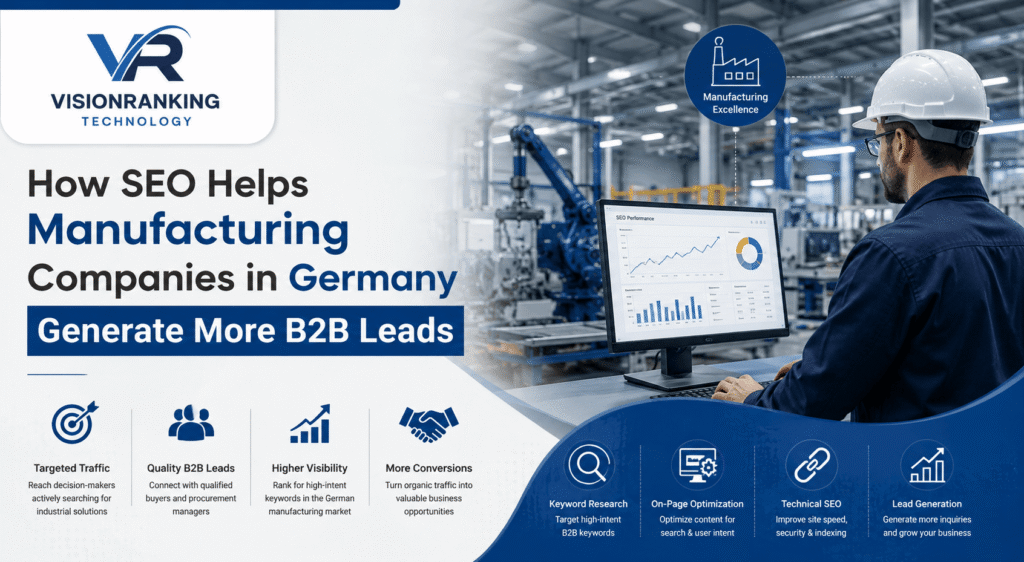
How SEO Helps Manufacturing Companies in Germany Generate More B2B Leads?
📌 Key Takeaways
- SEO helps German manufacturers reach qualified B2B buyers who are actively searching for products, suppliers, and industrial solutions.
- Manufacturing SEO requires a specialised strategy focused on technical products, industry-specific keywords, commercial intent, and decision-makers.
- Optimised product and service pages can create more lead opportunities by improving visibility for high-intent searches.
- Technical SEO, quality content, and strong website structure are essential for improving organic visibility and supporting long-term growth.
- SEO and AI search readiness work together to help manufacturing companies strengthen visibility across traditional search, Google AI Overviews, and conversational search.
Germany is one of the world’s most important manufacturing markets, with businesses operating across automotive, industrial machinery, engineering, electronics, chemicals, metalworking, packaging, automation, and many other sectors. For these companies, generating qualified B2B leads is rarely about reaching the largest possible audience. It is about reaching the right decision-makers at the right stage of the buying journey.
This is where SEO services for manufacturing companies can make a meaningful difference.
A strong SEO strategy can help a German manufacturing business become more visible when potential buyers are actively searching for products, components, industrial solutions, suppliers, or specialist services. Instead of relying entirely on referrals, trade shows, distributors, cold outreach, or paid advertising, manufacturers can build a consistent organic acquisition channel.
However, manufacturing SEO is very different from standard consumer-focused SEO. A manufacturer may need to reach procurement managers, engineers, technical directors, operations teams, business owners, distributors, and international buyers. These audiences often search using highly specific commercial and technical terms.
The goal is therefore not simply to increase website traffic. The real objective is to turn relevant search visibility into qualified B2B enquiries.
If your manufacturing company operates in Germany and wants to build a stronger organic lead-generation channel, Vision Ranking’s manufacturing SEO services can help create a strategy around your products, target industries, locations, and commercial objectives.
Why SEO Matters for Manufacturing Companies in Germany
Manufacturing businesses often have long sales cycles and high-value products. A potential customer may research a supplier several times before making contact.
They may search for:
- A specific industrial product
- A component or material
- A technical manufacturing solution
- A German manufacturer or supplier
- A specialist engineering service
- Product specifications
- Industry applications
- Alternative solutions
- Custom manufacturing capabilities
- OEM or B2B suppliers
If your website does not appear during these searches, potential customers may never discover your company.
SEO helps position your business in front of prospects who are already demonstrating an interest in what you provide.
This makes organic search particularly valuable for manufacturers because the traffic can be connected directly to commercial intent.
SEO can support manufacturers by helping them:
- Increase visibility for relevant product searches
- Reach decision-makers researching suppliers
- Generate enquiries from new markets
- Strengthen product and service visibility
- Build authority around technical expertise
- Support long B2B buying cycles
- Reduce dependence on paid acquisition
- Improve visibility across traditional and AI-powered search
The important point is that more traffic is not the primary goal. The goal is more relevant traffic that has a realistic chance of becoming a business opportunity.
Manufacturing SEO Requires a Different Approach
A manufacturing website can contain hundreds or thousands of products, specifications, applications, categories, technical documents, and service pages.
A general SEO strategy may not be enough.
For example, an industrial company selling a specialised component may receive little commercial value from ranking for a broad keyword with large search volume. A more specific product-related search with lower volume may produce a much stronger sales opportunity.
This means SEO services for manufacturing businesses need to consider:
- Product-level search intent
- Technical terminology
- Industry applications
- Buyer roles
- Product specifications
- Geographic targeting
- B2B purchasing behaviour
- Commercial search intent
- International search demand
- Website architecture
The strategy should be built around how your potential customers actually research suppliers.
How SEO Can Generate More Qualified B2B Leads
SEO contributes to lead generation at multiple stages of the buyer journey.
A prospect may first discover a manufacturing company through an informational search. Later, they may return through a product-specific search and eventually submit an enquiry.
A strong organic strategy supports these different stages.
| Search Stage | Example Intent | Business Opportunity |
| Awareness | Manufacturing solution for an industry problem | Introduce expertise |
| Research | Industrial product or technical solution | Build consideration |
| Evaluation | Product comparison or supplier search | Demonstrate capabilities |
| Commercial | Manufacturer or supplier search | Generate enquiry |
| Decision | Specific product/service + Germany | Convert high-intent prospect |
This is why manufacturers should not evaluate SEO only by looking at rankings.
A keyword ranking can be useful, but the bigger question is:
Is SEO helping the business reach people who could realistically become customers?
Product and Service Visibility Can Directly Influence Enquiries
For many manufacturing businesses, individual product and service pages are some of the most commercially valuable pages on the website.
If these pages contain limited information, weak targeting, unclear terminology, or technical content that search engines cannot properly understand, the company may lose valuable search opportunities.
A well-planned SEO campaign can improve the visibility of:
- Product categories
- Individual products
- Manufacturing services
- OEM capabilities
- Custom manufacturing
- Industry solutions
- Technical applications
- Locations and facilities
- Supporting resources
The objective is to make it easier for both search engines and potential buyers to understand what the company provides.
For example, a manufacturer offering a specialised industrial component should not rely solely on a generic “Products” page. Individual commercial pages can create additional opportunities to appear when buyers search for that particular product or solution.
Germany-Specific SEO Can Help Manufacturers Reach the Right Market
Germany is not simply another geographic keyword to add to a page.
A successful Germany-focused SEO strategy needs to reflect the market, audience, language, search behaviour, and commercial positioning of the business.
Depending on the company, the strategy may involve:
- German-language search terms
- English-language searches from international buyers
- German cities and industrial regions
- Industry-specific terminology
- Supplier and manufacturer searches
- Export-oriented search intent
- Local business visibility
- Technical product searches
For manufacturers serving both Germany and international markets, SEO can also help establish separate search pathways for different audiences.
This is especially useful when a company wants to attract both domestic German buyers and international B2B customers looking for German manufacturing capabilities.
If Germany is a major target market for your company, a dedicated SEO strategy for Germany can help align organic visibility with your commercial goals.
The Role of Technical SEO in Manufacturing Websites
Manufacturing websites can become technically complicated.
Large product inventories, filters, category structures, PDFs, duplicate URLs, dynamically generated pages, outdated pages, and complex navigation can all create SEO challenges.
Technical SEO helps ensure that search engines can efficiently understand and access the website.
Important areas may include:
- Website crawlability
- Indexation
- URL structure
- Internal linking
- XML sitemap configuration
- Canonical implementation
- Redirect management
- Mobile usability
- Page speed
- Structured data
- Duplicate content management
- Broken links
- Indexing issues
Technical improvements alone do not automatically generate leads.
Their value comes from creating a stronger foundation on which product, service, and commercial pages can perform more effectively.
For manufacturers with large or technically complex websites, this foundation can become particularly important as the SEO campaign grows.
Content Should Support the B2B Buying Journey
Manufacturing content should not exist simply to increase the number of pages on a website.
Every important piece of content should have a commercial or strategic purpose.
For example, content can help answer questions related to:
- Product applications
- Material selection
- Industry requirements
- Technical considerations
- Manufacturing capabilities
- Common purchasing concerns
- Product use cases
- Industry-specific challenges
This allows a manufacturer to demonstrate expertise while creating additional entry points through organic search.
But content quality matters
Manufacturing buyers are often technically knowledgeable. Generic content can quickly damage credibility.
A strong manufacturing content strategy should reflect the company’s:
- Technical expertise
- Actual products
- Industry experience
- Manufacturing capabilities
- Customer requirements
- Real applications
- Business strengths
The objective is not to publish content for the sake of publishing.
It is to build a useful information ecosystem around the company’s commercial offerings.
SEO and AI Search Are Becoming More Connected
Search behaviour is changing.
Alongside traditional Google results, users increasingly encounter AI-generated summaries and conversational search experiences. Google AI Overviews and other AI-powered search interfaces can influence how users discover and evaluate businesses.
For manufacturing companies, this creates another reason to build strong, trustworthy website content.
AI-powered search systems need clear information about:
- What the company manufactures
- Which industries it serves
- Which products it offers
- Where it operates
- What expertise it has
- What applications its products support
- Why buyers should consider the company
This does not mean creating content specifically for an algorithm.
It means developing a website with clear, authoritative, well-structured information that can be understood across modern search environments.
A manufacturing SEO strategy that considers both traditional organic rankings and AI search visibility can create a stronger long-term digital presence.
Common SEO Mistakes Manufacturing Companies Should Avoid
Manufacturing businesses often have excellent products but underperform online because their websites are not aligned with search behaviour.
Some common problems include:
1. Targeting only broad keywords
Broad keywords may attract traffic without attracting buyers.
2. Using technical product names without search research
Customers may use different terminology when searching for the same solution.
3. Putting too many products on one page
Combining unrelated products can make it difficult to establish clear relevance.
4. Publishing thin product pages
A product page with only a product name and a few lines of text may provide limited value to search engines or buyers.
5. Ignoring commercial intent
Informational traffic is useful, but manufacturers need pages designed to support enquiries and sales.
6. Neglecting internal linking
Important product and service pages can remain difficult to discover if the website architecture is weak.
7. Treating SEO as a one-time project
Search visibility requires ongoing monitoring, optimisation, content development, and technical improvements.
8. Focusing only on rankings
A ranking improvement is valuable only when it contributes to meaningful visibility, traffic, enquiries, or commercial opportunities.
What Results Should a Manufacturing Company Expect From SEO?
SEO should be treated as a long-term business acquisition channel rather than a quick advertising campaign.
The timeline can vary significantly depending on factors such as:
- Website authority
- Competition
- Existing rankings
- Technical condition
- Number of relevant pages
- Keyword difficulty
- Target market
- Content quality
- Backlink profile
- Website history
Early improvements may appear through technical fixes, indexing, on-page optimisation, and existing keyword opportunities.
More competitive commercial terms can require considerably more time and consistent optimisation.
A professional SEO campaign should therefore track multiple indicators.
Useful performance indicators include:
- Keyword ranking improvements
- Organic traffic growth
- Commercial keyword visibility
- Product-page visibility
- Organic enquiries
- Lead quality
- Search Console performance
- Conversion trends
- AI Overview visibility where measurable
- Growth in relevant landing-page traffic
The most important measure is ultimately whether organic search is helping create better business opportunities.
Business Benefits of SEO for Manufacturing Companies
A well-managed SEO campaign can create several long-term advantages.
Increased qualified visibility
Your company can appear when potential customers actively search for relevant products and solutions.
Stronger brand authority
Consistent technical and industry-focused content can reinforce your expertise.
More opportunities beyond traditional sales channels
SEO can complement referrals, distributors, exhibitions, outbound sales, and paid campaigns.
Better product discovery
Individual products and services can become organic entry points to the website.
Long-term acquisition value
Unlike a campaign that stops producing traffic when advertising spend stops, organic visibility can continue generating opportunities after pages establish strong rankings.
Improved understanding of customer demand
Search data can reveal what prospects are looking for and which products or topics attract interest.
Better digital readiness
A technically strong, well-structured website can support traditional search, local visibility, and emerging AI search experiences.
How Vision Ranking Approaches SEO for Manufacturing Businesses
At Vision Ranking, we understand that a manufacturing SEO campaign cannot be based on generic keyword targeting alone.
Our approach starts by understanding the business.
We look at the company’s products, services, target industries, locations, customer profiles, existing website performance, and commercial priorities.
From there, the strategy can include:
- Website and SEO audit
- Manufacturing industry research
- Keyword and search-intent research
- Competitor and market analysis
- Website architecture review
- On-page optimisation
- Product and service page optimisation
- Technical SEO improvements
- Content strategy
- Internal linking improvements
- Authority and backlink development
- Local and Germany-focused optimisation where relevant
- Search Console and analytics monitoring
- AI search and Google AI Overview readiness
- Continuous performance analysis
The exact activities depend on the condition and requirements of each website.
There is no single SEO package that should be applied identically to every manufacturing company.
Our Process for Manufacturing SEO
Step 1: Understand the Business
We first establish what the company sells, who it serves, where it operates, and which products or services have the greatest commercial value.
Step 2: Identify Search Opportunities
Keyword research goes beyond search volume. We evaluate intent, relevance, commercial value, competition, and the relationship between search terms and business offerings.
Step 3: Audit the Website
We identify technical, structural, content, on-page, indexing, and user-experience opportunities that may affect organic visibility.
Step 4: Build the SEO Roadmap
The findings are converted into a practical strategy prioritised around the company’s commercial objectives.
Step 5: Optimise Key Pages
Important product, category, service, industry, and location pages are improved to create stronger organic opportunities.
Step 6: Develop Supporting Content
Relevant content can support the buyer journey, demonstrate expertise, and strengthen topical authority.
Step 7: Build Authority
Where appropriate, the campaign can include strategic backlink and digital authority activities that support long-term organic performance.
Step 8: Monitor and Improve
SEO performance is continuously reviewed using ranking, traffic, Search Console, conversion, and other relevant data.
Why Choose Vision Ranking?
Manufacturing companies need an SEO partner that understands that visibility is only one part of the equation.
Vision Ranking focuses on connecting SEO activity with business objectives.
Our approach emphasises:
- Business-focused keyword targeting
- Commercial search intent
- Technical SEO
- Product and service visibility
- Local and international SEO
- Content strategy
- Authority building
- Performance reporting
- Long-term optimisation
- AI search readiness
We aim to operate as a long-term digital marketing partner rather than simply completing a list of SEO tasks each month.
If your manufacturing company wants to understand where its website currently stands, you can request a free SEO audit and identify the opportunities that may be affecting organic visibility and lead generation.
Red Flags When Choosing an SEO Agency for Manufacturing
Not every SEO provider is equipped to handle a technical B2B manufacturing website.
Be cautious when an agency:
- Guarantees specific rankings
- Focuses entirely on keyword counts
- Cannot explain its strategy clearly
- Does not ask about your products or customers
- Uses generic content for highly technical industries
- Promises immediate results for competitive terms
- Reports traffic without discussing lead quality
- Treats SEO as a fixed checklist
- Does not monitor technical issues
- Cannot explain what work has actually been completed
A trustworthy SEO partner should be transparent about opportunities, limitations, priorities, and expected timelines.
Questions to Ask Before Hiring an SEO Agency
Before selecting an SEO partner, manufacturing decision-makers should ask:
Will you research our specific industry and products?
A manufacturing SEO strategy should be built around the actual business.
How will you identify commercially valuable keywords?
Search volume alone should not determine the strategy.
How will you measure lead quality?
The agency should understand that a relevant B2B enquiry is more valuable than an irrelevant traffic increase.
How will you handle technical SEO?
This is particularly important for large manufacturing websites.
How will content support our products and services?
Content should have a strategic purpose rather than simply increasing page count.
How frequently will you review performance?
SEO requires ongoing analysis and adjustment.
How will you approach AI search visibility?
A modern strategy should consider changing search experiences, including Google AI Overviews and conversational search.
Manufacturing SEO vs. Traditional SEO
| Area | Traditional SEO Approach | Manufacturing SEO Approach |
| Keywords | General commercial terms | Product, technical, industry and application terms |
| Audience | Broad consumers | Procurement teams, engineers and decision-makers |
| Content | General informational content | Technical and industry-focused content |
| Website | Often smaller | Frequently large and product-heavy |
| Conversion | Purchase or enquiry | Often consultation, RFQ or B2B enquiry |
| Sales Cycle | Shorter | Often longer |
| Geography | May focus on one market | Germany plus international markets |
| Authority | General topical relevance | Industry expertise and technical credibility |
This distinction is important because manufacturing SEO should reflect the way B2B buyers research and evaluate suppliers.
Who Can Benefit From Manufacturing SEO?
SEO can be particularly valuable for:
- Industrial manufacturers
- Machinery manufacturers
- Automotive suppliers
- Engineering companies
- Electronics manufacturers
- Component manufacturers
- OEM manufacturers
- Industrial equipment suppliers
- Chemical manufacturers
- Metal manufacturers
- Packaging manufacturers
- Automation companies
- B2B product manufacturers
The opportunity is especially strong when the company has a broad product range, serves multiple industries, targets international customers, or wants to reduce dependence on traditional lead-generation channels.
The Long-Term Business Value of SEO
For manufacturing companies, SEO should not be viewed simply as a marketing expense.
It can become an important part of the company’s digital sales infrastructure.
A strong organic presence can help a manufacturer:
Get discovered when buyers begin researching.
Build trust through useful and authoritative information.
Demonstrate expertise before the first sales conversation.
Reach new markets without relying exclusively on outbound sales.
Generate enquiries from relevant product and service searches.
Support sales teams by giving prospects useful information before they make contact.
This is particularly valuable for businesses with complex products and long decision-making cycles.
The website can continue working as a discovery and qualification channel while the sales team focuses on converting opportunities.
Conclusion: Turn Search Visibility Into B2B Growth
German manufacturing companies operate in a competitive market where expertise, reliability, product quality, and strong business relationships matter.
SEO does not replace those strengths. It helps make them more discoverable.
A well-planned manufacturing SEO strategy can improve visibility for important products and services, attract relevant B2B visitors, strengthen industry authority, support AI search readiness, and create additional opportunities for qualified enquiries.
The right strategy also goes beyond rankings. It connects technical SEO, content, commercial search intent, website structure, authority, and conversion opportunities around the actual objectives of the business.
If your manufacturing company in Germany wants to understand its current organic visibility and identify opportunities for stronger B2B lead generation, talk to Vision Ranking.
Book a Free Consultation or Request a Free SEO Audit today.
Frequently Asked Questions
1. What are SEO services for manufacturing companies?
SEO services for manufacturing companies are designed to improve a manufacturer’s visibility in search engines for relevant products, services, industries, applications, and commercial searches. The strategy typically combines technical SEO, keyword research, on-page optimisation, content, authority building, and performance monitoring.
2. Why is SEO important for manufacturing companies in Germany?
SEO can help German manufacturers reach potential customers who are actively searching for industrial products, suppliers, manufacturers, and technical solutions. It can create an additional source of qualified B2B opportunities beyond referrals, trade shows, outbound sales, and paid advertising.
3. Can SEO generate B2B leads for manufacturers?
Yes. SEO can attract prospects searching for specific products, manufacturing capabilities, suppliers, and industry solutions. The quality of the strategy and website conversion experience plays an important role in turning organic visitors into enquiries.
4. How long does manufacturing SEO take to produce results?
The timeline varies depending on website authority, competition, technical condition, keyword difficulty, content quality, and market targeting. Some improvements can appear relatively early, while competitive commercial keywords generally require consistent long-term optimisation.
5. Should manufacturing companies create separate pages for products?
In many cases, dedicated product pages can create stronger organic opportunities because they allow each important product or solution to be clearly presented and optimised around its relevant search intent. The correct structure depends on the company’s product range and website architecture.
6. Does manufacturing SEO include technical SEO?
Yes. Technical SEO can be an important component of manufacturing SEO, particularly for websites with large product catalogues, complex navigation, duplicate URLs, indexing challenges, filters, or extensive technical documentation.
7. Can SEO help a manufacturing company target customers outside Germany?
Yes. A properly structured international SEO strategy can help manufacturers target additional countries and languages while maintaining Germany-focused visibility. The approach should be based on the company’s actual markets and customer acquisition priorities.
8. Does SEO help with Google AI Overviews?
SEO fundamentals remain important for visibility across evolving search experiences. Clear, authoritative, well-structured website information can help search systems better understand a company’s products, expertise, services, and market relevance.
9. How does Vision Ranking approach manufacturing SEO?
Vision Ranking develops manufacturing SEO strategies around the company’s products, target customers, industries, locations, website condition, and commercial goals. The work can include technical SEO, keyword research, product and service optimisation, content, authority building, reporting, and AI search readiness.
10. How can I get started with manufacturing SEO?
Start with an assessment of your current website, organic visibility, commercial keywords, technical SEO, product pages, and lead-generation opportunities. Request a free SEO audit from Vision Ranking to identify areas that may be limiting your search performance.