How Can Local SEO Help Gyms and Fitness Brands Attract More Customers?
📌 Key Takeaways
- Local SEO helps gyms appear when potential customers search for nearby fitness services.
- Google Business Profile optimisation is an important part of local visibility.
- Location-specific landing pages can help fitness brands target multiple areas more effectively.
- Fitness brands with multiple locations need a structured local SEO strategy to avoid duplicate or weak location pages.
- AI search experiences and conversational search make clear, trustworthy, locally relevant content increasingly important.
For gyms, fitness studios, personal trainers, yoga centres, CrossFit facilities, Pilates studios, and other fitness businesses, being visible locally can make a major difference to customer acquisition.
When someone searches for a nearby gym, personal trainer, fitness class, strength training centre, yoga studio, or fitness programme, they are often already considering taking action. They may be comparing locations, checking reviews, looking at opening hours, exploring services, or deciding whether to book a trial session.
That is where local SEO becomes valuable.
A strong local SEO strategy helps fitness brands appear in relevant Google Search and Google Maps results when potential customers are actively looking for services nearby. It can also strengthen your website, Google Business Profile, reviews, local authority, and overall online presence.
For fitness businesses competing in the United Kingdom, Australia, India, or other local markets, this visibility can translate into more calls, enquiries, trial bookings, membership enquiries, and visits.
At Vision Ranking, we provide SEO services for Fitness Brands designed around business goals rather than rankings alone. Our approach focuses on improving local visibility, attracting relevant searches, and building a stronger digital foundation for sustainable growth.
Why Is Local SEO Important for Gyms and Fitness Brands?
Fitness is inherently local.
Most people do not want to travel an hour to attend a regular gym session. They usually prefer a facility that is convenient to their home, workplace, university, or daily routine.
This creates a strong connection between local search and purchasing intent.
Consider someone searching for:
- Gym near me
- Personal trainer near me
- Best gym in Manchester
- Pilates classes in Sydney
- Yoga studio in London
- Fitness centre in Melbourne
- Weight training gym in Delhi
- CrossFit gym in Birmingham
- Women’s gym near me
- Personal training in Mumbai
These searches are different from broad informational searches such as “how to lose weight.”
A person searching for a gym in a specific location is potentially much closer to becoming a customer.
Local SEO helps your business compete for these searches by making your website and business information more relevant, trustworthy, and accessible to search engines and potential customers.
Google explains that local results are primarily influenced by relevance, distance, and prominence. Complete and accurate Business Profile information can help Google understand a business and match it with relevant searches.
For a fitness business, that means local SEO is not simply about getting more website visitors. The bigger opportunity is getting the right people to discover your business at the right moment.
How Can Local SEO Help Gyms Attract More Customers?
A well-planned local SEO strategy can support several stages of the customer journey.
1. Improve Visibility in Local Search
Your gym needs to appear when people search for the services you provide in your target area.
Optimisation can target combinations of:
Service + location
For example:
- Personal training in London
- Pilates classes in Sydney
- Gym in Birmingham
- Fitness classes in Melbourne
Service + intent
Examples include:
- Best personal trainer near me
- Gym with personal trainers
- Strength training gym near me
- Women’s fitness classes nearby
Problem + service
Examples include:
- Personal trainer for weight loss
- Strength training for beginners
- Fitness classes for seniors
- Post-pregnancy fitness classes
A professional strategy identifies the search themes most relevant to your actual services and commercial goals.
2. Increase Google Maps Visibility
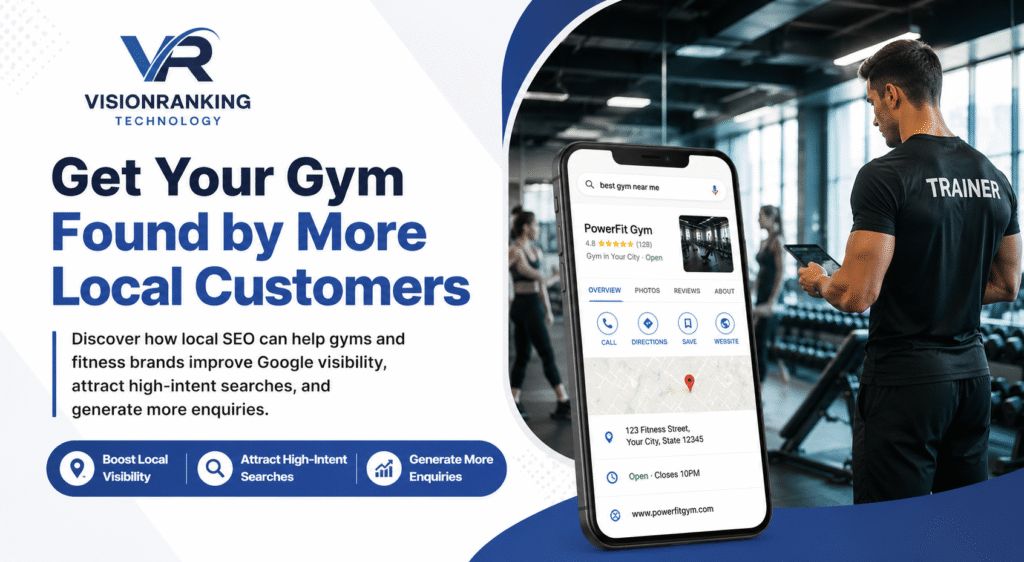
For many fitness businesses, Google Maps can be as important as traditional organic search.
A potential customer may search directly in Google Maps, compare nearby facilities, read reviews, check photos, view opening hours, or call a business without visiting its website.
Your Google Business Profile therefore needs to accurately represent your business.
Google states that local ranking is mainly based on relevance, distance, and prominence. It also notes that information such as reviews and links from other websites can contribute to prominence.
This makes Google Business Profile optimisation an important component of broader SEO services for Fitness Brands.
3. Generate More High-Intent Enquiries
Not every website visitor is equally valuable.
Someone searching for “best gym exercises” may simply want information.
Someone searching for “personal trainer in London prices” has a different level of commercial intent.
Local SEO helps fitness businesses target searches closer to customer action.
Depending on the business model, that action might be:
- Calling the gym
- Requesting membership information
- Booking a free consultation
- Booking a trial
- Scheduling a personal training session
- Enquiring about classes
- Visiting the facility
- Sending a WhatsApp enquiry
- Filling out a contact form
The objective should be to improve the quality of traffic, not simply increase traffic volume.
What Areas Should a Fitness Brand Target With Local SEO?
The answer depends on your business model and physical presence.
A single-location gym might focus on its city, neighbourhoods, and nearby service areas.
A fitness brand with multiple branches needs a much broader strategy.
Single-Location Gyms
A single gym could build visibility around:
- Its city
- Neighbourhoods around the facility
- Core fitness services
- Specific customer needs
- Local commercial searches
For example, a gym in Manchester could potentially target searches related to personal training, strength training, gym memberships, fitness classes, and other relevant services alongside location-based searches.
Multi-Location Fitness Brands
A brand with facilities across London, Birmingham, Manchester, Leeds, and other cities needs a location-specific SEO structure.
Each location should have genuinely useful information rather than simply changing the city name on an identical page.
A strong location page can include:
- Exact facility location
- Opening hours
- Available classes
- Trainers
- Facilities
- Membership options
- Parking information
- Public transport information
- Nearby areas served
- Local customer FAQs
- Relevant photos
- Booking options
This creates a better experience for customers and gives search engines clearer local signals.
Google Business Profile: A Major Local SEO Opportunity for Fitness Businesses
Your Google Business Profile is often one of the first things a potential customer sees.
Before visiting your website, they may see your:
- Business name
- Location
- Reviews
- Rating
- Photos
- Opening hours
- Phone number
- Website
- Services
- Directions
- Other business information
If this information is incomplete, inaccurate, outdated, or poorly managed, you may lose potential customers before they ever reach your website.
Google recommends keeping Business Profile information complete and accurate and explains that local ranking is influenced by relevance, distance, and prominence.
For fitness businesses, profile optimisation can include reviewing:
- Primary and secondary categories
- Business description
- Services
- Business hours
- Special hours
- Website URL
- Phone information
- Location information
- Photos and videos
- Review activity
- Business attributes where applicable
The goal is not to manipulate the profile. It is to make the information clear, accurate, and useful.
Why Reviews Matter for Gyms and Fitness Brands
Reviews can strongly influence customer decisions.
Joining a gym is often a personal decision. Customers want to know whether other people had a positive experience before committing to a membership or training programme.
Reviews can provide insight into:
- Trainer quality
- Customer service
- Equipment
- Cleanliness
- Class experience
- Staff attitude
- Overall atmosphere
- Membership experience
Reviews can also contribute to local prominence. Google notes that review count and positive ratings can help a business’s local ranking.
However, businesses should avoid artificial review tactics.
The better approach is to build a genuine review process that encourages real customers to share honest experiences.
A professional SEO strategy can also help you understand how reviews, local reputation, website content, and other signals fit together.
Local Content Strategy for Fitness Brands
Local SEO is not simply about adding city names to pages.
Search engines increasingly need context to understand what a business actually offers and who it serves.
Google’s guidance emphasises helpful, reliable, people-first content rather than content created primarily to manipulate search rankings.
For fitness brands, useful content could address genuine customer questions such as:
- What should I look for when choosing a gym?
- Is personal training worth it?
- Which gym membership is right for beginners?
- What fitness classes are available locally?
- How often should beginners train?
- What should I bring to my first gym session?
- What does personal training include?
- How can I choose a personal trainer?
- What facilities should a modern gym provide?
The content should connect naturally with your services and location.
This can help establish topical relevance while giving potential customers more reasons to trust your business.
Local Landing Pages: What Fitness Brands Need to Get Right
Creating a landing page for every location can be useful, but poor location pages can create problems.
A common mistake is producing dozens of pages that contain almost identical text with only the city name changed.
For example:
“Best Gym in London”
“Best Gym in Birmingham”
“Best Gym in Manchester”
If the pages contain essentially the same content, they may provide little additional value to users.
A better approach is to make every important location page genuinely useful.
| Weak Location Page | Strong Location Page |
| Generic city paragraph | Location-specific information |
| Same content across locations | Unique useful content |
| No local details | Local facilities and services |
| No clear CTA | Clear membership or enquiry action |
| Generic images | Relevant facility imagery |
| Minimal information | Detailed customer-focused information |
This is particularly important for larger fitness brands managing multiple branches.
SEO Services for Fitness Brands Should Go Beyond Keywords
Keywords are important, but they are only one part of a successful SEO campaign.
A professional strategy should consider the entire customer acquisition journey.
Technical SEO
Technical SEO helps search engines crawl, understand, and index your website effectively.
Areas may include:
- Website crawlability
- Indexation
- XML sitemap
- Robots.txt
- Canonical URLs
- Redirects
- Broken links
- Mobile usability
- Page speed
- Structured data
- URL structure
- Duplicate content
- Core technical issues
Google’s Search Essentials identify technical requirements, spam policies, and key best practices that support eligibility and performance in Search.
On-Page SEO
On-page optimisation can involve:
- Page titles
- Meta descriptions
- Headings
- Service content
- Location pages
- Internal links
- Image optimisation
- Alt text
- Structured information
- Conversion-focused content
Local SEO
Local SEO can focus on:
- Google Business Profile
- Local landing pages
- Local citations
- Business information consistency
- Reviews
- Local relevance
- Location-specific content
- Local authority
Authority Building
A fitness brand also needs a credible online presence.
Relevant digital PR, local references, industry mentions, partnerships, and quality backlinks can support broader authority.
The focus should be on relevance and quality rather than collecting large numbers of low-value links.
How Local SEO Supports Fitness Brands in the UK, Australia and India
Local search behaviour differs between markets, which means your strategy should not simply copy the same campaign across countries.
United Kingdom
Fitness brands in the UK may compete across cities, boroughs, towns, and neighbourhoods.
Location-specific searches can be especially valuable for gyms and personal trainers serving defined catchment areas.
A campaign may focus on city-level visibility while also addressing smaller local areas where appropriate.
Australia
Australian fitness businesses often operate across large metropolitan areas and suburbs.
A local strategy should consider the actual service radius and how customers search for gyms and fitness services within their area.
Location pages, Google Business Profile optimisation, local relevance, and strong service pages can all contribute to a broader strategy.
India
India has a highly competitive fitness market across major cities and growing urban areas.
Fitness brands may compete for searches around gyms, personal trainers, fitness centres, yoga, specialised training, and other services.
For multi-location brands, a structured location strategy can help prevent the website from becoming a collection of thin, repetitive pages.
The key principle across all three markets remains the same: build visibility around genuine services and locations instead of relying on generic keyword repetition.
Can Local SEO Help Fitness Brands Appear in AI Search Results?
Search is evolving beyond traditional blue links.
Google now provides AI Overviews in relevant searches, and Google describes these as AI-generated snapshots that can provide information with links to supporting sources.
This does not mean businesses should create content specifically to “game” AI results.
Instead, fitness brands should build a strong information ecosystem that is easy for users and search systems to understand.
That means:
- Clear service information
- Accurate business details
- Strong location relevance
- Helpful FAQs
- Consistent business information
- Authoritative website content
- Genuine reviews
- Strong local reputation
- Useful supporting content
- Clear connections between services and locations
Conversational search also changes how people may phrase their questions.
Instead of searching only for “gym London,” someone may ask:
“Which gyms near central London offer personal training for beginners?”
Your website should clearly communicate what you offer, where you operate, and who your services are designed for.
That is a much more sustainable approach to AI search readiness than trying to write content around a particular search feature.
Common Local SEO Mistakes Fitness Businesses Make
Many fitness businesses invest in their website but overlook local search fundamentals.
Here are some common problems we encounter in local SEO campaigns.
1. Treating Google Business Profile as a One-Time Task
Creating a profile is only the beginning.
Business information, services, photos, reviews, and customer interactions need ongoing attention.
2. Targeting Only “Gym Near Me”
“Near me” is an important search pattern, but it should not become the entire keyword strategy.
A fitness brand should consider services, locations, customer needs, and commercial intent.
3. Creating Duplicate Location Pages
Copying the same page across multiple cities creates little value.
Location pages should provide genuine local information.
4. Ignoring Service Pages
A gym may have separate offerings such as personal training, group classes, strength training, yoga, Pilates, or specialised programmes.
If these services are commercially important, they should have appropriate website coverage.
5. Focusing Only on Rankings
A ranking is not the final business objective.
The real questions are:
Are more relevant people finding you?
Are enquiries increasing?
Are calls increasing?
Are trial bookings improving?
Are customers discovering your locations?
SEO reporting should connect visibility with meaningful business outcomes.
6. Neglecting Mobile Experience
Fitness customers frequently search while travelling, commuting, or already near a facility.
A poor mobile experience can create unnecessary friction between discovery and enquiry.
7. Using Low-Quality Link Building
Large volumes of irrelevant links do not automatically create authority.
A sustainable strategy prioritises relevance, credibility, and long-term value.
Red Flags When Choosing an SEO Agency for Your Fitness Business
Choosing the right SEO partner matters because SEO is a long-term investment.
Be cautious if an agency:
- Guarantees a specific Google ranking
- Promises instant results
- Cannot explain what work will be completed
- Focuses only on keyword positions
- Uses large numbers of irrelevant backlinks
- Provides vague monthly reports
- Does not discuss your business goals
- Creates generic content without understanding your services
- Cannot explain how local SEO connects with lead generation
- Wants to use risky tactics that could damage your website
Google itself states that there is no way to request or pay for a better local ranking.
A trustworthy agency should set realistic expectations and explain what can be influenced, what requires time, and how progress will be measured.
Questions to Ask Before Hiring an SEO Agency
Before investing in SEO services for Fitness Brands, ask potential agencies:
Do you have experience with local businesses?
Local SEO requires a different approach from generic national SEO.
How will you measure success?
Look for more than keyword rankings.
Important indicators can include:
- Organic traffic
- Local visibility
- Google Business Profile activity
- Calls
- Enquiries
- Form submissions
- Booking actions
- Qualified leads
What will you do during the first few months?
A professional agency should be able to explain the audit, strategy, technical work, content, local optimisation, authority building, and reporting process.
How do you handle multiple locations?
This is particularly important for growing gym and fitness brands.
How will you keep me informed?
Regular reporting and communication should be part of the relationship.
Do you guarantee rankings?
Be cautious of guarantees.
SEO involves multiple variables, including search competition, website quality, market conditions, algorithm changes, and customer behaviour.
Our Local SEO Process for Fitness Brands
At Vision Ranking, our approach begins with understanding the business rather than immediately creating a list of keywords.
Step 1: Business and Market Analysis
We review:
- Your services
- Target locations
- Customer segments
- Competitors in the local market
- Existing online visibility
- Website performance
- Google Business Profile
- Current SEO strengths and weaknesses
Step 2: Keyword and Search Intent Research
We identify commercially relevant searches around your services and locations.
The goal is not to chase every possible keyword.
We prioritise opportunities that align with your business.
Step 3: Technical SEO Audit
We identify technical issues that could affect crawling, indexing, usability, or organic visibility.
Step 4: Website and On-Page Optimisation
We improve important pages so search engines and customers can understand:
- What you offer
- Where you offer it
- Who you serve
- Why customers should choose you
- What action they can take next
Step 5: Google Business Profile Optimisation
We review your local presence and identify opportunities to improve accuracy, relevance, completeness, and customer engagement.
Step 6: Local Authority Development
We work on relevant local and industry signals that can support your online authority.
Step 7: Content Strategy
We develop content around genuine customer questions, services, locations, and commercial opportunities.
Google’s guidance encourages helpful, reliable, people-first content that demonstrates expertise and provides substantial value to users.
Step 8: Monitoring and Reporting
We track progress and identify what is working, what needs improvement, and where new opportunities exist.
SEO should be treated as an ongoing growth process rather than a one-time website task.
Why Choose Vision Ranking for Fitness SEO?
Vision Ranking approaches SEO as a business growth channel.
We understand that a fitness business does not simply need more website traffic.
You need potential customers who are relevant to your services and location.
Our approach focuses on:
Business-first strategy
We align SEO activity with your commercial objectives.
Local search expertise
We focus on the factors that influence visibility across Google Search and Maps.
Technical and content optimisation
We look beyond keywords to improve the overall quality and accessibility of your website.
Transparent communication
You should understand what is being worked on and why.
Long-term growth
We focus on building a stronger organic presence instead of chasing shortcuts.
Flexible location targeting
Whether you operate from one gym or manage multiple fitness locations, we can structure the strategy around your business model.
If your fitness business is struggling to generate enough organic leads, a professional local SEO audit can help identify where the biggest opportunities are.
What Business Benefits Can Fitness Brands Expect From Local SEO?
SEO results vary depending on competition, location, website condition, authority, budget, and the quality of implementation. No responsible agency should promise a fixed number of leads or a guaranteed ranking.
However, a well-executed local SEO strategy can support business goals such as:
- Greater local search visibility
- More relevant website traffic
- More Google Maps exposure
- Increased calls
- More membership enquiries
- More trial requests
- Stronger brand visibility
- Better visibility for individual services
- Improved local reputation
- Stronger long-term organic acquisition
The most important benefit is compounding visibility.
Paid advertising can provide immediate exposure while the campaign is active. SEO is different. The goal is to build an organic asset that can continue attracting relevant searches over time.
That is why businesses should evaluate SEO as a long-term investment.
How Long Does Local SEO Take for a Fitness Business?
There is no universal timeline.
A new gym operating in a competitive city may require more time than an established fitness brand with strong reviews, a technically healthy website, and existing local authority.
Factors that can influence progress include:
- Domain history
- Website quality
- Local competition
- Number of locations
- Existing Google Business Profile strength
- Review profile
- Content quality
- Backlink profile
- Technical SEO
- Search demand
- Market location
The right approach is to establish a baseline, implement improvements, monitor trends, and continuously refine the strategy.
Short-term improvements may appear in some areas, while stronger organic growth can take longer to develop.
The goal should be sustainable progress rather than unrealistic promises.
Who Should Invest in Local SEO Services for Fitness Brands?
Local SEO can be particularly valuable for:
- Independent gyms
- Boutique fitness studios
- Personal trainers
- Yoga studios
- Pilates studios
- CrossFit facilities
- Women’s fitness centres
- Strength and conditioning facilities
- Martial arts and fitness centres
- Sports training facilities
- Wellness and fitness centres
- Multi-location gym brands
- Franchise fitness businesses
If customers need to find your business in a particular geographical area, local SEO deserves consideration.
Frequently Asked Questions
1. What are SEO services for Fitness Brands?
SEO services for Fitness Brands are search optimisation services designed to improve the online visibility of gyms, fitness studios, personal trainers, wellness centres, and related businesses. The strategy can include technical SEO, on-page optimisation, local SEO, Google Business Profile optimisation, content, local authority building, and performance tracking.
2. Is local SEO important for gyms?
Yes. Gyms typically serve customers within a defined geographical area, making local search highly relevant. Local SEO can help potential customers discover your gym when they search for nearby fitness services.
3. Can local SEO help a personal trainer generate leads?
It can. Personal trainers can target relevant service and location searches, strengthen their Google Business Profile, build local relevance, and improve website pages designed around enquiries and bookings.
4. Does Google Business Profile affect local SEO?
Google Business Profile is an important part of local search visibility. Google explains that complete and accurate business information can help businesses appear for relevant local searches, while local results are influenced by relevance, distance, and prominence.
5. Should a fitness brand create separate pages for every location?
Not automatically. Location pages can be useful when each location represents a genuine business service area and the page contains unique, valuable information. Creating large numbers of thin or repetitive pages is unlikely to provide the same value as well-developed location pages.
6. How important are reviews for a gym?
Reviews can influence customer trust and contribute to local prominence. Genuine customer feedback can also help prospective members understand the real experience of using your gym.
7. Can SEO help a gym compete with larger fitness brands?
Yes, but the strategy needs to be realistic. A smaller gym can focus on specific locations, services, customer needs, and local relevance instead of trying to compete for every broad fitness keyword.
8. Does local SEO work in the UK, Australia and India?
Yes. The principles of local search apply across these markets, although search behaviour, competition, locations, and customer expectations differ. The strategy should be adapted to the specific market and service area.
9. Does Vision Ranking guarantee Google rankings?
No responsible SEO agency should guarantee specific rankings. Search results depend on many factors outside an agency’s complete control. Vision Ranking focuses on strategy, implementation, measurable progress, and long-term organic growth.
10. How can I find out whether my fitness business needs local SEO?
A local SEO audit can identify visibility gaps across your website, Google Business Profile, location pages, technical SEO, content, reviews, and local authority. The findings can then be used to prioritise the opportunities most relevant to your business.
Final Thoughts: Turn Local Search Visibility Into Fitness Business Growth
People are already searching for gyms, personal trainers, fitness classes, and wellness services in their local areas.
The challenge is making sure your business appears when those searches happen.
Local SEO helps connect your fitness brand with customers who are actively looking for what you offer. From Google Business Profile optimisation and location pages to technical SEO, content, reviews, and local authority, each element contributes to a stronger search presence.
For fitness businesses in the United Kingdom, Australia, India, and other competitive markets, the opportunity is not simply to rank higher.
It is to become easier to find, easier to trust, and easier to contact.
At Vision Ranking, we build SEO strategies around that objective.
If you want to understand where your gym or fitness brand currently stands, start with a clear assessment rather than guesswork.
Request a Free SEO Audit from Vision Ranking and discover the opportunities that could help your business improve local visibility and attract more relevant customers.Ready to discuss your growth goals? Talk to Our Experts today.