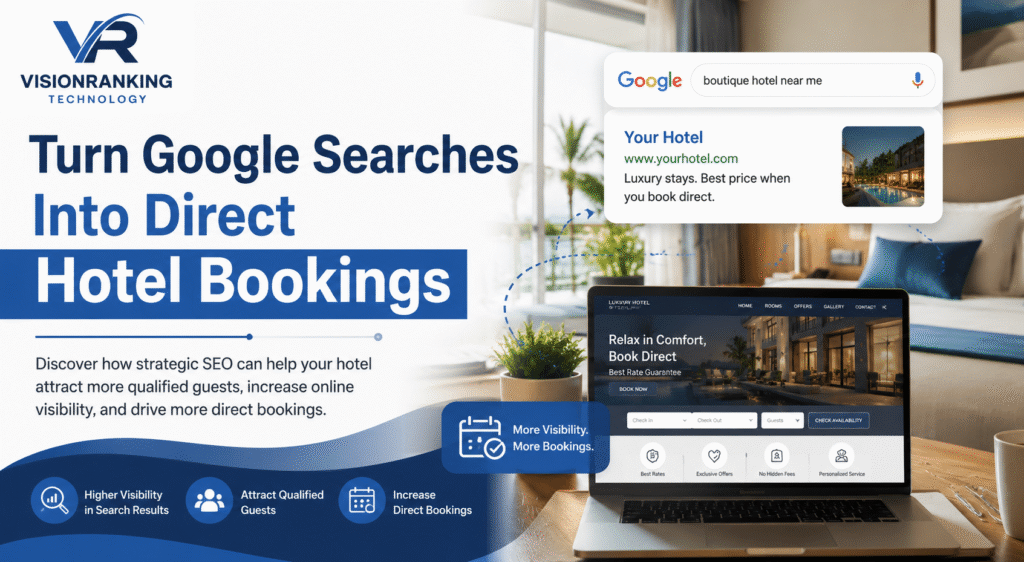
How Can Hotels Get More Direct Bookings With SEO?
📌 Key Takeaways
- SEO can help hotels increase direct bookings by attracting guests actively searching for accommodation.
- Hotel SEO services should target booking-intent keywords, not just broad, high-volume terms.
- Local SEO for hotels can improve visibility for location-based searches and nearby travel queries.
- Hotel website SEO should combine search visibility with a smooth, trust-building booking experience.
- Consistent SEO and content optimisation can build long-term organic visibility and reduce reliance on third-party booking platforms.
For many hotels, getting discovered online is only the first step. The bigger challenge is turning that visibility into direct bookings.
Guests often search for hotels, compare locations, check reviews, explore room options, and then decide where to book. If your hotel website does not appear prominently during these searches, you may be losing potential guests before they ever discover your property.
This is where a strategic SEO campaign can make a significant difference.
Effective SEO for hotels is not simply about ranking a hotel website for a few keywords. It is about improving your visibility across relevant searches, attracting guests who are actively looking for accommodation, building trust, improving the website experience, and encouraging visitors to book directly.
For hotels in the United Kingdom, Australia, and India, this can be particularly valuable because travellers may search using location-specific, service-specific, and intent-driven phrases before making a booking decision.
With the right strategy, hotel SEO services can help your website attract qualified organic traffic and create more opportunities for direct reservations.
Why Direct Hotel Bookings Matter
Online travel platforms can help hotels reach a large audience, but depending entirely on third-party booking platforms can create challenges.
Hotels may have to deal with:
- Commission costs
- Increased competition
- Limited control over the customer journey
- Competition with other properties on the same platform
- Less opportunity to build a direct relationship with guests
- Difficulty differentiating the hotel’s brand
A strong organic presence gives your hotel another channel for generating bookings.
When a traveller finds your website directly through Google and completes a reservation on your own booking system, the customer journey is more closely connected to your brand.
SEO does not eliminate the value of third-party platforms. Instead, it can help create a healthier balance between third-party bookings and direct reservations.
How SEO Can Help Hotels Get More Direct Bookings
A successful hotel SEO campaign connects search visibility with booking intent.
Someone searching for “hotels in London” has a different intent from someone searching for “family hotel near Heathrow Airport with parking.”
The second search can indicate a much stronger booking requirement.
A professional SEO strategy identifies these different search behaviours and builds visibility around the searches that matter to the hotel.
A well-planned campaign can help with:
- Increasing visibility for relevant hotel searches
- Attracting location-specific traffic
- Improving important landing pages
- Strengthening local search presence
- Supporting destination-related searches
- Improving organic visibility for room and service-related searches
- Building trust through useful content
- Improving the path from search to booking
The objective is not simply more visitors. The objective is more relevant visitors with genuine booking intent.
What Is Hotel SEO?
Hotel SEO is the process of improving a hotel’s website and online presence so it can appear more prominently for relevant search queries.
Unlike general SEO, hotel SEO requires an understanding of how travellers search.
Potential guests may search for:
- Hotels in a specific city
- Hotels near an airport
- Boutique hotels in a destination
- Family-friendly hotels
- Business hotels
- Hotels with conference facilities
- Hotels with parking
- Hotels near tourist attractions
- Luxury hotels
- Affordable hotels
- Hotel rooms for specific dates
- Hotels near transport hubs
An experienced hotel SEO agency looks beyond broad keywords and considers the complete search journey.
The strategy should connect your hotel’s location, services, property features, target guests, and commercial goals with the way people search online.
Which Hotel Searches Should Your SEO Strategy Target?
One of the most important parts of hotel SEO is understanding search intent.
A hotel should not focus exclusively on one broad phrase such as “hotel in London” or “hotel in Sydney.”
Instead, the campaign should consider several keyword groups.
Location-Based Searches
These searches include the destination or geographical area.
Examples include:
- Hotel in London
- Hotels in Manchester
- Hotels in Sydney
- Hotels in Melbourne
- Hotels in Delhi
- Hotels in Mumbai
Feature-Based Searches
These searches focus on a specific hotel feature.
Examples include:
- Hotel with airport transfer
- Hotel with parking
- Hotel with swimming pool
- Business hotel with meeting rooms
- Family hotel with connecting rooms
Experience-Based Searches
Travellers may also search according to the experience they want.
Examples include:
- Boutique hotel in central London
- Luxury hotel near Sydney Harbour
- Beach hotel in Goa
- Romantic hotel in Jaipur
Problem and Convenience Searches
Some users search based on their immediate requirements.
For example:
- Hotel near Heathrow Airport
- Hotel near Birmingham city centre
- Hotel near Sydney Airport
- Hotel near a conference centre
A comprehensive hotel website SEO strategy can bring these different search opportunities together.
Why Local SEO for Hotels Is Important
Hotels are inherently location-driven businesses.
Travellers often use location-based searches when deciding where to stay. That makes local SEO for hotels an important part of the overall strategy.
Local visibility can help your hotel appear when users search for accommodation or related services within a specific destination.
A strong local SEO strategy can support visibility through:
- Accurate business information
- Consistent hotel details across relevant platforms
- Location-focused website content
- Optimised hotel pages
- Local landing pages where appropriate
- Reviews and reputation signals
- Relevant local content
- Strong location relevance
For example, a hotel in Manchester should not only target broad accommodation searches. It can also build relevance around nearby attractions, transport links, business districts, event venues, and other locations that matter to potential guests.
This creates additional opportunities to reach travellers at different stages of their decision-making process.
Hotel SEO Should Focus on Bookings, Not Just Rankings
A common mistake is measuring SEO success entirely through keyword positions.
Ranking improvements are useful, but hotel owners ultimately care about business outcomes.
Consider two scenarios.
Hotel A receives 5,000 organic visitors every month but most visitors leave without taking action.
Hotel B receives 2,000 organic visitors, but those visitors are actively searching for the hotel’s location, room types, facilities, and availability.
Hotel B may have a much more valuable organic channel.
This is why professional SEO should connect rankings with meaningful business metrics such as:
- Organic traffic quality
- Landing page engagement
- Booking-related actions
- Enquiry activity
- Phone calls
- Search visibility
- Conversion behaviour
- Growth in relevant non-branded searches
The right strategy is designed around the hotel’s commercial objectives.
How Hotel Website SEO Can Improve the Booking Journey
SEO and conversion optimisation work closely together.
Getting a potential guest to your website is only part of the process. The website must also make it easy for that visitor to understand the property and take the next step.
Important areas include:
Clear Hotel Information
Visitors should quickly understand what the hotel offers, where it is located, and why it may be suitable for their trip.
Strong Location Information
Explain the hotel’s proximity to airports, attractions, business districts, transport links, and other relevant destinations.
Useful Room Pages
Each important room type should have clear information rather than forcing visitors to search through the website.
Mobile Experience
Many travellers research accommodation from smartphones. A slow or difficult mobile experience can create unnecessary friction.
Clear Booking Actions
Visitors should not have to hunt for the booking option.
Trust Signals
Guest reviews, ratings, facilities, policies, photographs, and other relevant information can help reduce uncertainty.
A strong hotel website SEO campaign considers these factors alongside technical and content optimisation.
What Does a Hotel SEO Agency Actually Do?
Choosing an SEO provider is an important business decision.
A professional hotel SEO agency should look at the complete search ecosystem rather than simply adding keywords to website pages.
A typical campaign may include:
- Website SEO analysis
- Keyword and search intent research
- Competitor market analysis
- Technical SEO
- On-page optimisation
- Content strategy
- Internal linking
- Local SEO
- Google Business Profile optimisation
- Content development
- Authority building
- Performance monitoring
- Search Console analysis
- Analytics review
- Conversion-focused recommendations
The exact strategy should depend on the hotel’s current website, market, location, competition, and business objectives.
There is no universal SEO checklist that works equally well for every property.
Our SEO Process at Vision Ranking
At Vision Ranking, we approach SEO as a long-term growth strategy rather than a collection of isolated tasks.
Our process begins with understanding the business.
1. Website and SEO Audit
We review the hotel’s website to identify technical, on-page, content, indexing, and performance opportunities.
2. Keyword Research
We identify commercially relevant keywords based on location, services, hotel type, guest requirements, and search intent.
3. Competitor and Market Research
We analyse the search landscape to understand what types of pages and content are performing for relevant searches.
4. Website Optimisation
We improve important on-page elements, including titles, headings, content structure, internal links, URLs, and other relevant SEO elements.
5. Local SEO
We strengthen location relevance and improve the hotel’s visibility for appropriate local searches.
6. Content Strategy
We identify content opportunities that can attract potential guests throughout the research and booking journey.
7. Authority Building
We work on relevant off-page SEO activities designed to strengthen the website’s authority and online presence.
8. Performance Monitoring
SEO performance is reviewed regularly to identify improvements, opportunities, and areas requiring further attention.
9. Continuous Optimisation
Search behaviour and Google’s results continue to change. We refine the strategy based on performance data and emerging opportunities.
Common Hotel SEO Mistakes
Hotels can invest considerable time and money into digital marketing but still struggle to generate organic bookings because of common SEO problems.
Targeting Only One Broad Keyword
A hotel may focus entirely on a phrase such as “hotel in London.”
This can limit the number of relevant searches the website can capture.
Ignoring Location Intent
Hotel customers care deeply about location. Weak location signals can make it harder to compete for valuable local searches.
Creating Thin Location Pages
Creating multiple pages with almost identical content and changing only the city name can create a poor user experience and weak search relevance.
Neglecting Room and Service Pages
Important commercial pages should be properly optimised instead of focusing all SEO attention on the homepage.
Ignoring Mobile Users
A booking journey that is difficult on mobile devices can reduce the value of organic traffic.
Publishing Content Without a Strategy
Publishing random hotel blogs may generate traffic but not necessarily qualified visitors.
Content should have a clear relationship with the hotel’s target audience and commercial objectives.
Expecting Immediate Results
SEO is generally a long-term marketing channel. Sustainable visibility requires consistent optimisation, quality content, authority building, and ongoing monitoring.
Red Flags When Choosing Hotel SEO Services
Not every SEO provider follows the same approach.
Hotels should be cautious when an agency:
- Guarantees a specific Google ranking
- Promises overnight results
- Cannot explain its strategy clearly
- Focuses only on keyword rankings
- Uses irrelevant backlinks
- Provides generic reports with little business insight
- Does not ask about the hotel’s target market
- Does not discuss conversion goals
- Uses the same strategy for every client
- Cannot explain what work will be performed
Good SEO requires transparency.
Before hiring an agency, hotel decision-makers should understand what the agency plans to do, how progress will be measured, and how the campaign connects with business goals.
Questions to Ask Before Hiring a Hotel SEO Agency
Before choosing an SEO partner, consider asking:
- What is your approach to SEO for hotels?
- How will you identify the most valuable search opportunities?
- How will you measure campaign performance?
- What technical SEO improvements do you expect to make?
- How will you approach local SEO?
- What type of content will you recommend?
- How will you improve commercial landing pages?
- How frequently will performance be reviewed?
- What reporting will we receive?
- How will the strategy evolve as search behaviour changes?
The answers can reveal whether an agency is thinking strategically or simply selling a predefined package.
How Much Time Does Hotel SEO Take?
SEO results vary significantly from one hotel to another.
Factors that can influence progress include:
- Website age
- Existing authority
- Technical condition
- Content quality
- Competition
- Target locations
- Number of target keywords
- Current search visibility
- Website structure
- Local search presence
- Consistency of optimisation
A new hotel website competing in a highly competitive destination may require considerably more time and effort than an established property with a strong online presence.
Rather than promising a fixed timeline, a responsible SEO provider should evaluate the current position and establish realistic milestones.
The focus should be on building sustainable search visibility and improving opportunities over time.
Can SEO Help Hotels Prepare for AI Search?
Search behaviour is evolving beyond traditional blue-link results.
Google AI Overviews and conversational search experiences are changing how users discover and evaluate information.
For hotels, this makes it increasingly important to provide clear, useful, trustworthy information about:
- Hotel location
- Rooms
- Facilities
- Services
- Nearby attractions
- Guest experience
- Policies
- Frequently asked questions
- Local travel information
AI-driven search experiences still depend on reliable information and strong online signals.
A hotel with well-structured website content, clear business information, useful resources, and a strong overall digital presence can be better positioned to participate in these evolving search experiences.
SEO should therefore consider both traditional organic visibility and emerging AI search behaviour.
Business Benefits of Investing in Hotel SEO
A well-executed SEO strategy can provide several long-term benefits.
More Qualified Organic Traffic
Your website can attract visitors who are actively searching for relevant hotel services and locations.
Greater Direct Booking Opportunities
More relevant visibility can create additional opportunities for travellers to book directly through your website.
Stronger Brand Visibility
Repeated exposure in relevant searches can help increase awareness of the hotel.
Reduced Dependence on Paid Traffic
Organic search can become a valuable additional acquisition channel alongside paid advertising and third-party booking platforms.
Better Local Visibility
Local SEO can help the hotel become more visible to users searching within its destination.
Stronger Website Experience
SEO improvements often uncover usability, content, technical, and structural issues that can also affect visitors.
Long-Term Marketing Value
Unlike a campaign that stops generating traffic as soon as advertising spend stops, SEO aims to build an organic asset that can continue generating opportunities over time.
Who Can Benefit From Hotel SEO Services?
Hotel SEO can be valuable for a wide range of properties, including:
- Independent hotels
- Boutique hotels
- Luxury hotels
- Budget hotels
- Business hotels
- Resort properties
- Family hotels
- City hotels
- Airport hotels
- Hospitality groups
- Hotels launching new locations
- Hotels with low direct booking rates
The strategy should always be adapted to the property’s market and objectives.
For example, a boutique hotel may focus heavily on destination and experience-related searches, while an airport hotel may prioritise convenience-driven searches.
Why Choose Vision Ranking for Hotel SEO?
At Vision Ranking, we understand that SEO should support business growth rather than exist as a separate marketing activity.
Our approach focuses on creating a search strategy aligned with your hotel’s target audience, locations, services, and commercial priorities.
We focus on:
- Strategic keyword targeting
- Technical SEO
- On-page optimisation
- Content planning
- Local SEO
- Authority building
- Performance monitoring
- Conversion-focused recommendations
- Long-term search growth
We do not believe in one-size-fits-all SEO.
Your hotel has its own market, customers, location, competition, and business goals. Your SEO strategy should reflect those differences.
If your goal is to attract more qualified visitors and create more direct booking opportunities, our team can evaluate your current search presence and identify practical growth opportunities.
Is SEO a Better Option Than Relying Only on Booking Platforms?
For most hotels, it does not have to be an either-or decision.
Third-party booking platforms can provide valuable exposure, while SEO can help strengthen the hotel’s own website and organic visibility.
The goal is to build a diversified acquisition strategy.
When a hotel can attract potential guests through organic search, paid campaigns, social media, referrals, repeat customers, and booking platforms, it is less dependent on any single channel.
SEO can become one part of a broader digital marketing strategy designed to support sustainable direct bookings.
How to Get Started With Hotel SEO
The first step is understanding where your hotel currently stands.
A professional SEO assessment can identify:
- Which keywords your website currently ranks for
- Which pages attract organic traffic
- Where ranking opportunities exist
- Technical SEO issues
- Content gaps
- Local SEO opportunities
- Website optimisation opportunities
- Potential conversion barriers
From there, an SEO strategy can be developed around the hotel’s priorities.
If you are looking for SEO services for hotels, the focus should not simply be on getting more traffic. The strategy should be designed to attract the right visitors and move them closer to making a booking.
Ready to explore the opportunities for your hotel? Request a Free Audit from Vision Ranking and let our SEO experts identify areas where your website can improve its organic visibility and booking potential.
Frequently Asked Questions
1. What are SEO services for hotels?
SEO services for hotels are specialised search engine optimisation activities designed to improve a hotel’s visibility in relevant search results. They can include technical SEO, keyword research, content optimisation, local SEO, website optimisation, authority building, and ongoing performance monitoring.
2. How can SEO help a hotel get more direct bookings?
SEO can help hotels attract users who are actively searching for accommodation, destinations, hotel facilities, and related services. By improving organic visibility and creating a stronger website experience, hotels can generate more opportunities for visitors to book directly.
3. What is the difference between SEO for hotels and regular SEO?
Hotel SEO considers the unique search behaviour of travellers. It places greater emphasis on location-based searches, destination intent, hotel facilities, room types, local visibility, travel-related content, and booking-focused website pages.
4. Is local SEO important for hotels?
Yes. Hotels are strongly connected to their physical locations, so local SEO can play an important role in helping potential guests discover them through location-based searches.
5. How long does hotel SEO take to produce results?
The timeframe varies depending on factors such as competition, website authority, technical condition, target locations, content quality, and the current search position. A professional agency should provide realistic expectations rather than guarantee a specific ranking or timeline.
6. Should hotels invest in hotel website SEO?
Yes, particularly when the hotel wants to increase organic visibility and create more direct booking opportunities. A well-optimised website can support both search performance and the visitor’s journey toward making a reservation.
7. Can an SEO agency help a new hotel website?
Yes. Starting SEO early can help establish the website’s technical foundation, keyword targeting, content structure, local relevance, and authority. However, new websites generally need time to establish visibility and compete with established properties.
8. Does hotel SEO replace booking platforms?
Not necessarily. SEO and booking platforms can work together. SEO can help hotels increase their own website visibility and direct booking opportunities while third-party platforms continue to provide additional exposure.
9. What should I look for in a hotel SEO agency?
Look for an agency that understands search intent, local SEO, technical optimisation, content strategy, conversion-focused SEO, reporting, and long-term growth. Avoid agencies that rely on ranking guarantees or vague promises.
10. Can Vision Ranking help with SEO for hotels in the UK, Australia, and India?
Yes. Vision Ranking can develop an SEO strategy based on your hotel’s target market, location, competition, website condition, and business objectives. The campaign can focus on improving relevant organic visibility and creating more qualified opportunities for direct bookings.
Final Thoughts
Getting more direct hotel bookings requires more than simply having a website.
Your hotel needs to be visible when potential guests search, provide the information they need, create confidence in the property, and make it easy for them to take the next step.
That is where strategic SEO can make a difference.
From hotel website SEO and location-focused optimisation to content, local visibility, technical improvements, and AI search readiness, every part of the strategy should work toward the same goal: attracting more qualified potential guests and creating more opportunities for direct bookings.
If your hotel is struggling to generate enough organic traffic or relying too heavily on third-party booking platforms, it may be time to evaluate your search strategy.
Talk to Vision Ranking about your hotel SEO requirements and request a Free SEO Audit to discover where your website can improve.