How a Website Development Agency Improves Conversion, Speed, and User Experience
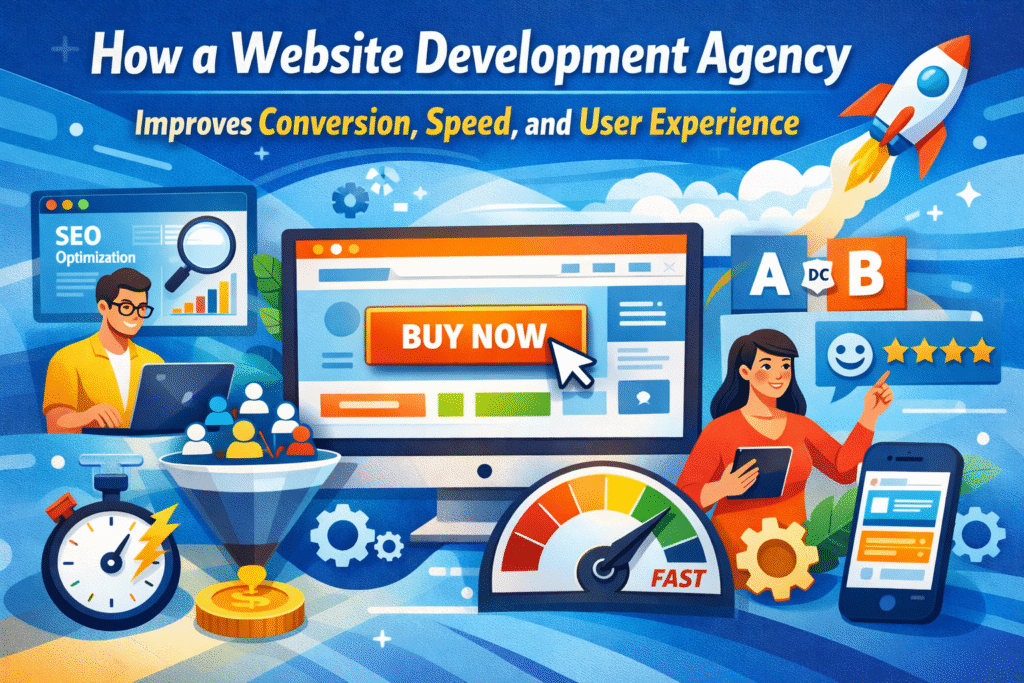
In today’s digital economy, a website is more than an online presence. It is a business asset that influences trust, conversion, customer retention, and long-term brand authority. As user expectations rise and competition intensifies, businesses can’t afford outdated or average-performing websites. They need platforms that load instantly, function seamlessly, and guide users toward meaningful actions.
This is where a professional website development agency becomes indispensable. A capable agency doesn’t just build pages, it builds digital experiences that convert visitors into customers, elevate brand credibility, and support long-term growth. Whether it’s building a new website or optimizing an existing one, the right agency ensures your online presence performs like a true business engine.
In this blog, we break down exactly how a website development agency strengthens three critical pillars of online success:
Conversion
Turning visitors into leads or customers.
Speed
Fast loading and smooth performance across all devices.
User Experience (UX)
Creating intuitive, enjoyable, and friction-free interactions.
Let’s explore how expert teams bring these elements together to build websites that deliver measurable business impact.
1. Building with a Clear Conversion Strategy, Not Just Design
Most businesses focus heavily on design aesthetics. While appearance matters, design alone does not drive conversions. A development agency starts by understanding the bigger picture:
- What actions do you want users to take?
- What motivates your ideal customer?
- Where do users typically drop off?
- Which pages influence conversions the most?
A strategic agency approaches your website as a conversion ecosystem—every section, button, and flow is purposeful.
1.1 Using User Behavior Data to Guide Design
Professionals never rely on guesswork. They evaluate:
- Heatmaps
- Scroll depth
- Session recordings
- Bounce rates
- Past conversion paths
This helps in restructuring pages to match real user behavior instead of assumptions.
1.2 Creating High-Impact Landing Pages
Focused landing pages are the heart of conversion. Agencies optimize them by:
- Using attention-grabbing headlines
- Adding value-driven content
- Creating clear, high-contrast call-to-action (CTA) buttons
- Reducing distractions
- Building trust through social proof
A well-built landing page developed with intention can increase conversions dramatically.
1.3 Strategic CTA Placement
Conversions often fail because CTAs are placed randomly. Experts follow proven patterns:
- Above the fold
- After key value propositions
- In the footer
- On product/service pages
- Within sticky headers
This ensures the user always knows the next step without feeling pressured.
2. Improving Website Speed for Better Performance & Rankings
Speed is a silent business driver. Users abandon slow websites in seconds, and search engines downgrade sites that underperform. A development agency ensures your website is optimized from the code level to the server level.
2.1 Eliminating Unnecessary Code & Bloat
One major cause of slow websites is heavy, bloated code. Professionals:
- Minify CSS/JS
- Remove unused libraries
- Optimize scripts
- Compress images
- Clean up outdated plugins
Lean code – faster performance.
2.2 Server & Hosting Optimization
Your hosting provider affects site speed more than you think. Agencies help you choose:
- Managed cloud hosting
- CDN integration
- High-performance caching
- Optimized server configurations
These improvements dramatically boost loading speeds globally.
2.3 Image, Video & Media Optimization
Large images are the reason websites load slowly. Experts ensure:
- Next-gen formats (WebP)
- Lazy loading
- Responsive image scaling
- Video compression
The result is a fast-loading experience even on mobile networks.
3. Enhancing User Experience to Keep Visitors Engaged
User experience (UX) is the backbone of retention and conversion. Even the most beautiful website fails if users struggle to navigate it. A development agency focuses on building friction-free, intuitive digital journeys.
3.1 Simplifying Navigation
A complex menu confuses visitors. Agencies create:
- Clean navigation bars
- Logical categorization
- Clear hierarchy
- Sticky headers
- Mobile-first menus
When users find what they need effortlessly, they stay longer and convert more often.
3.2 Creating Mobile-First Experiences
Over 60% of website traffic comes from mobile. Agencies prioritize:
- Responsive layouts
- Touch-friendly interactions
- Optimized mobile CTAs
- Fast-loading mobile pages
Mobile friendliness directly influences conversions.
4. Designing Digital Experiences around Real User Behaviour
Strong user experience isn’t built on assumptions. It’s built on understanding how people think, move, scroll, and decide. Professional agencies use behaviour-driven insights to structure websites with clarity and intention.
4.1 Reducing Cognitive Load
People don’t like to think too hard when using a website. If a user has to guess, try twice, or search too long, they leave. Agencies simplify the journey by:
- Using concise headlines
- Removing unnecessary elements
- Reducing the number of choices
- Presenting information logically
- Adding visual cues and icons
When a website is easier to use, users stay longer, trust the brand more, and convert at higher rates.
4.2 Building Predictable Pathways
A predictable path doesn’t mean a boring design. It means users instinctively know:
- Where the menu is
- Where to find contact details
- How to locate pricing or services
- What button completes an action
Predictable design reduces frustration and increases completion of key tasks like form submissions, booking requests, or purchases.
4.3 Making Content Scannable
Visitors don’t read every line they scan. Agencies structure content so the most important information stands out naturally through:
- Short paragraphs
- Bold key phrases
- Bullet points
- Subheadings
- Visual separators
This approach keeps readers engaged and helps them make decisions faster.
5. Conversion Psychology: Turning Interest into Action
Conversions depend on psychology as much as technology. A reliable development agency uses proven behavioural principles to guide users toward taking the next step.
5.1 Building Trust Through Visual Credibility
First impressions matter. Trust-building elements include:
- Clean, modern design
- Consistent branding
- Professional typography
- High-quality visuals
- Certifications or awards
- Clear contact information
When a website looks credible, users feel safe to continue.
5.2 Reducing Friction in Key Actions
The more steps required, the fewer conversions happen. Agencies reduce friction by:
- Simplifying forms
- Offering one-click actions
- Reducing required fields
- Adding autofill features
- Ensuring fast checkout flows
Frictionless experiences increase conversions instantly.
5.3 Strategic Use of Social Proof
People trust people. Agencies place social proof where it impacts decisions most:
- Testimonials near CTAs
- Client logos above the fold
- Case study highlights on service pages
- Ratings and reviews on product pages
Strategically placed proof builds confidence at the right moment.
5.4 Clarity in Value Propositions
A business loses conversions when users ask:
“Why should I choose you?”
A website development agency ensures your value proposition is:
- Clear
- Visible early
- Repeated through the journey
- Supported by benefits and results
Clarity increases persuasion and persuasion increases conversions.
6. Technical Excellence: The Core of User Satisfaction
While design and content influence perception, technical performance impacts the actual experience. This section explores how expert developers ensure your website performs at its peak.
6.1 Clean Code Structure
Behind every fast website is clean, well-organized code. Agencies ensure:
- Lightweight framework usage
- Reduced DOM size
- Modular CSS
- Minimal third-party scripts
- Efficient rendering
Cleaner code results in faster pages and fewer technical issues.
6.2 Strong Website Architecture
Architecture influences both search engines and users. Agencies design structures that:
- Improve crawl efficiency
- Enhance navigation
- Support future scalability
- Keep content organised
- Make internal linking seamless
Good architecture is invisible to users but essential for performance.
6.3 Robust Security Layers
Security builds trust and protects business operations. Professional teams implement:
- SSL certificates
- Firewall protection
- Secure hosting
- Database encryption
- Server hardening
- Regular vulnerability scans
For businesses, strong security means reliability and long-term stability.
6.4 Optimising for Multi-Device Performance
Users browse from phones, tablets, laptops, and large screens. Agencies ensure:
- Layout responsiveness
- Touch-friendly elements
- Adaptive images
- Consistent spacing
- Cross-browser compatibility
This guarantees a smooth experience no matter the device.
7. Speed Engineering: Beyond Basic Optimization
Speed isn’t just loading time, it’s responsiveness, smoothness, and stability. Agencies take performance deeper than simple image compression.
7.1 Server-Level Speed Enhancements
A professional team optimizes the environment your website lives in:
- Dedicated hosting
- Server-side caching
- GZIP compression
- CDN integration
- HTTP/2 or HTTP/3 adoption
These improvements enhance global speed and uptime reliability.
7.2 Frontend Performance Optimization
Frontend optimisation improves the way users see speed:
- Eliminating render-blocking resources
- Prefetching key assets
- Prioritising visible content
- Optimising JavaScript execution
- Maintaining a minimal design footprint
The result: faster, clearer, more responsive interactions.
7.3 Stability & Smooth Interactions
Speed includes how smoothly elements respond. Agencies improve stability through:
- Optimised animations
- Controlled transitions
- No layout shifts
- Predictable loading placements
Smoothness enhances user confidence and satisfaction.
8. Conversion-Focused Design: Aligning Aesthetics with Purpose
Every website has a purpose and conversion-focused design ensures that every visual element supports that purpose. While aesthetics play a role in capturing attention, purpose-driven design ensures attention turns into action.
8.1 Creating Visual Hierarchy That Guides the Eye
Users do not decide randomly; they follow visual cues. Agencies create hierarchy using:
- Strategic font sizes
- Contrast in key areas
- Intentional placement of value points
- Balanced spacing
- Hero sections that instantly communicate relevance
When hierarchy is clear, users instantly understand what matters most.
8.2 Using White Space to Increase Clarity
White space is not “empty space” it is breathing room for the brain. Professional designers use spacing to:
- Prevent visual clutter
- Highlight essential elements
- Increase content readability
- Help CTAs stand out
- Keep sections clean and professional
Simple layouts often outperform complex ones because they reduce overwhelm.
8.3 Designing CTA Blocks That Motivate Action
A strong website uses CTAs that feel like invitations, not pressure. Agencies build CTA blocks that:
- Clearly communicate value
- Are placed in natural decision points
- Use contrasting but harmonious colours
- Feel confidence-driven (“Get Started”, “Book a Free Strategy Call”)
- Increase urgency without manipulation
These small enhancements often create significant increases in conversions.
9. Alignment Between Design, Development & Content
A website performs best when design, development, and content work as one — not as isolated parts. This alignment ensures your message, user experience, and performance all support each other.
9.1 Designers Shape User Perception
Design influences emotions, trust, and understanding. Designers ensure:
- Layout supports clarity
- Colours reinforce brand personality
- Visuals communicate expertise
- Navigation feels effortless
Good design makes users feel confident about taking the next step.
9.2 Developers Shape Experience Stability
Development influences how the website behaves. Developers ensure:
- Fast loading
- Smooth interactions
- Responsive layouts
- Reliability
Even the best design fails without structure and performance behind it.
9.3 Content Shapes Decision-Making
Content turns curiosity into clarity. Content teams ensure:
- Clear value propositions
- Benefit-focused messaging
- SEO-rich structure
- Human-friendly tone
When these three departments align, the website becomes a powerful conversion engine.
10. Personalization: Creating Experiences That Feel Tailored
Users convert better when they feel understood. Agencies implement personalization that makes each visitor’s experience feel relevant.
10.1 Behavioral Personalization
This includes adjustments based on:
- Past interactions
- Device type
- Preferred categories
- Engagement history
These small differences create meaningful results.
10.2 Location-Based Personalization
Businesses with multiple regions benefit from:
- Geo-targeted content
- Local contact details
- Region-specific offers
- Relevant language or currency
This builds connection and trust quickly.
10.3 Funnel-Based Personalization
A returning visitor should not see the same message as a first-time visitor. Agencies create:
- First-time landing experiences
- Repeat-visitor optimization
- Lead nurturing flows
- Return customer incentives
This maximizes conversions across every stage of the user journey.
11. Performance Monitoring: How Agencies Maintain Long-Term Efficiency
A high-performing website requires continuous monitoring, testing, and adjustments. Professional agencies use performance frameworks to enhance long-term success.
11.1 Heatmaps & Behaviour Tracking
This reveals:
- Where users drop off
- Which sections they ignore
- What elements cause friction
This data shapes ongoing refinements.
11.2 Speed & Performance Audits
Regular audits ensure:
- Scripts remain optimized
- Plugins stay updated
- Hosting configuration is current
- Images are compressed
- Code remains lean
This prevents long-term slowdowns.
11.3 Real-User Monitoring (RUM)
This measures real user experience, including:
- Load time variations
- Device-level performance
- Interaction delays
- Network-based issues
Long-term monitoring allows agencies to make proactive improvements.
12. Why Businesses Trust Website Development Agencies for Growth
A good website development agency becomes a long-term digital partner. Businesses trust agencies because they provide:
12.1 Expertise Across Multiple Disciplines
From design to development, UX to conversion optimization an agency brings a level of expertise that is hard to build internally.
12.2 Access to Modern Tools & Technology
Agencies use advanced tools that provide:
- Accurate performance analysis
- CRO insights
- UX data
- Speed metrics
- Code-level inspections
This improves decision-making and execution.
12.3 Scalability Without Stress
When your business grows, your website must evolve. Agencies handle:
- New features
- Design updates
- Speed upgrades
- Security enhancements
- Integrations
This saves time, money, and future risk.
12.4 Strategic Guidance for Continuous Growth
Experienced teams don’t just build their guide. They help businesses:
- Improve online visibility
- Create better customer journeys
- Strengthen brand identity
- Increase conversions
This partnership becomes a long-term competitive advantage.
13. Final Conclusion: Why Your Business Needs a Professional Website Development Partner
A modern website is no longer a static digital brochure, it is a performance-driven business engine. It influences brand trust, sales, visibility, customer experience, and long-term competitiveness. While DIY builders or generic templates may seem convenient at first, they fail to deliver the depth, performance, and reliability that a professional development agency provides.
A capable agency transforms your website into a strategic growth asset. From improving conversion pathways and eliminating friction to strengthening speed, security, and user experience every improvement contributes to measurable business growth. Your website becomes:
- Faster and more stable
- Smooth and user-friendly
- Designed to convert
- Optimized for all devices
- Scalable as your company grows
- Backed by dependable technical expertise
Today’s digital landscape is crowded, competitive, and unforgiving. A slow, confusing, or outdated website pushes customers away. A well-built website, on the other hand, builds trust instantly, guides visitors effortlessly, and moves them toward becoming loyal customers.
This is the foundation a professional website development agency brings to your business clarity, structure, performance, and growth. It’s not just about building a website; it’s about building your digital future with confidence.
FAQs
1. Why should a business work with a professional website development agency?
A professional agency offers expertise, strategy, and long-term support. They build websites that load faster, convert better, and deliver a seamless user experience — something DIY tools cannot match.
2. How does website speed impact conversions?
Slow websites cause users to leave before they even see your offer. Faster websites increase engagement, build trust, and significantly improve conversion rates.
3. What makes a website “user-friendly”?
Clear navigation, clean layout, fast loading, readable content, and easy-to-complete actions. A user-friendly website makes browsing effortless and enjoyable for all visitors.
4. Can a website really help increase business revenue?
Yes. A high-performing website increases lead generation, improves customer trust, enhances visibility, and guides users toward taking profitable actions.
5. How often should a business update its website?
Design updates every 2–3 years and performance/technical updates continuously. Regular audits ensure your website remains secure, fast, and aligned with user expectations.
6. What’s the difference between design and development?
Design shapes the visual and emotional experience. Development shapes the performance, structure, and functionality. Both must work together for success.
7. Why is mobile optimisation so important?
Most users browse on mobile devices. Without proper optimisation, businesses lose potential customers due to slow, broken, or difficult-to-navigate mobile experiences.