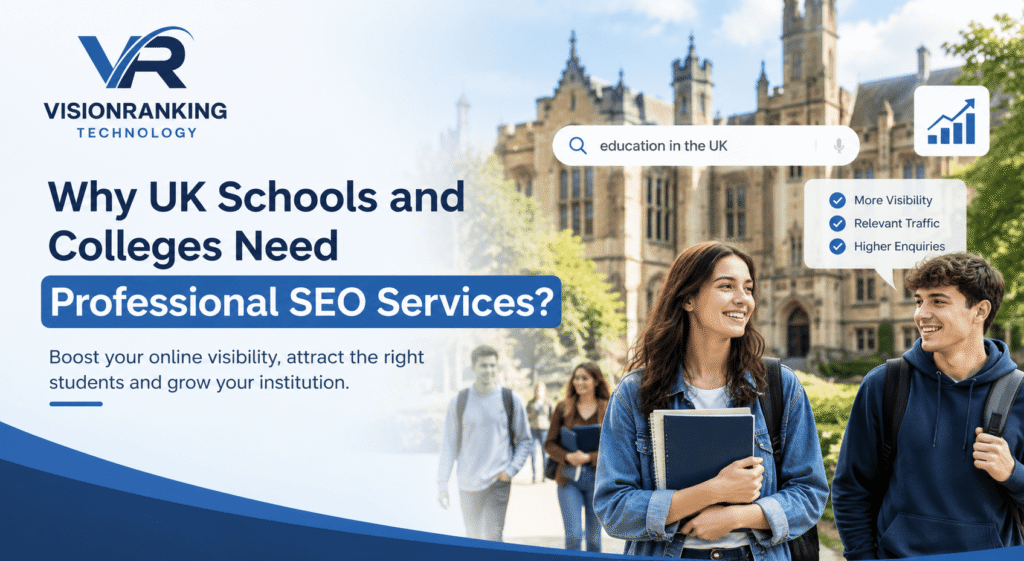
Why UK Schools and Colleges Need Professional SEO Services?
📌 Key Takeaways
- Improve Online Visibility: Professional education SEO services help UK schools and colleges appear in relevant search results and reach prospective students and parents.
- Generate Qualified Enquiries: Targeted keyword research and optimised course pages help attract relevant visitors and encourage admissions enquiries, prospectus requests, and course applications.
- Strengthen Website Performance: Technical SEO, mobile optimisation, and a clear website structure improve accessibility and create a better experience for prospective students.
- Prepare for AI Search: Useful content, accurate information, and clear page structures support visibility across traditional search results and evolving search experiences, including Google AI Overviews.
- Invest in Long-Term Growth: A consistent SEO strategy helps educational institutions build online credibility, monitor performance, and identify opportunities for sustainable growth with support from Vision Ranking.
Schools, colleges, and other educational institutions across the United Kingdom face growing competition when attracting students, increasing enrolments, and building a strong reputation. Parents compare schools online, students research courses through search engines, and adult learners explore colleges before deciding where to study. If your institution does not appear when prospective students search for relevant educational opportunities, you risk losing enquiries to institutions with stronger online visibility.
A well-designed website is an important starting point, but having a website alone does not guarantee that people will find it. Your institution needs a clear search engine optimisation strategy to reach the right audience, communicate its strengths, and turn website visits into meaningful enquiries.
This is where education SEO services become valuable. Professional SEO helps educational institutions improve their visibility in Google Search, attract relevant website traffic, and make important information easier for prospective students and parents to find.
For UK schools and colleges, effective SEO involves more than improving keyword rankings. It includes technical website improvements, course and programme page optimisation, location-based search visibility, useful content, and a straightforward enquiry journey.
At Vision Ranking, we help businesses and organisations strengthen their online presence through strategic SEO. Our education SEO services focus on helping educational organisations reach relevant audiences, improve search visibility, and support long-term business growth.
Whether you manage an independent school, a private college, a vocational training centre, or a professional education provider, the right SEO strategy helps connect your institution with people actively searching for what you offer.
1. Why Do UK Schools and Colleges Need Professional SEO Services?
Choosing an educational institution involves research and comparison. Parents want information about academic standards, facilities, pastoral care, admissions, and school locations. Students want to understand course options, entry requirements, qualifications, fees, and future career opportunities.
Search engines help people find this information. Your website needs to appear for relevant searches and provide convincing answers once visitors arrive.
Professional SEO addresses three important business objectives.
- Improve online visibility: Your institution becomes easier to find for searches related to its courses, educational services, and location.
- Attract relevant enquiries: A targeted SEO strategy focuses on people whose needs match your institution’s programmes and admissions criteria.
- Build confidence before contact: Clear, informative pages help parents, students, and other decision-makers understand what your institution offers before contacting your admissions team.
Consider an independent college in Birmingham offering business, healthcare, and vocational courses. Its website might look professional, but prospective students searching for suitable local courses might not find it.
An education SEO strategy would assess the college’s current search visibility, identify relevant search terms, improve programme pages, address technical issues, and strengthen internal links between related pages.
The objective is to help more suitable prospective students discover the college and take the next step.
If your institution receives website traffic but struggles to generate admissions enquiries, a professional SEO review can help identify the reasons.
Looking to improve your institution’s visibility? Explore Vision Ranking’s services to discuss a strategy aligned with your admissions and growth objectives.
2. How Education SEO Helps Attract More Students
Student recruitment is one of the main reasons educational institutions invest in SEO. However, attracting more visitors alone does not guarantee better enrolment outcomes.
Your website needs to reach people who are genuinely interested in your courses, school, or educational services.
Education SEO helps achieve this by aligning website content with the different ways prospective students and parents search online.
Reach people searching for specific courses
A prospective student might search for a particular qualification, subject, or training programme rather than the name of an institution.
Your course pages need to explain the programme clearly and match the information people want.
Useful page elements include:
- Course name and overview.
- Entry requirements and eligibility.
- Course duration and study format.
- Fees and funding information, where applicable.
- Qualification details and accreditation, where applicable.
- Career pathways and progression opportunities.
- Application deadlines and admissions procedures.
- Contact details and enquiry options.
Not every course page needs the same structure. A school admissions page serves a different purpose from a postgraduate programme page or a professional training course.
An experienced education SEO company assesses these differences when planning content and page optimisation.
Reach parents and students at different stages
Some visitors are exploring educational options for the first time. Others already know which course or school they want and are comparing providers.
Your website should support both groups.
Informational content can explain admissions procedures, subject choices, qualifications, or the differences between available programmes. Commercial pages should communicate the institution’s strengths, course details, and reasons to enquire.
Connecting these pages through relevant internal links helps visitors move naturally from research to consideration and contact.
Generate enquiries from relevant audiences
SEO should support your institution’s wider recruitment objectives.
Depending on your organisation, meaningful conversions might include:
- School admissions enquiries.
- College application enquiries.
- Course prospectus requests.
- Open-day registrations.
- Campus visit bookings.
- Calls to the admissions team.
- Enquiries from international students.
- Requests for corporate training or professional development.
Tracking these actions provides a more useful view of performance than website traffic alone.
For example, a college might receive fewer visits to a specialised training programme page than to its general homepage, but the programme page could generate more relevant enquiries. Measuring both visibility and conversion activity helps the institution understand which pages contribute to recruitment.
3. Which Educational Institutions Benefit From Education SEO?
Education SEO is relevant to organisations with different audiences, locations, and recruitment models. A suitable strategy depends on what you offer and how prospective students make decisions.
| Educational institution | Main SEO priorities | Potential business objective |
| Independent and private schools | School admissions, facilities, location, curriculum and parent enquiries | Increase qualified admissions enquiries |
| Colleges | Course pages, qualifications, subject searches and admissions information | Generate course enquiries and applications |
| Universities and higher education providers | Degree programmes, postgraduate courses, research and international student information | Improve programme visibility and recruitment |
| Vocational training centres | Professional qualifications, training courses, eligibility and practical outcomes | Attract suitable course applicants |
| Online education providers | Course topics, online learning options, qualifications and audience-specific content | Reach learners across the UK |
| Language schools | Language courses, study options, locations and learning objectives | Increase enrolment enquiries |
| Professional training companies | Corporate training, certification programmes and employer-focused content | Generate business and individual training leads |
| Tutoring and supplementary education providers | Subjects, age groups, service areas and tutor expertise | Increase relevant parent and student enquiries |
Each organisation needs a different approach to keyword research, content, and conversion tracking.
For example, a local independent school will benefit from location-specific visibility and detailed admissions information. A nationwide online training provider will need to target relevant course searches across a broader geographical area.
An effective SEO campaign accounts for these differences instead of applying the same template to every educational website.
4. How to Choose the Right Education SEO Keywords
Keyword research helps establish how prospective students, parents, and educational decision-makers search for your services.
The aim is not to insert as many keywords as possible into your website. It is to identify relevant searches and ensure your pages address the underlying needs.
For UK educational organisations, keyword research often includes four categories.
Service and commercial keywords
These searches indicate an interest in a specific educational service or provider.
Examples include:
- Private school admissions in London.
- Business management courses in Manchester.
- Professional training courses in Birmingham.
- Online qualifications in the UK.
- English language courses in Leeds.
These terms need to match the institution’s actual services, locations, and eligibility requirements.
Course-specific keywords
Students often search for a subject, qualification, or learning outcome.
Examples include healthcare courses, engineering qualifications, accounting training, and postgraduate business programmes.
Course-specific keywords help institutions develop focused landing pages that explain the relevant programme.
Location-based keywords
Geographical searches matter when students and parents want an institution within a practical travelling distance.
Examples include private schools in Bristol, colleges in Nottingham, and vocational training providers in Glasgow.
A location page should contain useful information about the institution’s genuine presence and service offering. Creating multiple near-identical location pages without meaningful local value is unlikely to provide a strong foundation for sustainable SEO.
Informational keywords
People often research educational options before they are ready to contact an institution.
They might want to understand entry requirements, application procedures, qualification levels, or course differences.
Informational content gives your institution an opportunity to answer these questions and direct readers towards relevant admissions or course pages.
Why keyword mapping matters
Once the target keywords are identified, each important search theme should be mapped to the most relevant existing or planned webpage.
For example:
| Search theme | Recommended webpage |
| School admissions | Admissions page |
| College business courses | Business course category or programme page |
| Vocational qualifications | Relevant vocational training page |
| International student applications | International admissions page |
| Education SEO services | Education SEO service page |
Keyword mapping reduces unnecessary overlap between pages and makes the website’s structure easier to understand.
Vision Ranking can review your existing website, identify relevant search opportunities, and develop a keyword strategy around your educational services and recruitment priorities.
5. The Importance of Technical SEO for Educational Websites
Even useful content needs a technically accessible website to perform effectively in search results.
Educational websites often contain many pages, including course descriptions, admissions information, departmental pages, staff profiles, news articles, and downloadable documents. Without proper technical management, important pages might remain difficult to discover or index.
Professional technical SEO helps identify issues affecting search visibility and the experience of website visitors.
Important technical SEO considerations
- Crawlability and indexation: Search engines need to access important webpages. Incorrect robots directives, accidental noindex settings, or broken internal links might prevent key pages from appearing in search results.
- Website structure: Course categories, subject pages, admissions information, and contact pages should follow a logical hierarchy. Clear navigation helps visitors and search engines understand the relationship between pages.
- Page speed and mobile usability: Parents and students often access websites on mobile devices. Pages should load efficiently, display correctly, and provide accessible navigation.
- Duplicate content: Similar course descriptions or repeated location pages can create unnecessary overlap. Each important page should have a clear purpose and provide information relevant to its audience.
- Broken links and redirects: Outdated course URLs and broken links create poor experiences. Appropriate redirects and updated internal links help preserve a consistent journey through the website.
- XML sitemap and canonical tags: These technical elements help communicate information about preferred URLs and important pages to search engines when implemented correctly.
- Structured data: Relevant structured data can help search engines interpret eligible information about an organisation, its webpages, and other supported entities. Implementation should reflect the actual content and follow applicable search engine guidelines.
A technical SEO audit helps prioritise these issues according to their potential impact.
For example, if a college has redesigned its website and changed dozens of course URLs without suitable redirects, visitors following old links might encounter errors. Search engines might also need time to process the changed URLs.
Identifying and correcting these issues is an important part of maintaining search visibility.
Explore Vision Ranking’s technical SEO services if your educational website needs a deeper review of crawlability, indexation, site structure, or other technical issues.
6. Why High-Quality Content Matters for Education SEO
Educational decisions often involve significant commitments of time, money, and effort. Parents and students need reliable information before choosing an institution.
Your website content should answer their questions accurately and explain what makes your organisation suitable for their needs.
Thin descriptions, generic promotional statements, and repetitive articles rarely communicate enough value to support these decisions.
Build useful course and admissions pages
Every important programme should have a page that explains its purpose, audience, requirements, and practical details.
For example, a professional training provider offering project management qualifications should clearly explain the intended learners, entry requirements, course format, certification details, and application process.
This gives prospective students a clearer basis for deciding whether the course meets their needs.
Address common questions
Admissions teams often answer the same questions repeatedly.
Your website can address common concerns about:
- Application deadlines.
- Course entry requirements.
- Available qualifications.
- Learning formats.
- Fees and payment arrangements.
- International student eligibility.
- Campus facilities.
- Assessment and progression.
Publishing accurate answers improves the usefulness of your website and helps visitors find relevant information before contacting the institution.
Demonstrate experience and credibility
Educational websites should communicate trust through verifiable information.
Depending on the institution, useful trust signals include:
- Staff qualifications and professional experience.
- Recognised accreditation or awarding-body information.
- Genuine student testimonials published with appropriate permission.
- Accurate details about facilities and learning resources.
- Published course outcomes supported by evidence.
- Clear admissions policies and contact information.
- Relevant case studies and student experiences.
Claims about qualifications, accreditation, graduate outcomes, or employment prospects should be accurate and appropriately supported.
Keep information current
Outdated course fees, application deadlines, programme details, and staff information can confuse prospective students.
A content review process helps ensure that important pages reflect the institution’s current offering.
Professional education SEO combines content planning with ongoing optimisation, helping your institution maintain useful, relevant information as its programmes and recruitment priorities change.
7. Local SEO for Schools, Colleges, and Training Centres
Local SEO is particularly important for educational institutions that attract students from nearby towns, cities, and communities.
Parents might search for independent schools near their home, while adults looking for professional qualifications might prefer a training centre within commuting distance.
Local visibility helps your institution appear for relevant geographical searches and gives prospective visitors practical information about your location.
Optimise your Google Business Profile
Eligible educational organisations with a physical presence should maintain accurate business information on their Google Business Profile.
Important details include:
- Correct institution name.
- Accurate address and contact details.
- Appropriate business category.
- Current opening hours where applicable.
- Website URL.
- Relevant photographs.
- Accurate service information.
- Genuine reviews and appropriate responses.
The available profile features and eligibility requirements depend on the type of educational organisation.
A school, university, tutoring centre, and online-only education provider do not necessarily qualify for the same profile setup. The strategy should reflect Google’s applicable guidelines.
Strengthen location-specific pages
If your institution operates across multiple campuses or has several genuine locations, each relevant location page should provide useful information about that particular site.
Include accurate contact details, available programmes, campus facilities, transport information where relevant, and appropriate directions.
Avoid publishing multiple pages with almost identical content simply to target nearby towns.
Build local relevance and trust
Relevant local partnerships, community participation, educational events, and genuine mentions from reputable organisations can help strengthen an institution’s wider online presence.
Local SEO should support the institution’s actual activities rather than rely on artificial listings or irrelevant links.
For schools and colleges competing for local admissions, these improvements provide a stronger foundation for attracting relevant visitors.
8. Preparing Educational Websites for Google AI Overviews and Conversational Search
Search behaviour continues to evolve. Alongside traditional search results, users increasingly encounter AI-generated summaries and conversational search experiences when researching questions and services.
For educational organisations, this creates additional reasons to maintain accurate, useful, well-structured website content.
A parent might ask a conversational search tool about school admissions requirements. A student might ask which qualifications are relevant to a particular career. Another visitor might compare different types of professional training.
Your website should provide clear, reliable information that addresses these questions.
What does AI search readiness involve?
AI search readiness builds on established SEO practices rather than replacing them.
Important areas include:
- Clear answers: Explain admissions procedures, course requirements, fees, qualifications, and programme details in direct language.
- Useful page structure: Use descriptive headings, logical sections, and relevant internal links so readers can find information easily.
- Accurate information: Keep course details, policies, contact information, and institutional claims up to date.
- Technical accessibility: Ensure important pages are accessible to search engine crawlers and eligible for indexing.
- Evidence of expertise: Publish accurate information about staff, qualifications, programmes, and the institution’s educational approach.
- Consistent institutional information: Maintain accurate details across the website and relevant public profiles.
These practices support both conventional organic search and the broader effort to make your content understandable across different search experiences.
Google’s official guidance confirms that established SEO fundamentals, including useful content and technical accessibility, remain relevant to its generative AI search features. However, following best practices does not guarantee inclusion in AI Overviews or any particular AI-generated answer.
Where AEO and GEO fit into the strategy
Answer Engine Optimisation (AEO) focuses on helping content address users’ questions clearly. Generative Engine Optimisation (GEO) refers to work intended to improve visibility across generative AI search experiences.
For educational institutions, both concepts reinforce the importance of accurate, relevant content and a technically accessible website.
However, no agency should promise that a specific page will appear in every AI answer. Visibility depends on multiple factors, and results vary across queries and platforms.
Vision Ranking approaches SEO, AEO, and GEO as complementary elements of a broader search visibility strategy, with an emphasis on useful content, sound technical foundations, and measurable business objectives.
9. Common Education SEO Mistakes That Limit Enquiries
An educational website might have useful programmes and a strong reputation but still struggle to attract enquiries from search engines.
Several common mistakes contribute to this problem.
Mistake 1: Targeting broad keywords without considering intent
A college might target a broad term such as education without considering whether searchers want school information, teaching resources, university programmes, or training services.
Keyword selection should reflect the actual audience and the institution’s offering.
Mistake 2: Using the same content across multiple course pages
Similar descriptions make it difficult for prospective students to understand the differences between programmes.
Each page should explain its own course details, intended audience, requirements, and benefits.
Mistake 3: Ignoring the admissions journey
Some websites focus on attracting traffic but provide no clear next step.
Visitors should be able to find admissions information, request a prospectus where available, contact the relevant department, or begin an application without unnecessary difficulty.
Mistake 4: Publishing content without a clear strategy
Regular blog publishing does not automatically produce useful search traffic or qualified enquiries.
Content topics should relate to prospective students’ needs and support important course, admissions, and service pages through relevant internal links.
Mistake 5: Neglecting mobile usability
Complicated menus, slow-loading pages, difficult forms, and unreadable text create unnecessary barriers for mobile visitors.
A mobile usability review helps identify problems that interfere with browsing and enquiries.
Mistake 6: Measuring rankings without measuring conversions
Keyword rankings provide useful information, but they do not tell the entire story.
An institution should also monitor organic enquiries, prospectus requests, application starts, relevant landing pages, and other meaningful conversion events.
Mistake 7: Expecting immediate results
SEO involves technical improvements, content development, search engine processing, and ongoing evaluation. Results vary according to competition, website condition, location, and the work required.
Treating SEO as a long-term investment leads to more realistic planning than expecting guaranteed rankings within a fixed period.
Need help identifying these issues? Request an SEO review from Vision Ranking to understand which improvements deserve priority on your educational website.
10. How Vision Ranking Approaches Education SEO
An effective education SEO campaign starts with understanding the institution, its audience, and its business objectives.
Vision Ranking provides SEO services for organisations seeking to strengthen their search visibility and attract relevant visitors. Our approach focuses on building a strategy around your website’s existing performance, target audience, and growth priorities.
Step 1: Website and SEO audit
We review your website to identify technical issues, content gaps, internal linking opportunities, and areas requiring further investigation.
The audit helps establish a practical starting point for the campaign.
Step 2: Keyword research and search intent analysis
We identify relevant search terms associated with your educational services, programmes, target locations, and audience needs.
Keyword mapping helps connect each priority search theme to the most appropriate webpage.
Step 3: On-page optimisation
We review important elements such as:
- SEO titles and meta descriptions.
- Heading structure.
- Page content and keyword relevance.
- Internal links.
- Image optimisation.
- Canonical tags and indexing directives, where relevant.
- Suitable structured data.
- Calls to action and enquiry pathways.
Recommendations are prioritised according to the website’s requirements and campaign objectives.
Step 4: Content planning and development
We identify opportunities to improve existing pages and develop new content where a genuine audience need exists.
Depending on the institution, this might include course pages, admissions information, location pages, subject resources, and articles addressing common questions.
The goal is to make the website more useful to prospective students while supporting relevant search visibility.
Step 5: Authority and local visibility
Where appropriate, the campaign can include relevant link-building activities, local SEO improvements, Google Business Profile optimisation for eligible organisations, and other activities that strengthen online visibility.
Any external promotion should remain relevant to the institution and support a sustainable SEO strategy.
Step 6: Performance monitoring and reporting
We review performance indicators such as organic impressions, clicks, keyword visibility, landing-page traffic, and recorded conversions where tracking is available.
The findings inform future priorities and help assess whether the campaign is contributing to the institution’s objectives.
For UK organisations seeking a broader market-focused strategy, explore Vision Ranking’s SEO services in the United Kingdom.
11. Business Benefits of Investing in Education SEO
A well-planned education SEO strategy supports several business objectives.
| Business benefit | How SEO contributes |
| Better search visibility | Helps relevant webpages compete for searches associated with the institution’s programmes and services |
| More relevant website traffic | Connects content with the needs and search intent of prospective students and parents |
| Improved enquiry opportunities | Directs visitors towards admissions pages, prospectus requests, course enquiries, and other relevant actions |
| Stronger institutional credibility | Provides clear programme details, staff information, accurate policies, and useful educational content |
| Greater local discoverability | Supports visibility for relevant geographical searches and eligible local business profiles |
| Improved website experience | Identifies navigation, technical, content, and conversion barriers |
| Better long-term planning | Performance data helps inform future content, technical, and marketing priorities |
| Broader search readiness | Applies established SEO principles to conventional search and relevant AI search experiences |
SEO should be assessed in the context of the institution’s recruitment model and wider marketing activities.
For example, a private school might prioritise admissions enquiries and open-day registrations. A vocational training company might focus on course enquiries from eligible learners. A university department might measure engagement with specific programme pages and application journeys.
The right performance indicators depend on the organisation.
SEO also requires continued investment in monitoring, maintenance, and improvement. Search visibility can change as competitors update their websites, search behaviour evolves, and programmes or admissions requirements change.
A professional SEO partner helps your organisation respond to these developments through planned work rather than isolated changes.
12. Common Red Flags When Choosing an Education SEO Company
Selecting an SEO agency is an important decision. Your institution needs a partner that understands your objectives, communicates clearly, and explains its recommendations.
Be cautious of agencies that:
- Guarantee first-page rankings for every target keyword.
- Promise immediate enrolment increases without reviewing your website.
- Offer vague reports without explaining completed work.
- Recommend large volumes of irrelevant backlinks.
- Publish generic content without understanding your programmes.
- Avoid explaining their technical recommendations.
- Claim guaranteed placement in Google AI Overviews or AI-generated answers.
- Focus exclusively on keyword rankings while ignoring enquiries.
- Refuse to explain how campaign performance is measured.
Google advises website owners to evaluate third-party SEO providers carefully and remain cautious of unrealistic promises. Its guide to hiring an SEO explains important considerations when choosing a professional service.
A credible agency should explain what it plans to do, why the work matters, how progress will be monitored, and which factors remain outside its control.
13. Questions to Ask Before Hiring an Education SEO Agency
Before committing to an SEO campaign, ask questions that help establish whether the agency understands your institution and has a practical approach.
1. How will you identify relevant keywords for our institution?
The agency should explain how it evaluates search intent, course relevance, location, and audience requirements.
2. Will you review our existing website before recommending changes?
An initial review helps identify the site’s current strengths, technical problems, and content opportunities.
3. How will you prioritise our course and admissions pages?
The agency should explain how important landing pages will be selected and how they relate to your recruitment objectives.
4. How will you measure qualified enquiries?
Discuss conversion tracking, enquiry forms, prospectus requests, application starts, and other relevant actions.
5. What technical SEO issues will you investigate?
Ask about crawlability, indexation, site structure, mobile usability, redirects, and other relevant technical factors.
6. How will you support local search visibility?
For institutions with physical locations, discuss location pages, Google Business Profile eligibility, and local search opportunities.
7. How will you approach AI search visibility?
Look for an explanation grounded in useful content, technical accessibility, and established SEO principles rather than guaranteed AI placements.
8. How frequently will you report progress?
Agree on reporting frequency, performance indicators, completed work, and the next priorities.
9. What results should we realistically expect?
A professional agency should discuss the factors affecting performance and explain that rankings, traffic, and enquiries are not guaranteed.
10. How will the strategy change as our institution grows?
Your SEO priorities might change when you launch new courses, expand to another location, target international students, or revise your admissions model.
The answers should help you evaluate whether the agency offers a structured, transparent service aligned with your institution’s goals.
14. Why Choose Vision Ranking for Education SEO Services?
Educational organisations need an SEO partner that understands the relationship between online visibility, useful content, website performance, and business objectives.
Vision Ranking helps organisations develop SEO strategies based on their websites, target audiences, and growth priorities.
Our approach focuses on practical improvements rather than unsupported promises.
A strategy aligned with your objectives
We assess your website and target audience before prioritising SEO activities. The strategy should reflect whether your organisation wants to increase admissions enquiries, attract learners to specific courses, improve local visibility, or reach a broader UK audience.
Technical and on-page SEO support
We identify relevant technical issues and on-page opportunities to improve how important webpages are structured, accessed, and presented in search results.
Content that addresses real audience needs
We focus on relevant content that explains your services, answers common questions, and supports prospective students during their research.
A broader approach to search visibility
Traditional SEO remains central to our approach. Where appropriate, we also consider AEO, GEO, and visibility across AI-powered search experiences.
These activities support a broader search strategy without promising specific rankings or AI-generated placements.
Performance-focused reporting
Reporting should help you understand what has changed, which pages are attracting relevant visitors, and where further improvements are needed.
Where suitable conversion tracking is in place, we also assess the actions visitors take after arriving on the website.
A long-term working relationship
Educational organisations need ongoing support as courses change, admissions periods approach, and search competition evolves.
Vision Ranking aims to build a working relationship around clear priorities, regular communication, and continued improvement.
Learn more about our education SEO services and discuss how a tailored strategy might support your institution.
15. What Results Should UK Schools and Colleges Expect From SEO?
SEO results depend on the institution’s current website, target keywords, competition, content quality, technical condition, and the resources available to implement recommendations.
Some technical improvements address clear problems quickly. Improvements in organic rankings, website traffic, and qualified enquiries often require continued work and monitoring.
A realistic campaign should establish a baseline before setting performance targets.
Early campaign priorities
During the initial stage, the focus often includes:
- Understanding existing search visibility.
- Identifying technical issues.
- Reviewing important course and admissions pages.
- Establishing keyword priorities.
- Checking conversion tracking.
- Planning content improvements.
These activities establish the foundation for future optimisation.
Ongoing optimisation
As the campaign progresses, the focus shifts towards implementing recommendations, improving content, strengthening internal links, and monitoring changes in search performance.
The agency should review which pages are gaining visibility, where visitors are engaging, and which opportunities require further attention.
Measuring business impact
Useful performance indicators include:
- Organic impressions and clicks.
- Rankings for relevant search terms.
- Traffic to priority course pages.
- Admissions and course enquiry submissions.
- Prospectus requests and open-day registrations.
- Organic conversion rate.
- Qualified leads, where reliable tracking is available.
An increase in impressions without a corresponding increase in enquiries might indicate that the institution needs to improve search intent alignment, landing-page content, or conversion pathways.
Similarly, strong rankings for irrelevant searches might create traffic without supporting enrolment objectives.
The main goal is to build sustainable search visibility that contributes to meaningful business outcomes. Vision Ranking works towards this goal through planned optimisation, relevant content, technical improvements, and performance monitoring.
Frequently Asked Questions About Education SEO Services
1. What are education SEO services?
Education SEO services involve improving an educational organisation’s website to strengthen its visibility in relevant search results. The work typically includes keyword research, technical SEO, on-page optimisation, content development, local SEO, internal linking, and performance monitoring. The strategy depends on the institution’s audience, programmes, and recruitment objectives.
2. Why do schools and colleges need SEO?
SEO helps schools and colleges reach people searching for relevant educational opportunities. It improves the chances of prospective students and parents finding important information about programmes, admissions, facilities, and locations. A well-planned strategy also helps institutions direct relevant visitors towards enquiries, applications, and other recruitment actions.
3. How much do education SEO services cost in the UK?
The cost depends on the size of the website, the number of programmes and locations, the level of competition, the technical work required, and the scope of ongoing support. A smaller training provider might need a more focused campaign than a large college with numerous departments. Request a tailored proposal based on your institution’s requirements.
4. How long does SEO take to show results for educational websites?
The timeline varies according to the website’s existing condition, competition, target keywords, and implementation speed. Some technical improvements address identifiable problems early, while meaningful changes in rankings, traffic, and enquiries often require sustained work. An SEO provider should establish baseline measurements and review progress regularly rather than guarantee a fixed timeline.
5. What is the difference between education SEO and general SEO?
Both approaches use established SEO principles, including keyword research, technical optimisation, content improvement, and performance analysis. Education SEO applies these principles to educational audiences and their specific needs, such as admissions, course requirements, qualifications, campus locations, and student recruitment.
6. Can SEO help a local school attract more admissions enquiries?
Yes. Local SEO helps eligible schools improve their visibility for relevant location-based searches. Optimising important admissions pages, maintaining accurate public information, improving mobile usability, and providing clear enquiry options can support the admissions journey. Actual results depend on local competition, search demand, and the school’s website.
7. Do educational institutions need a separate webpage for every course?
A dedicated page is useful when a course has distinct information, search demand, requirements, or an application journey. However, creating a separate page for every minor variation is not always necessary. The website structure should reflect the actual programme offering and help visitors find accurate, relevant information without unnecessary duplication.
8. How does SEO support Google AI Overviews and other AI search experiences?
SEO helps maintain the technical accessibility, content quality, and clear structure that search systems use to discover and understand webpages. Accurate course information, useful answers, descriptive headings, and sound technical foundations support broader search readiness. However, no agency can guarantee that a website will appear in a particular AI-generated response.
9. How do you measure the success of an education SEO campaign?
Success can be assessed through organic impressions, clicks, keyword visibility, traffic to priority pages, and relevant conversion actions. Depending on the institution, conversions might include admissions enquiries, prospectus requests, open-day registrations, or course applications. Combining search performance with reliable conversion tracking gives a more useful picture of business impact.
10. How do we get started with Vision Ranking?
Start by sharing your website URL, the programmes or educational services you want to promote, your target UK locations, and your main recruitment objectives. Vision Ranking can review these requirements and discuss suitable SEO priorities. The next step is to establish the scope of work and agree on a practical plan for improving your online visibility.
Conclusion: Strengthen Your Institution’s Online Visibility With Education SEO
Schools, colleges, training centres, and other educational organisations need a strong online presence to reach prospective students and parents.
A professional SEO strategy helps your institution improve its visibility for relevant searches, communicate programme information clearly, address technical website issues, and provide a more straightforward route from discovery to enquiry.
The strongest approach connects keyword research, technical SEO, useful content, local visibility, and conversion tracking with your institution’s recruitment objectives. It also prepares your website for evolving search experiences, including Google AI Overviews, without relying on unsupported promises.
For UK educational organisations, SEO is a long-term investment in discoverability and sustainable digital growth. Regular monitoring and ongoing optimisation help keep your website aligned with changing programmes, audience needs, and search behaviour.
Vision Ranking is ready to help your institution plan its next steps.
If your school, college, or education business wants to attract more relevant visitors and improve its search visibility, speak with our team about a strategy tailored to your objectives.
Explore our education SEO services or our SEO services in the United Kingdom to discuss your requirements.
Request an SEO consultation to review your website, identify opportunities, and establish the priorities for your next campaign.