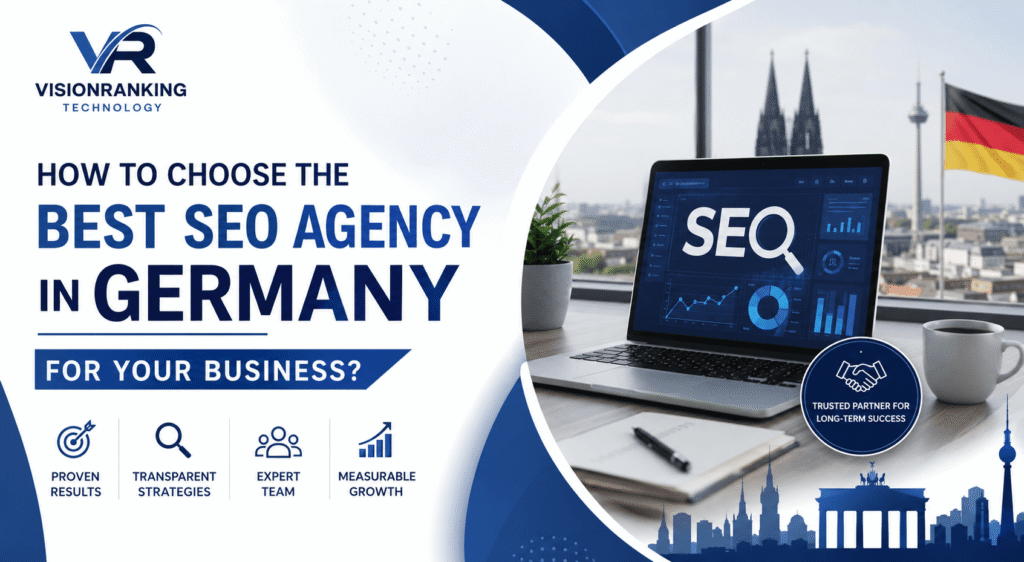
How to Choose the Best SEO Agency in Germany for Your Business?
📌 Key Takeaways
- Choose an SEO agency based on your business objectives, target market, website requirements, and industry rather than rankings alone.
- Germany-focused SEO requires attention to German search intent, language quality, regional demand, competition, and market-specific customer behaviour.
- A strong SEO strategy should combine technical SEO, content, on-page optimisation, authority development, conversion considerations, and measurement.
- Modern search visibility also includes AI-generated answers, AI Overview results, brand visibility, structured information, and other evolving search experiences.
- Before signing an agreement, evaluate the agency’s expertise, reporting, communication, deliverables, transparency, contract terms, and ability to connect SEO activity with business outcomes.
Choosing the right SEO agency can have a direct impact on how easily your business is discovered by potential customers online. However, selecting an SEO partner is not simply about finding a company that promises higher rankings or more website traffic.
Businesses operating in Germany can have very different SEO requirements depending on their industry, target audience, location, website structure, competition, language requirements, and business objectives. A local service business may need a strong local SEO strategy, while a B2B company may require industry-focused content and commercial landing pages. An e-commerce business may need technical SEO and product-page optimisation, while an international company may require a broader multilingual and international SEO strategy.
The best SEO agency in Germany for one business may not necessarily be the right choice for another.
The more important question is whether an SEO agency understands your business, target market, website, customers, search behaviour, and commercial objectives well enough to build a strategy around them.
This guide explains what businesses should evaluate before choosing an SEO agency in Germany, what questions to ask during the selection process, what warning signs to look for, and how to determine whether an agency’s approach is aligned with your long-term growth objectives.
What Should You Look for in an SEO Agency in Germany?
Before contacting an SEO company in Germany, establish what you actually want SEO to accomplish.
Your objectives could include:
- Generating more qualified website traffic
- Increasing enquiries and leads
- Improving visibility for commercial searches
- Increasing online sales
- Reaching customers in specific German cities or regions
- Improving visibility for German-language searches
- Expanding into additional markets
- Improving technical website performance
- Strengthening brand visibility in search
- Increasing visibility across emerging AI search experiences
Once your objectives are clear, it becomes easier to compare different SEO agencies.
An agency that mainly focuses on keyword rankings may not be suitable if your primary objective is qualified leads. Similarly, an agency specialising in local SEO may not have the right capabilities for a large international e-commerce website.
The right SEO partner should first understand what your business needs to achieve and then determine which SEO activities can support those goals.
1. Start With Your Business Goals
SEO should support your wider business strategy rather than operate as a separate marketing activity.
Before selecting an agency, consider what you want your website to achieve over the coming months.
For a local business in Germany, objectives could include:
- More local enquiries
- Increased visibility in relevant locations
- More calls and website visits
- Stronger visibility for service-related searches
- Improved Google Business Profile visibility
For an e-commerce business, the focus may include:
- Increasing visibility for important product categories
- Improving product-page performance
- Increasing qualified organic traffic
- Supporting online revenue
- Improving transactional search visibility
For a B2B company, priorities may include:
- Reaching decision-makers
- Increasing visibility for commercial searches
- Generating qualified enquiries
- Building industry-specific topical authority
- Improving important product and service pages
For an international company, SEO may involve:
- Country-specific search visibility
- German-language optimisation
- International website architecture
- Localised content
- International technical SEO
- Hreflang implementation
Why Business Goals Matter
Suppose an industrial equipment company receives thousands of visitors from broad informational searches but very few enquiries.
Increasing traffic alone may not solve the underlying business problem.
The SEO strategy may instead need to focus on commercial product searches, product and service pages, technical content, internal linking, conversion paths, and relevant search intent.
This is why an SEO agency should not begin with keywords alone. It should understand the relationship between search visibility, website experience, customer intent, and business outcomes.
2. Check Whether the Agency Understands the German Market
Germany should not simply be treated as another location added to an international SEO campaign.
Businesses targeting German customers need to consider language, search intent, regional demand, competition, customer expectations, and the way products and services are searched for in the market.
German-language SEO is particularly important when the primary audience searches in German.
Simply translating English content into German does not automatically create effective German SEO content. Content should reflect the terminology, intent, context, and expectations of the intended audience.
When evaluating an agency, ask:
- How do you research German search intent?
- How do you conduct German keyword research?
- How do you approach German-language content?
- How do you handle regional SEO?
- How do you identify commercially valuable searches?
- How do you research the competitive landscape?
- How do you approach businesses targeting Germany and other countries?
- How do you adapt content for German-speaking audiences?
The answers can reveal whether an agency has a structured approach to Germany-focused SEO rather than simply applying a generic international template.
3. Review the SEO Strategy Before Signing
A professional SEO agency should be able to explain the major areas it intends to investigate and improve.
You do not necessarily need a lengthy strategy document before beginning an engagement. However, you should understand what the agency will work on, why those areas matter, how progress will be measured, and how the work connects to your business objectives.
A comprehensive SEO campaign may include several areas.
Technical SEO
Technical SEO provides the foundation for search engines to discover, understand, crawl, and index important website pages.
Depending on the website, technical work may include:
- Crawlability
- Indexation
- Website architecture
- Internal linking
- Canonicalisation
- Redirects
- XML sitemap optimisation
- Robots.txt
- Structured data
- Mobile usability
- Page performance
- Duplicate content
- Thin content
- Website errors
- JavaScript-related SEO issues
Technical SEO should not be treated as a one-time checklist. Website changes, new content, migrations, development updates, and search engine changes can create new technical requirements over time.
Content Strategy
Content should be created around actual search intent and business priorities rather than simply publishing a large number of articles.
A strong content strategy may consider:
- Search intent
- Keyword relevance
- Customer questions
- Topic coverage
- Commercial opportunities
- Existing content quality
- Content gaps
- Internal linking opportunities
- Competitor search visibility
- Industry expertise
- Conversion opportunities
For businesses targeting Germany, content quality also includes natural and audience-appropriate German language where German-language search visibility is a priority.
On-Page SEO
On-page optimisation can include:
- Page titles
- Headings
- Meta descriptions
- Content structure
- Internal links
- Image optimisation
- URLs
- Entity relevance
- Topical relevance
- Structured information
- Search-intent alignment
The objective should not be to insert keywords repeatedly.
Instead, on-page SEO should help search engines understand the purpose and relevance of a page while providing a clear and useful experience for visitors.
Authority Development
Depending on the industry and competitive environment, SEO may also involve earning relevant mentions and links from credible websites.
However, businesses should look beyond the number of backlinks an agency promises.
Important considerations include:
- Relevance
- Quality
- Context
- Editorial value
- Industry alignment
- Sustainable acquisition practices
A large number of irrelevant links does not necessarily create meaningful authority for a business.
4. Evaluate the Agency’s Technical SEO Expertise
Technical SEO can become particularly important when a website is large, complex, multilingual, e-commerce based, or frequently updated.
Before choosing an SEO agency, ask how it identifies technical problems and how technical recommendations are prioritised.
An agency should be able to investigate issues such as:
- Indexation problems
- Crawl inefficiencies
- Duplicate URLs
- Canonical issues
- Redirect chains
- Broken internal links
- Sitemap problems
- Website architecture
- Mobile usability
- Page performance
- Structured data
- International SEO implementation
More importantly, the agency should be able to explain why a technical issue matters to your website and what business or search visibility impact it may have.
A technical audit is most valuable when it leads to prioritised recommendations and implementation rather than becoming a document that is never acted upon.
5. Ask How the Agency Measures SEO Success
One of the most important questions to ask an SEO agency is:
How will you measure success?
A useful reporting framework should connect SEO metrics with business objectives.
Depending on the campaign, relevant measurements may include:
- Organic traffic
- Search impressions
- Click-through rate
- Keyword visibility
- Relevant ranking movements
- Organic leads
- Organic conversions
- Revenue
- Important landing-page performance
- Indexed pages
- Technical improvements
- Search visibility trends
- AI search visibility where relevant
No single metric provides the complete picture.
For example, an increase in organic traffic may look positive, but if the additional visitors are not relevant to the business and do not generate enquiries or sales, the commercial impact may be limited.
The important question is not simply:
“How many keywords are ranking?”
It is:
“Is SEO increasing relevant visibility and helping the business achieve its objectives?”
6. Look Beyond Keyword Rankings
Keyword rankings remain an important SEO measurement, but they should not be treated as the only indicator of performance.
A website can rank for hundreds of keywords without generating meaningful business results.
A more complete customer journey looks like:
Search → Visibility → Click → Relevant Page → Engagement → Enquiry or Purchase
This means an SEO agency should understand more than ranking positions.
It should also consider:
- Search intent
- Landing-page relevance
- Content quality
- User experience
- Conversion paths
- Lead-generation opportunities
- Commercial search visibility
If an agency talks almost exclusively about ranking positions but rarely discusses traffic quality, conversions, landing pages, or business objectives, ask how its work will contribute to your actual goals.
7. Evaluate the Agency’s Content Approach
Publishing large quantities of generic content is not the same as building search visibility.
Before hiring an agency, ask:
How do you decide what content to create?
A strong answer should go beyond search volume.
Content planning may consider:
- Search intent
- Commercial relevance
- Customer questions
- Existing search results
- Content gaps
- Product and service relevance
- Industry expertise
- Internal linking
- Conversion opportunities
- Existing website authority
For German audiences, language quality is also important.
Content should sound natural to the intended audience rather than read like direct machine translation.
The strongest content strategy connects what people search for with what the business actually provides.
8. Consider AI Search and Modern Search Visibility
Search behaviour continues to evolve.
Users may now encounter information through traditional organic results as well as AI-generated answers, AI Overview results, featured search features, structured information, and other search experiences.
This does not make traditional SEO irrelevant.
Instead, it increases the importance of having useful, well-structured, trustworthy, and clearly organised information across the website.
When evaluating an SEO agency, ask how its strategy considers:
- Search intent
- Helpful and useful content
- Entity understanding
- Brand visibility
- Structured information
- Content relationships
- Featured search results
- AI-generated answers
- AI Overview visibility
- Emerging search experiences
A modern SEO strategy should not chase every new trend. It should build a strong search foundation while adapting to how people discover and consume information.
For businesses already receiving visibility in AI Overview results or other AI-generated search experiences, this can also become an important area for monitoring and ongoing optimisation.
9. Check the Agency’s Experience With Your Type of Business
SEO requirements can differ significantly between industries and website models.
Local Business
Potential priorities may include:
- Local landing pages
- Google Business Profile optimisation
- Location relevance
- Reviews
- Local content
- Service-area targeting
E-commerce Business
Potential priorities may include:
- Category architecture
- Product-page optimisation
- Product schema
- Internal linking
- Faceted navigation
- Crawl management
- Transactional search visibility
B2B Business
Potential priorities may include:
- Commercial landing pages
- Industry-specific content
- Product and service pages
- Decision-maker focused content
- Lead-generation journeys
- Expertise-focused resources
International Business
Potential priorities may include:
- Country targeting
- Language architecture
- International keyword research
- Hreflang
- Localised content
- International technical SEO
The important point is that an agency should adapt its strategy to your business rather than forcing every client into the same SEO package.
10. Evaluate Communication and Transparency
SEO is generally an ongoing process, so communication can have a significant impact on the working relationship.
Before signing an agreement, ask:
- Who will manage the account?
- Who will actually work on the SEO campaign?
- How frequently will communication take place?
- How quickly are questions normally addressed?
- Will important recommendations be explained?
- Can you review major website changes?
- How will completed work be documented?
- What happens if performance is slower than expected?
Technical expertise is valuable, but the agency should also be able to explain technical recommendations in language that business decision-makers can understand.
You should know:
What was done?
Why was it done?
What changed?
What happens next?
11. Review the Reporting Process
SEO reporting should make performance easier to understand rather than simply provide a large collection of numbers.
Before choosing an agency, ask:
- How often will reports be provided?
- Which metrics will be included?
- Will completed work be documented?
- Will technical recommendations be explained?
- Will keyword trends be shown?
- Will traffic and conversion data be reviewed?
- How will important changes be communicated?
- Will the strategy be adjusted based on performance?
A useful report should provide context.
For example, rather than simply saying that rankings changed, the report should help explain which pages and search terms changed, what work was completed, and what the next priorities are.
12. Compare Value, Scope, and Pricing
SEO pricing can vary considerably depending on website size, competition, market, industry, technical requirements, content needs, and the amount of ongoing work.
A lower monthly price does not automatically mean better value.
Likewise, a higher price does not automatically mean better SEO.
Instead, compare:
- Strategy
- Technical SEO
- Content support
- On-page optimisation
- Reporting
- Communication
- Expertise
- Authority development
- Analytics
- Conversion considerations
- Expected workload
- Contract terms
- Measurement framework
For example, one proposal may include technical auditing, content strategy, on-page optimisation, reporting, and ongoing consultation, while another may primarily provide a fixed number of articles and backlinks.
These are not directly comparable services.
Ask each agency exactly what is included and how the proposed activities support your business objectives.
13. Watch for SEO Red Flags
Understanding what to avoid can help businesses reduce the risk of entering an unsuitable SEO partnership.
Guaranteed Number-One Rankings
Search performance depends on competition, website quality, search behaviour, algorithm changes, and other factors.
Be cautious when an agency guarantees specific ranking positions.
Extremely Cheap Packages With Huge Promises
If an agency promises extensive technical work, large amounts of content, hundreds of links, and guaranteed rankings for an unusually low fee, ask how the work will realistically be delivered.
Secretive Strategies
You do not need to know every operational detail, but an agency should be able to explain its major activities and reasoning.
Poor-Quality Link Building
Large numbers of irrelevant or low-quality links may provide little meaningful value.
Keyword Stuffing
Repeatedly inserting awkward keyword variations can reduce readability and create a poor user experience.
No Clear Reporting
If you cannot understand what an agency is doing, what has been completed, and how performance is measured, clarify the reporting process before committing to a long-term agreement.
14. Ask About the SEO Specialist Working on Your Account
An agency’s overall capabilities are important, but the people working on your campaign also matter.
Ask how the SEO specialist or team approaches:
- Technical audits
- Keyword research
- Search-intent analysis
- Content planning
- Competitor research
- Local SEO
- International SEO
- Analytics
- On-page optimisation
- Website migrations
- Performance monitoring
The objective is not to test someone with technical questions.
Instead, look at whether they can explain why a particular recommendation is appropriate for your business.
A strong SEO approach should be based on evidence, website data, search behaviour, and business priorities rather than applying the same checklist to every website.
15. Create an SEO Agency Evaluation Framework
When comparing agencies, create a simple framework based on your actual requirements.
| Evaluation Factor | What to Check |
| Industry understanding | Experience with your business model and market |
| Germany SEO expertise | Understanding of German search intent and audience |
| Technical SEO | Ability to identify and resolve technical issues |
| Content strategy | Search intent, topical relevance and commercial value |
| On-page SEO | Optimisation of important website pages |
| Local SEO | Ability to target cities, regions and local customers |
| International SEO | Experience with multilingual and multi-country websites |
| AI search visibility | Approach to AI Overview and emerging search experiences |
| Reporting | Clear and meaningful performance reporting |
| Communication | Accessibility and clarity |
| Transparency | Clear explanation of work and recommendations |
| Measurement | Connection between SEO and business objectives |
| Contract | Clear scope, terms and cancellation conditions |
This framework does not automatically determine which agency is right for your business.
Instead, it helps you compare providers according to the requirements that actually matter to your organisation.
How Vision Ranking Can Support Businesses Targeting Germany
Businesses looking for SEO services in Germany need more than a list of keywords or a standard monthly SEO package.
The campaign should begin with understanding the website, business objectives, target audience, search opportunities, technical condition, competition, and areas where additional search visibility can contribute to business growth.
Vision Ranking provides SEO-focused services that can cover areas such as:
- SEO strategy
- Technical SEO
- On-page SEO
- Keyword research
- Content strategy
- Local SEO
- International SEO
- Website optimisation
- AI search visibility
- AI Overview visibility
- Search performance monitoring
- SEO reporting
The exact priorities should depend on the website and business requirements.
For a business targeting Germany, this can include understanding German search intent, identifying commercially valuable search opportunities, improving important website pages, addressing technical SEO issues, developing relevant content, and monitoring changes in search visibility.
The objective is not simply to increase the number of keywords appearing in search results.
It is to build relevant visibility that can support qualified traffic, enquiries, conversions, brand discovery, and long-term organic growth.
Common Mistakes Businesses Make When Choosing an SEO Agency
Choosing Based Only on Price
Price should be evaluated alongside scope, expertise, workload, deliverables, and expected business value.
Focusing Only on Rankings
Rankings are useful, but qualified traffic, enquiries, conversions, and relevant visibility provide additional context.
Signing a Long Contract Without Understanding Deliverables
Understand what is included, how the work will be reported, how cancellation works, and what happens to website access and completed work when the relationship ends.
Not Asking Who Owns Important Accounts
Your business should maintain appropriate access to important assets such as:
- Google Analytics
- Google Search Console
- Website administration
- Domain management
- Google Business Profile
- Advertising platforms
- Other important marketing accounts
Expecting Immediate Results
SEO performance can take time, particularly in competitive industries or when substantial technical, content, and authority improvements are required.
Treating SEO as a One-Time Project
A technical audit may be completed once, but search performance often requires continuous monitoring, optimisation, content development, testing, and refinement.
Questions to Ask Before Hiring an SEO Agency in Germany
Before signing an agreement, consider asking:
- What SEO problems do you currently see on our website?
- What would you prioritise first?
- How do you research our German target audience?
- How do you identify commercially valuable keywords?
- How will you measure SEO success?
- What work will be completed each month?
- Who will work on our account?
- How do you approach German-language content?
- What is your approach to technical SEO?
- How do you approach link acquisition and authority development?
- How do you approach AI search and AI Overview visibility?
- How frequently will we receive reports?
- How will you explain completed SEO work?
- What access will we retain to our website and data?
- What are the contract and cancellation terms?
- How will the strategy change if performance data shows a different opportunity?
The quality of the answers can tell you much about how an agency approaches SEO and whether its working process is aligned with your expectations.
FAQs About Choosing an SEO Agency in Germany
1. How do I choose the best SEO agency in Germany?
Start by defining your business goals, target audience, market, website requirements, and SEO priorities. Then evaluate agencies based on Germany-specific expertise, technical SEO capabilities, content strategy, reporting, communication, transparency, measurement, and relevant experience.
2. How much do SEO services in Germany cost?
There is no single standard SEO price. Costs can vary according to website size, competition, technical complexity, target market, content requirements, and the scope of ongoing work. Ask for a clear breakdown of deliverables instead of comparing monthly fees alone.
3. Should I hire an SEO company or an individual SEO specialist?
It depends on the requirements of your project. An individual specialist may be suitable for focused SEO work, while an agency can provide access to multiple capabilities such as technical SEO, content, development, analytics, and broader digital marketing support.
4. How long does SEO take to show results?
The timeframe varies depending on competition, website condition, technical issues, content quality, authority, target keywords, and the amount of work implemented. Some improvements may appear relatively quickly, while competitive search terms can require longer-term optimisation.
5. Is German SEO different from English SEO?
The fundamental principles of SEO remain similar, but language, search behaviour, terminology, cultural context, local competition, and search intent can differ. German-language content should reflect how the intended audience actually searches rather than simply translating English content word-for-word.
6. Should an SEO agency guarantee rankings?
Businesses should be cautious about guarantees of specific ranking positions. Search results can change because of competition, algorithm updates, search intent, website changes, and other factors. A more useful approach is to establish measurable objectives and monitor progress over time.
7. What should a monthly SEO report include?
Depending on the campaign, a useful report may include organic traffic, search impressions, relevant keyword movements, completed work, technical findings, content progress, conversions, important landing-page performance, and recommendations for the next stage.
8. Can an SEO agency help with local visibility in Germany?
Yes. Businesses targeting specific German cities or service areas can use local SEO strategies that may include location-specific landing pages, Google Business Profile optimisation, local content, reviews, business information, and other relevant local search signals.
9. Can SEO help a German business appear in AI-generated search results?
SEO can contribute to the information and website signals that search systems use to understand businesses and their content. Modern strategies can also consider structured information, entity relevance, useful content, brand visibility, and AI Overview or other AI-assisted search experiences where applicable.
10. What should I do before contacting an SEO agency?
Define your primary business objectives, identify your main products or services, understand your target audience, gather relevant website and analytics information, and list known website or SEO challenges. This gives an SEO agency the context needed to provide more relevant recommendations.
Final Thoughts
Choosing the best SEO agency in Germany is not simply about finding the company with the biggest promises, the largest number of backlinks, or the lowest monthly price.
The more important consideration is whether the agency’s approach matches your business goals, target audience, website, industry, market, and long-term growth requirements.
Look for an SEO partner that can demonstrate:
- Germany-focused search understanding
- Strong technical SEO capabilities
- Relevant content strategy
- Clear on-page optimisation
- Meaningful reporting
- Transparent communication
- Sustainable authority-building practices
- Conversion-focused thinking
- Adaptability to changing search behaviour
- Awareness of AI search and AI Overview visibility
A strong SEO campaign should connect technical improvements, relevant content, search visibility, user experience, and business outcomes rather than treating rankings as the only objective.
If your business is targeting customers in Germany and you want to understand where your website currently stands, the next step is to evaluate its technical SEO, search visibility, content, commercial opportunities, and overall search strategy.
Vision Ranking can help assess these areas and develop an SEO strategy based on your website, target market, and business objectives.