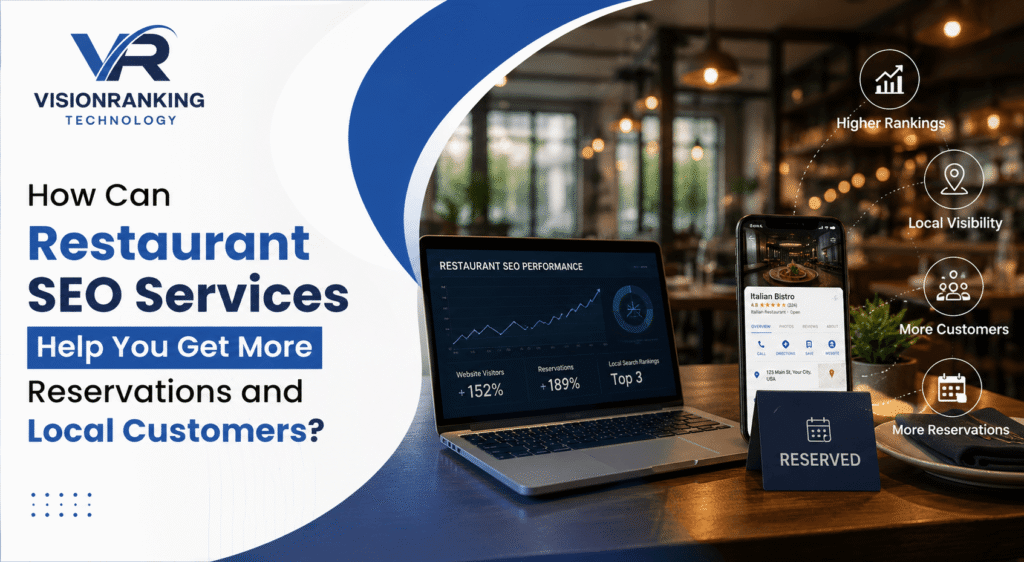
How Can Restaurant SEO Services Help You Get More Reservations and Local Customers?
📌 Key Takeaways
- Improve Local Search Visibility: Restaurant SEO services help your business appear in relevant Google Search and Maps results when nearby customers look for dining options.
- Generate More Reservation Opportunities: An optimised website with clear menus, contact details and booking options makes it easier for visitors to become customers.
- Target Relevant Customers: Cuisine-specific, location-based and reservation-focused keywords help attract people actively searching for your restaurant’s services.
- Strengthen Online Trust: An updated Google Business Profile, genuine customer reviews, quality photographs and useful website content improve your restaurant’s online presence.
- Build Long-Term Search Visibility: Consistent SEO, AEO, GEO and technical optimisation help your restaurant strengthen its organic presence and prepare for evolving search experiences, including Google AI Overviews.
Running a restaurant in the UK involves more than serving good food and providing excellent customer service. You also need to make sure local customers can find your restaurant when they search online for places to eat, compare menus, check reviews or look for somewhere to book a table.
Today, many customers start their restaurant search on Google. They use searches such as “Italian restaurant near me”, “best family restaurant in Manchester”, “Indian restaurants in Birmingham” or “restaurants open for dinner in London”. These searches often indicate a strong intention to visit a restaurant or make a reservation.
However, having a website does not automatically bring customers through your doors. Your restaurant needs to appear in relevant search results, communicate what makes your business different and make it easy for visitors to take the next step.
This is where professional restaurant SEO services become valuable.
Restaurant SEO focuses on improving your website’s visibility in Google Search, Google Maps and other relevant search experiences. It helps potential customers find your restaurant, understand your menu, explore your services and contact you or reserve a table.
For restaurant owners, the objective is straightforward: attract relevant local visitors, generate more reservation opportunities and build a consistent online presence.
At Vision Ranking, we help businesses strengthen their search visibility through strategic SEO, local optimisation, content development and technical improvements. Our approach focuses on your restaurant’s location, target customers, services and business objectives rather than chasing rankings without considering their commercial value.
If you want to understand how SEO can support your restaurant’s growth, this guide explains the key benefits, challenges, strategies and factors to consider before choosing an SEO agency.
1. Why Do Restaurants Need Professional SEO Services?
The restaurant industry is highly location-dependent. Customers usually prefer restaurants that are convenient to reach, offer the food they want and have positive customer feedback.
When someone searches for a restaurant, Google displays several types of results, including:
- Google Maps listings and local business profiles.
- Organic website results.
- Restaurant menus and relevant business information.
- Review-related information.
- Images and other visual results.
- Search features such as AI Overviews, where available and relevant.
If your restaurant has limited online visibility, potential customers might find other local businesses before they find yours.
Professional SEO helps address this problem by improving how search engines understand and present your restaurant.
For example, consider a restaurant in Birmingham specialising in Indian cuisine. Its potential customers might search for:
- Indian restaurant in Birmingham.
- Best Indian restaurant near me.
- Family-friendly Indian restaurant in Birmingham.
- Indian restaurant with private dining.
- Indian restaurant for birthday celebrations.
A properly planned SEO campaign helps your restaurant target relevant searches based on its actual menu, location, facilities and customer requirements.
Why this matters for restaurant owners:
- More opportunities to appear in relevant local searches.
- Better visibility among customers searching for specific cuisines.
- Increased qualified website traffic.
- More opportunities for calls, enquiries and reservations.
- Stronger brand recognition in your service area.
- A more reliable long-term source of customer acquisition.
The objective is not to attract every website visitor. It is to reach people who have a genuine interest in visiting your restaurant.
If your restaurant struggles to attract organic traffic or generate enquiries through its website, a professional SEO assessment is a useful starting point.
2. How Does Local SEO Help Restaurants Attract Nearby Customers?
Local SEO is one of the most important parts of a restaurant’s digital marketing strategy because most restaurant searches have a geographical connection.
A customer looking for a cafe in Leeds is unlikely to travel to another city for a casual coffee. They want relevant options within a reasonable distance.
Local SEO helps search engines understand where your restaurant operates, what type of food you serve and which customers your business is relevant to.
Google Business Profile optimisation
Your Google Business Profile is an important part of your local search presence. It displays information about your restaurant across Google Search and Maps.
An optimised profile should include:
- Correct restaurant name, address and telephone number.
- Accurate opening and closing hours.
- Appropriate primary and secondary business categories.
- Restaurant website and menu links.
- Reservation and food-ordering links, where available.
- High-quality photographs of food, interiors and dining areas.
- Relevant business descriptions.
- Regular responses to customer reviews.
Google explains that local search visibility is influenced by relevance, distance and prominence. Complete business information, customer reviews and other signals help Google understand and assess a business’s local presence.
Location-based keyword targeting
Your restaurant website should reflect the areas and locations you genuinely serve.
For example:
| Restaurant location | Potential search terms |
| London | Restaurant in London |
| Manchester | Best restaurants in Manchester |
| Birmingham | Indian restaurant in Birmingham |
| Leeds | Cafe in Leeds |
| Bristol | Family-friendly restaurant in Bristol |
| Liverpool | Italian restaurant in Liverpool |
The keyword strategy should also reflect your restaurant’s cuisine, dining experience and special facilities.
A restaurant offering private dining, outdoor seating or vegan food should have relevant website content explaining these services.
Local citations and business information
Your restaurant details should remain consistent across relevant business directories, food platforms and other online listings.
Inconsistent addresses, telephone numbers or business names can confuse customers and create difficulties when search engines assess your business information.
A restaurant SEO company should review these listings and identify inconsistencies that need attention.
Business impact: Local SEO creates more opportunities for nearby customers to discover your restaurant when they are actively searching for dining options.
3. How Can Restaurant Website Optimisation Generate More Reservations?
Your website is more than an online brochure. It should guide visitors towards meaningful actions, such as checking your menu, calling your restaurant or booking a table.
A restaurant might receive website visitors but still struggle to generate reservations because its website does not provide enough information or make the booking process convenient.
Professional website optimisation addresses these issues.
Important website elements for restaurants
| Website element | Why it matters |
| Homepage banner | Communicates your restaurant’s identity and main offering |
| Menu section | Helps customers understand food choices and prices |
| Reservation button | Makes table bookings easier |
| Food photography | Gives visitors a visual understanding of your dishes |
| Location and map | Helps customers find your restaurant |
| Opening hours | Provides essential visiting information |
| Customer testimonials | Builds confidence among potential diners |
| Contact information | Makes enquiries and communication easier |
| Mobile-friendly design | Improves usability on smartphones |
| FAQs | Answers common customer questions |
Make the reservation journey simple
Imagine a customer searching for a restaurant for a family dinner.
They visit your website and want to know:
- What food do you serve?
- Is there a suitable menu for children?
- Where is the restaurant located?
- What time does the restaurant close?
- Is online table booking available?
- Can they arrange a birthday celebration?
If the customer has to navigate several pages to find these answers, they might leave and consider another restaurant.
A well-optimised website should provide important information without unnecessary steps.
We recommend clear reservation buttons in prominent website locations, a simple booking form, accessible telephone details and links to the relevant booking platform.
The booking process should also work properly on mobile devices, since customers frequently use smartphones to research local restaurants.
A practical consideration: SEO brings relevant visitors to your website, while website usability helps convert those visitors into enquiries and reservations. Both areas need attention.
4. Why Is Restaurant Keyword Research Important for Getting Qualified Leads?
Not every keyword attracts the same type of customer.
Someone searching for “how to cook Italian pasta” has a different objective from someone searching for “Italian restaurant near me”.
The first person wants cooking information. The second might be looking for a restaurant to visit.
For restaurant businesses, keyword research should identify searches connected to actual customer requirements and commercial opportunities.
Different types of restaurant keywords
| Keyword category | Example keywords | Search intent |
| Location-based | Restaurant in London | Local discovery |
| Cuisine-based | Indian restaurant near me | Finding a specific cuisine |
| Commercial | Best Italian restaurant in Manchester | Comparing restaurants |
| Reservation-focused | Book a restaurant table in London | Making a reservation |
| Service-based | Restaurant with private dining | Finding a specific facility |
| Occasion-based | Restaurant for birthday dinner | Planning an event |
| Dietary | Vegan restaurant in Bristol | Finding suitable food options |
Target keywords that match your restaurant
A restaurant specialising in seafood should not spend its entire SEO budget targeting general restaurant searches.
Its strategy should include relevant terms connected to seafood, local dining, specific dishes and the locations it serves.
Similarly, a cafe should consider searches related to breakfast, brunch, speciality coffee, takeaway and its local area.
The keyword strategy should reflect:
- Your restaurant’s cuisine.
- Your geographical location.
- Your target customer groups.
- Your dining facilities.
- Your menu and special offerings.
- Your commercial priorities.
At Vision Ranking, we approach keyword research with a focus on search intent and business relevance. We identify opportunities that align with your restaurant’s services rather than selecting keywords based on search volume alone.
This helps build a more meaningful SEO strategy with a stronger connection to potential reservations and enquiries.
5. How Does Restaurant Content Marketing Improve Search Visibility?
Customers often search for restaurants using specific questions and requirements.
They might want to find a suitable venue for a business lunch, understand the difference between dining options or explore restaurants offering a particular cuisine.
Useful website content helps your restaurant address these searches while providing more information about your business.
Content opportunities for restaurant websites
Consider the following examples:
For restaurants:
- What Should You Look for When Choosing a Family-Friendly Restaurant in London?
- Where Can You Find Authentic Indian Food in Birmingham?
- What Makes a Restaurant Suitable for Business Meetings?
- How Do You Choose a Restaurant for a Birthday Celebration?
For cafes:
- What Makes a Cafe a Good Place for Weekend Brunch?
- Where Can You Find Speciality Coffee in Manchester?
- What Should You Look for When Choosing a Cafe for Remote Working?
These topics can support informational and commercial search intent.
However, content should remain relevant to the restaurant’s actual business. Publishing unrelated articles simply to increase website content does not create a meaningful SEO strategy.
Important content sections for restaurant websites
A well-developed restaurant website should explain:
- The restaurant’s background and dining concept.
- Its cuisine and speciality dishes.
- Menu options and pricing.
- Dining facilities and customer experience.
- Private dining or event facilities, where available.
- Location and accessibility.
- Reservation and ordering options.
- Customer feedback and testimonials.
Original photographs, accurate menu information and genuine business details help visitors understand what your restaurant offers.
For example, a restaurant offering wedding reception dining should explain its event facilities, menu arrangements, capacity and enquiry process rather than relying on a single photograph.
Content also supports topical relevance by helping search engines understand the relationship between your restaurant, cuisine, location and services.
If your website needs stronger content coverage, Vision Ranking’s restaurant SEO services include strategic optimisation focused on relevant business and customer searches.
6. How Can AI Search and Google AI Overviews Help Restaurants Gain Visibility?
Search behaviour is changing. Customers are increasingly using conversational queries and AI-powered search experiences to research businesses, compare options and find answers.
For example, a customer might search:
- Which restaurants in London offer private dining for families?
- Where can I find an Indian restaurant with vegetarian options in Manchester?
- Which cafes in Birmingham are suitable for business meetings?
- What restaurants near me offer online table reservations?
These searches require clear and relevant information.
Google AI Overviews and other AI-powered search experiences introduce additional ways for users to explore information and discover relevant websites.
For restaurants, this creates an opportunity to strengthen their digital presence through well-structured content and accurate business information.
What does AI search optimisation involve?
A practical AI search strategy should include:
- Clearly written information about your restaurant.
- Accurate cuisine, location and service details.
- Detailed and accessible menu information.
- Relevant question-based website content.
- Clear headings and descriptive page structures.
- Consistent business information across relevant platforms.
- Appropriate internal links between related pages.
- Technical accessibility and indexable website content.
- Relevant local business structured data.
Understanding SEO, AEO and GEO
These three concepts are related but focus on different aspects of search visibility.
| Approach | Main objective | Restaurant application |
| SEO | Improve organic search visibility | Rank for restaurant and cuisine-related searches |
| AEO | Make information easier to identify and use in answer-based search | Answer questions about menus, opening hours and facilities |
| GEO | Strengthen visibility across generative AI search experiences | Provide useful information about restaurant services and locations |
It is important to understand that AI visibility is not guaranteed through a separate optimisation trick.
Google’s published guidance confirms that established SEO fundamentals remain relevant to AI Overviews and AI Mode. Pages need to meet normal technical requirements and provide helpful, reliable information. Google does not require special AI-specific schema or separate technical optimisation to appear in these experiences.
For restaurant owners, the practical priority should be maintaining accurate business information and creating useful website content that addresses real customer questions.
Vision Ranking integrates SEO, AEO and GEO considerations into its broader digital marketing approach to help businesses prepare for changing search behaviour.
7. What Are the Main Business Benefits of Investing in Restaurant SEO?
Restaurant SEO should support measurable business objectives. Higher rankings are useful, but the real value comes from attracting relevant customers and creating opportunities for business growth.
Here are some important benefits.
1. Increased local visibility
Your restaurant has more opportunities to appear when customers search for relevant dining options in your service area.
2. More qualified website traffic
Targeting cuisine-specific, location-based and reservation-focused searches helps attract visitors with a stronger interest in your restaurant.
3. More reservation opportunities
Improved website visibility, clear booking options and accurate Google Business Profile information create additional opportunities for customers to reserve tables.
4. Better brand recognition
Appearing consistently across relevant search results helps customers become familiar with your restaurant.
5. Improved customer trust
Accurate business information, genuine reviews, quality photographs and useful website content help customers make informed decisions.
6. Greater visibility for speciality services
SEO helps restaurants communicate specific offerings such as:
- Private dining.
- Corporate dining.
- Family dining.
- Outdoor seating.
- Birthday celebrations.
- Vegan and vegetarian menus.
- Catering services.
- Takeaway and delivery.
7. Long-term marketing value
Unlike a paid advertising campaign, organic search visibility does not depend on paying for every click. However, SEO requires ongoing investment, monitoring, content improvements and technical maintenance.
It is important to recognise that SEO does not guarantee a fixed number of reservations. Customer demand, restaurant location, competition, pricing, reviews and booking experience all influence the final outcome.
The strongest campaigns connect search performance with actual business enquiries and reservations wherever reliable tracking is available.
8. What Are the Common SEO Mistakes That Prevent Restaurants from Getting More Customers?
Many restaurant websites have the basic information customers need, but several optimisation issues limit their search visibility and conversion potential.
Understanding these problems is important before investing in an SEO campaign.
Mistake 1: Targeting only general restaurant keywords
Using broad terms such as “restaurant” or “best food” does not adequately communicate your restaurant’s location, cuisine or speciality.
Our recommendation: Build a keyword strategy around location, cuisine, dining facilities and customer requirements.
Mistake 2: Ignoring Google Business Profile
Some restaurants create a Business Profile but rarely update their opening hours, photographs, menu or business information.
Our recommendation: Maintain an accurate profile and regularly review its information, customer feedback and booking links.
Customers often check menus before visiting a restaurant. An outdated menu, missing prices or unclear food descriptions can create uncertainty.
Our recommendation: Keep your website menu and Google Business Profile menu information accurate and consistent.
Mistake 4: Poor mobile website experience
A website that loads slowly, displays poorly on mobile devices or has difficult navigation can discourage potential customers.
Our recommendation: Prioritise mobile usability, page speed, accessible navigation and convenient booking options.
Mistake 5: Publishing irrelevant blog content
Publishing articles without considering the restaurant’s services, location or audience can attract visitors who have little interest in becoming customers.
Our recommendation: Create content around relevant dining searches, local requirements and genuine business offerings.
Mistake 6: Neglecting customer reviews
Reviews influence customer decisions. Ignoring feedback or failing to address genuine complaints can affect how potential customers perceive your restaurant.
Our recommendation: Encourage genuine customer feedback and respond professionally to positive and negative reviews.
Mistake 7: Ignoring technical SEO
Broken links, duplicate pages, indexing problems, missing metadata and incorrect redirects can affect how search engines access and understand your website.
Our recommendation: Conduct regular technical SEO audits and prioritise issues based on their impact.
Mistake 8: Measuring success through rankings alone
A restaurant might rank for several keywords without generating meaningful enquiries or reservations.
Our recommendation: Evaluate organic traffic, relevant search queries, calls, booking clicks, enquiries and completed reservations wherever tracking permits.
An effective SEO strategy should connect search visibility with business performance.
9. What Restaurant SEO Services Should an Agency Provide?
Before hiring an agency, restaurant owners should understand what a professional SEO campaign includes.
Restaurant SEO involves several connected activities. Focusing on only one area, such as keyword placement or backlink creation, is unlikely to address every website and marketing challenge.
Here is what a comprehensive campaign should cover.
| SEO service | Activities involved | Business objective |
| SEO audit | Website structure, technical issues and content analysis | Identify optimisation opportunities |
| Keyword research | Cuisine, location and commercial keyword research | Attract relevant search traffic |
| On-page SEO | Titles, descriptions, headings and content | Improve page relevance |
| Technical SEO | Crawling, indexing, speed and mobile performance | Improve search accessibility |
| Local SEO | Google Business Profile and local listings | Improve local discovery |
| Content optimisation | Service pages, menus and blog content | Address customer searches |
| Link building | Relevant and quality-focused backlinks | Strengthen website authority |
| Schema implementation | Appropriate restaurant and local business markup | Help search engines interpret information |
| Conversion optimisation | Booking buttons, forms and contact information | Support enquiries and reservations |
| Performance reporting | Search visibility, traffic and conversion analysis | Measure campaign progress |
Why does an integrated SEO strategy matter?
Consider a restaurant with a technically sound website and well-written content but an incomplete Google Business Profile.
Its website might perform reasonably well in organic search, while its local search presence remains underdeveloped.
Another restaurant might have good local visibility but a confusing website with no clear reservation process.
Both situations require different improvements.
A professional SEO strategy identifies these gaps and prioritises activities according to the restaurant’s business requirements.
10. How Does Vision Ranking Help Restaurants Improve Their Online Visibility?
At Vision Ranking, we understand that restaurant businesses need a digital marketing strategy connected to customer acquisition and business growth.
Our approach focuses on understanding your business before recommending optimisation activities.
We consider your location, cuisine, target customers, website structure, existing search performance and commercial priorities.
Our restaurant SEO services focus on improving organic visibility, strengthening local search presence and creating better opportunities for customer enquiries.
Our restaurant SEO approach
1. Website and SEO audit
We review your existing website to identify technical issues, content gaps, indexing problems, missing optimisation elements and usability concerns.
2. Keyword research and competitor analysis
We identify relevant search opportunities based on your restaurant’s cuisine, location, speciality services and customer requirements.
3. On-page optimisation
We improve important website elements, including:
- Meta titles and descriptions.
- H1, H2 and H3 headings.
- Page content and keyword relevance.
- Image alt attributes.
- Internal linking.
- URL structure.
- Relevant structured data.
4. Local SEO optimisation
We review your Google Business Profile, business categories, location information, photographs, menu details and customer-facing links.
5. Content development
We identify opportunities to improve restaurant service pages, location-related content, FAQs and relevant blog articles.
6. Technical SEO improvements
We work on crawling, indexing, website performance, mobile usability, redirects and other technical areas that affect search visibility.
7. Authority building
We focus on relevant link-building opportunities and a sustainable approach to improving your website’s authority.
8. Reporting and performance analysis
We monitor campaign progress using relevant SEO metrics, including:
- Keyword ranking performance.
- Google Search Console impressions and clicks.
- Organic website traffic.
- Landing page performance.
- Local search visibility.
- Enquiry and booking-related actions, where tracking is available.
Why Choose Vision Ranking?
Choosing an SEO agency is an important business decision. You need a team that understands the relationship between search visibility, website performance and customer acquisition.
Vision Ranking offers:
- Business-focused SEO strategies: Recommendations based on your restaurant’s objectives and target audience.
- Industry-relevant keyword research: Focus on cuisine, location and customer search intent.
- Technical and on-page expertise: Attention to the website elements supporting organic visibility.
- Local SEO support: Improvements to your local search presence and Google Business Profile.
- AI search readiness: Consideration of AEO, GEO and conversational search alongside traditional SEO.
- Transparent reporting: Regular updates on completed activities and measurable performance.
- Long-term optimisation: Continued improvements based on search data and business priorities.
We believe restaurant SEO should be planned around your business rather than following the same checklist for every client.
11. What Results Should You Expect from Restaurant SEO Services?
Restaurant owners often want to understand how quickly SEO will generate more reservations.
The honest answer is that SEO is a gradual process. Results depend on your website’s existing condition, local competition, restaurant location, content quality, technical health and campaign scope.
A new restaurant website will generally have different requirements from an established restaurant with an existing organic search presence.
Understanding the SEO growth process
| Campaign stage | Main focus | What to monitor |
| Initial stage | Audit, keyword research and strategy | Existing website issues and baseline performance |
| Early implementation | Technical and on-page improvements | Crawling, indexing and optimisation progress |
| Development stage | Local SEO and content improvements | Impressions, clicks and keyword movement |
| Growth stage | Content expansion and authority building | Organic traffic and relevant landing page performance |
| Ongoing stage | Refinement and conversion optimisation | Enquiries, booking actions and business outcomes |
These are general campaign stages, not guaranteed ranking or reservation milestones. The time required varies between websites and locations.
What should restaurant owners measure?
A useful SEO report should go beyond keyword rankings.
Consider monitoring:
- How many relevant searches display your website?
- Which restaurant-related keywords generate impressions?
- Which landing pages attract organic visitors?
- Are visitors exploring your menu and location pages?
- Are customers clicking reservation links?
- Are calls and enquiry forms increasing?
- Which locations and services generate the strongest interest?
For example, a restaurant might notice that its private dining page attracts fewer visitors than its homepage but generates more event enquiries.
This is useful commercial information. It helps the business understand which services deserve additional marketing attention.
Our recommendation: Set realistic objectives with your SEO agency and review performance regularly. Focus on the quality of traffic and customer actions rather than expecting a fixed number of reservations from a ranking improvement.
12. How to Choose the Right Restaurant SEO Company in the UK?
Selecting an SEO agency requires more than comparing monthly prices.
Your chosen partner should understand local search, website optimisation, content strategy and the commercial requirements of restaurant businesses.
Before making a decision, evaluate the agency’s working approach.
Red flags to watch for when choosing an agency
Guaranteed first-page rankings
No responsible agency should guarantee specific Google rankings because search algorithms and competition are outside its direct control.
Unclear SEO activities
If an agency cannot explain what it plans to optimise, how it will approach your website or what its monthly work includes, request a clearer strategy.
Unrealistic reservation promises
SEO can create more opportunities for reservations, but the agency does not control customer demand, food quality, pricing or the restaurant’s booking capacity.
Low-quality link-building practices
Large quantities of irrelevant or manipulative backlinks do not represent a sustainable SEO strategy.
No reporting or performance tracking
You should receive clear updates about completed activities, website performance and the next priorities.
Identical strategies for every business
A cafe, fine-dining restaurant, takeaway business and multi-location restaurant have different customer requirements. Their SEO strategies should reflect those differences.
Questions to ask before hiring a restaurant SEO agency
Before signing an agreement, consider asking:
- How will you identify keywords relevant to my restaurant’s location and cuisine?
- What will you include in the initial website SEO audit?
- How will you improve my Google Business Profile?
- Will you optimise menu, location and reservation-related pages?
- How will you address technical SEO issues?
- What is your approach to content development and link building?
- How will you measure calls, enquiries and reservation-related actions?
- What activities will be included in the monthly SEO campaign?
- How frequently will I receive performance reports?
- How will you adapt the strategy if search performance does not improve?
A professional agency should provide clear answers and explain the reasoning behind its recommendations.
Is a low-cost restaurant SEO package always the right choice?
Not necessarily.
The cost of SEO depends on the website’s condition, the number of restaurant locations, the competition, the amount of content required and the scope of optimisation.
A campaign with limited activity might not address the issues affecting your restaurant’s online visibility.
Instead of selecting an agency based only on price, compare the scope of work, expertise, reporting process and suitability of its strategy.
Vision Ranking focuses on understanding these requirements before recommending an SEO approach.
13. Which Restaurant Businesses Need Professional SEO Services?
Restaurant SEO is relevant to businesses of different sizes and dining categories. However, the strategy should reflect the business model and its target customers.
Here are some examples.
Independent restaurants
Independent restaurants often depend on customers from nearby neighbourhoods. Local SEO and cuisine-specific keyword targeting help improve their online discovery.
Cafes and coffee shops
Cafes can benefit from location-based searches related to breakfast, brunch, speciality coffee, takeaway and suitable places for meetings.
Fine-dining restaurants
Fine-dining businesses often need content that communicates their cuisine, dining experience, atmosphere, menu and reservation arrangements.
Family restaurants
Family restaurants should provide useful information about children’s menus, seating arrangements, facilities and group bookings.
Takeaway and delivery restaurants
These businesses need clear menu information, accurate ordering links and relevant local visibility for delivery-related searches.
Multi-location restaurant groups
Businesses operating across multiple towns or cities need a location-specific strategy that accurately represents each branch and avoids duplicate or unhelpful content.
Restaurants offering private dining and events
Restaurants providing corporate dining, birthday celebrations, private events or group bookings can benefit from dedicated service pages that address these requirements.
The main principle is simple: your SEO strategy should reflect what your restaurant offers and what your potential customers are searching for.
14. How Can Restaurant Owners Get Started with an SEO Campaign?
Starting an SEO campaign becomes easier when you have a clear understanding of your current website performance and business priorities.
Before implementing changes, we recommend reviewing the following areas:
- Current website performance: Understand how your website performs in Google Search and whether important pages are indexed.
- Local search presence: Review your Google Business Profile and visibility for relevant local searches.
- Keyword opportunities: Identify the searches customers use when looking for restaurants like yours.
- Website conversion experience: Check whether customers can easily explore menus, contact your restaurant and make reservations.
- Competitor visibility: Understand which types of local searches and website content present opportunities for your business.
At Vision Ranking, we start by understanding these requirements and preparing an SEO strategy around your restaurant’s objectives.
You do not need to invest in every SEO activity at once. A structured approach helps prioritise important improvements and build a stronger foundation for long-term growth.
Ready to improve your restaurant’s search visibility?
Book a free consultation with Vision Ranking. Our team will discuss your website, local search presence and potential SEO opportunities to help you attract more relevant customers.
Explore Restaurant SEO Services | Contact Vision Ranking
Frequently Asked Questions About Restaurant SEO Services
1. What are restaurant SEO services?
Restaurant SEO services involve improving a restaurant’s website and online presence to increase its visibility in relevant search results. These services include keyword research, on-page SEO, technical optimisation, local SEO, Google Business Profile management, content development and link building. The objective is to attract relevant customers and create more opportunities for enquiries and reservations.
2. How can SEO help my restaurant get more reservations?
SEO helps your restaurant appear when potential customers search for relevant dining options. By improving local visibility, website content, Google Business Profile information and reservation links, you create more opportunities for customers to discover your restaurant and book a table.
3. How much do restaurant SEO services cost in the UK?
Restaurant SEO pricing depends on your website’s condition, business location, competition, number of branches and campaign requirements. A single-location cafe might require a different level of optimisation from a restaurant group operating across several UK cities. Request a tailored proposal based on your business objectives and required activities.
4. How long does restaurant SEO take to show results?
SEO does not follow a fixed timeline. Improvements depend on website history, competition, technical issues, content quality and optimisation activities. Some changes might become visible earlier, while stronger organic growth often requires sustained work over several months. Regular monitoring helps identify progress and opportunities.
5. Why is local SEO important for restaurants?
Local SEO helps restaurants appear in relevant geographical searches on Google Search and Maps. It improves opportunities for nearby customers to find restaurant locations, explore menus, check opening hours, read reviews and access reservation information.
6. Does Google Business Profile help restaurants get more customers?
Yes. Google Business Profile provides important information about your restaurant, including its location, opening hours, photographs, menu and customer reviews. Restaurants can also provide relevant reservation and ordering links where supported. Maintaining accurate information makes it easier for customers to evaluate and contact your business.
7. What keywords should a restaurant target?
A restaurant should target keywords related to its cuisine, location, dining facilities and customer requirements. Examples include “Indian restaurant in London”, “family restaurant in Manchester”, “Italian restaurant near me” and “restaurant with private dining”. The final keyword selection should reflect the restaurant’s actual services and target audience.
8. Can restaurant SEO improve visibility in Google AI Overviews?
Restaurant websites can become eligible for relevant AI-powered search experiences by following established SEO practices. Helpful content, accurate business information, accessible website pages and appropriate technical optimisation support search visibility. However, appearing in Google AI Overviews is not guaranteed, and Google does not require separate AI-specific optimisation to qualify.
9. How do I choose the best restaurant SEO company in the UK?
Look for an agency with a clear SEO process, relevant local search expertise, transparent reporting and an understanding of your restaurant’s business objectives. Ask about keyword research, technical SEO, Google Business Profile optimisation, content development and conversion tracking. Avoid agencies promising guaranteed rankings or unrealistic reservation figures.
10. Why should I choose Vision Ranking for restaurant SEO?
Vision Ranking provides business-focused SEO strategies covering keyword research, website optimisation, technical SEO, local SEO, content development and authority building. Our approach also considers AEO, GEO and AI search readiness. We focus on improving your restaurant’s online visibility and creating more opportunities for relevant customer enquiries and reservations.
Conclusion: Build a Stronger Online Presence for Your Restaurant
A successful restaurant depends on attracting customers, delivering a positive dining experience and building long-term relationships.
Your online presence plays an important role in this process. When potential customers search for restaurants in their area, your business needs accurate information, relevant website content and an accessible reservation journey.
Professional restaurant SEO services help bring these elements together.
From local search optimisation and keyword research to technical improvements, content development and AI search readiness, every activity should support your restaurant’s wider business objectives.
However, sustainable SEO growth requires consistency, realistic expectations and regular performance analysis. Rankings alone do not determine success. Relevant website visitors, customer enquiries and completed reservations provide a clearer picture of business impact.
Vision Ranking helps restaurants and cafes strengthen their digital presence through strategic SEO and ongoing optimisation.
Whether you operate an independent cafe, a family restaurant, a fine-dining establishment or a multi-location restaurant group, our team can help identify opportunities to improve your search visibility.
Want more local customers to find your restaurant?
Contact Vision Ranking to discuss your restaurant’s SEO requirements and request a free consultation.