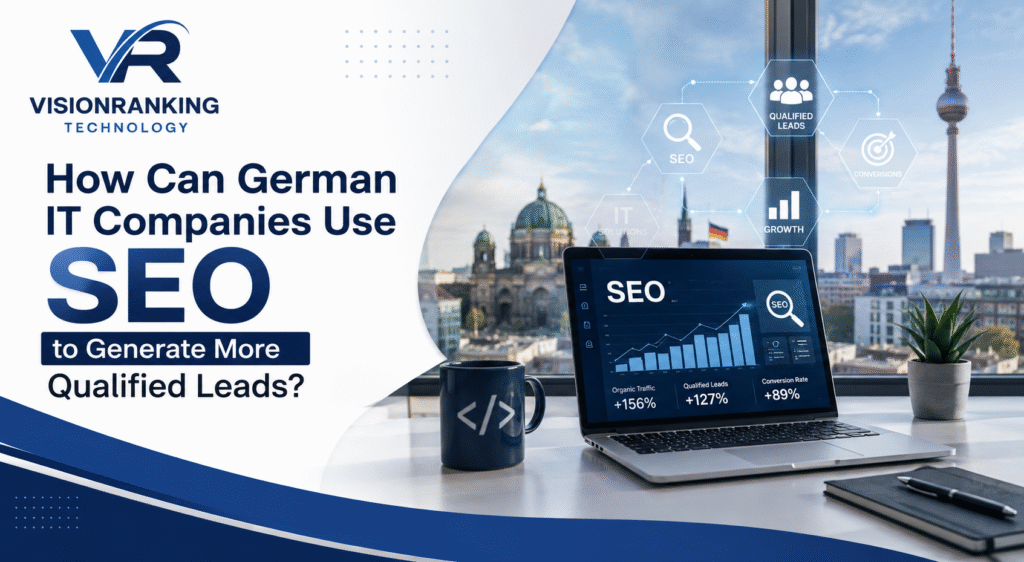
How Can German IT Companies Use SEO to Generate More Qualified Leads?
📌 Key Takeaways
- SEO can help German IT companies attract qualified leads by reaching potential customers actively searching for specific technology services and solutions.
- A successful SEO strategy goes beyond rankings and traffic by connecting search intent, service pages, content, technical SEO, and conversion opportunities with business goals.
- German-language and industry-specific SEO matters because IT buyers use specialised terminology and search differently across services, industries, and customer segments.
- AI search and Google AI Overviews are changing discovery, making authoritative, useful, well-structured content increasingly important for long-term search visibility.
- Long-term SEO partnerships can support sustainable growth through continuous technical optimisation, content development, authority building, performance monitoring, and strategic improvements.
For German IT companies, getting website traffic is only one part of the growth equation. The bigger challenge is attracting the right visitors: business decision-makers, technology buyers, procurement teams, software users, and organisations actively looking for the services or solutions your company provides.
This is where strategic SEO becomes important.
A well-planned SEO strategy can help IT companies appear when potential customers search for software development, IT consulting, cloud solutions, cybersecurity, managed services, enterprise technology, SaaS products, and other specialised solutions. More importantly, it can help businesses attract visitors with genuine commercial intent rather than simply increasing website traffic.
For companies operating in Germany, search visibility also requires an understanding of the local market, German-language search behaviour, technical requirements, competition within specialised industries, and increasingly important AI-driven search experiences.
Working with an experienced SEO specialist in Germany or an established SEO partner can help turn organic search into a long-term lead generation channel.
Vision Ranking works with businesses that want to strengthen their organic visibility, attract qualified prospects, and build a sustainable search strategy around measurable business goals.
Looking to understand where your website stands? Request a Free SEO Audit from Vision Ranking.
Why SEO Matters for German IT Companies
IT buyers rarely make purchasing decisions after seeing a company website once.
A potential customer may first search for a solution, compare providers, read technical information, investigate capabilities, check reviews, and return to Google several times before contacting a company.
This creates multiple opportunities for an IT business to become visible throughout the buying journey.
A strong SEO strategy can help your business appear for searches related to:
- IT services
- Software development
- Cloud solutions
- Cybersecurity
- Managed IT services
- Enterprise software
- SaaS solutions
- IT consulting
- Digital transformation
- Technology implementation
- Industry-specific software
- B2B technology solutions
The objective should not simply be to rank for a large number of keywords.
The real objective is to generate relevant visibility that contributes to qualified enquiries and business opportunities.
For example, a visitor searching for a specific enterprise technology solution may have significantly stronger commercial intent than someone searching for a general definition of a technology term.
This distinction is important when developing an SEO strategy for an IT company.
How SEO Generates Qualified Leads Instead of Just Traffic
SEO becomes more valuable when it is connected to the actual customer journey.
Consider a German software company offering enterprise automation solutions.
A potential customer might move through several stages:
- Search for a business problem.
- Research possible technology solutions.
- Compare different approaches.
- Search for suitable providers.
- Review service pages and case studies.
- Contact a company for consultation or pricing.
SEO can support visibility at multiple points in this journey.
Informational Searches
At the beginning, prospects may search for information about a problem or technology.
Relevant content can introduce the company to potential buyers before they are ready to contact a provider.
Commercial Searches
Later, users may search for specific services or solutions.
Service pages optimised around commercial search intent can help capture this demand.
High-Intent Searches
The strongest opportunities often come from searches where the user is actively looking for a provider.
Examples include searches containing terms such as:
- IT service provider
- software development company
- cybersecurity services
- cloud consulting
- enterprise software company
- IT consulting services
- software development services Germany
The strategy should connect these searches with relevant landing pages and clear conversion paths.
SEO Services Germany: What Should an IT Company Focus On?
SEO for technology businesses is rarely limited to publishing blog articles.
A comprehensive SEO services Germany strategy should consider the complete website ecosystem.
This can include:
Technical SEO
Search engines need to crawl, understand, and index the website efficiently.
Technical SEO may involve reviewing:
- Website architecture
- Indexation
- Crawlability
- Internal linking
- Canonical implementation
- Redirects
- XML sitemaps
- Page speed
- Mobile usability
- Structured data
- Duplicate content
- Core technical issues
For technology companies with large websites, technical problems can become more complicated because of multiple services, product pages, documentation sections, locations, and content categories.
On-Page SEO
Every important landing page should clearly communicate its purpose.
This includes reviewing:
- Page titles
- Meta descriptions
- Heading structures
- Search intent
- Keyword relevance
- Content quality
- Internal links
- Image optimisation
- FAQs
- Structured information
The objective is to make the page useful for both search engines and potential customers.
Content Strategy
IT companies often have highly technical expertise inside the organisation.
However, technical knowledge does not automatically translate into search-friendly content.
SEO content should connect technical expertise with the questions and commercial concerns of potential customers.
Authority and Off-Page SEO
Competitive technology markets require more than strong onsite optimisation.
A long-term strategy may also involve building relevant authority through high-quality digital mentions, industry-relevant websites, professional publications, and appropriate backlink opportunities.
The emphasis should remain on relevance and quality rather than simply accumulating large numbers of links.
Why German IT Websites Need Industry-Specific SEO
A generic SEO strategy may not fully address the needs of a technology company.
IT buyers often have very specific requirements.
For example, a cybersecurity provider may need visibility around security solutions, compliance-related requirements, risk management, and industry-specific services.
A software development company may need to target searches related to development technologies, project types, industries, platforms, and business requirements.
A cloud services provider may need to establish visibility around migration, infrastructure, optimisation, security, and managed cloud services.
This means SEO should be connected to:
Business offering + target customer + search intent + industry terminology + location.
An experienced SEO specialist Germany can help identify these relationships and build a strategy around the company’s actual commercial objectives.
German Language and Search Intent Matter
German IT companies targeting customers in Germany should carefully consider language and search behaviour.
Simply translating English content into German is not always enough.
Search intent can change depending on terminology, wording, industry preferences, and how potential customers describe a problem.
For example, a technical term used by a software company may not be the same term used by a purchasing manager searching for a solution.
A strong SEO strategy should therefore consider:
- German search terminology
- Business language
- Industry-specific terminology
- Customer pain points
- Commercial intent
- Regional targeting
- Service-specific searches
- Long-tail searches
Content should feel natural to German users rather than appearing to be a direct translation created solely for search engines.
Turning Service Pages Into Lead Generation Assets
One of the most overlooked SEO opportunities for IT companies is the service page.
A service page should do more than describe what a company does.
It should answer important questions a potential customer may have before contacting the business.
A strong service page can communicate:
- What the service is
- Who it is for
- Which business problems it addresses
- What the company provides
- Relevant expertise
- Key benefits
- Implementation considerations
- FAQs
- Trust signals
- Clear next steps
For example, instead of having a generic page titled “IT Services”, an organisation may benefit from dedicated pages around its most commercially important services.
This creates more opportunities to match specific search intent with relevant landing pages.
Talk to Vision Ranking to identify which service pages could have stronger organic lead-generation potential.
SEO and AI Search: Preparing for the Changing Search Journey
Search behaviour continues to evolve.
Google AI Overviews and conversational search experiences are changing how people discover and evaluate information.
For IT companies, this makes useful, authoritative, well-structured content increasingly important.
A business may no longer rely solely on a traditional blue-link ranking to become visible during a customer’s research journey.
Potential customers can encounter information through:
- Traditional search results
- AI-generated search experiences
- Featured search elements
- Conversational queries
- Local search results
- Business profiles
- Industry content
- Third-party mentions
This means modern SEO should consider broader search visibility rather than focusing only on traditional keyword rankings.
Companies should build content that clearly demonstrates expertise, answers genuine customer questions, provides useful context, and supports the overall authority of the brand.
AI search readiness should complement traditional SEO, not replace the fundamentals.
Common SEO Mistakes Made by IT Companies
Technology companies often have strong technical teams but may still struggle with organic search.
Some common problems include:
1. Focusing Only on Technical Keywords
Technical terminology may be accurate, but potential customers may search using simpler business language.
2. Creating Content Without Commercial Intent
A large content library does not automatically generate qualified leads.
Content should have a clear purpose within the customer journey.
3. Using One Page for Multiple Services
Trying to target too many unrelated services on one page can make the page less relevant to individual searches.
4. Ignoring Conversion Paths
Getting a visitor to the website is only part of the process.
Visitors should have clear opportunities to request a consultation, contact the company, enquire about a service, or take another relevant action.
5. Treating SEO as a Short-Term Campaign
SEO normally requires ongoing optimisation, content development, technical improvements, authority building, and performance analysis.
6. Measuring Only Rankings
Rankings are useful indicators, but decision-makers should also examine organic traffic, enquiries, engagement, landing-page performance, search visibility, and business outcomes.
Comparison: Traffic-Focused SEO vs Lead-Focused SEO
| Traffic-Focused Approach | Lead-Focused SEO Approach |
| Concentrates mainly on visitor volume | Concentrates on qualified visitors |
| Targets broad keywords | Targets relevant commercial and informational intent |
| Measures rankings heavily | Reviews rankings, traffic and conversions |
| Produces content for volume | Produces content around customer needs |
| Treats pages independently | Connects pages to the customer journey |
| Focuses mainly on Google rankings | Considers broader search visibility |
| Often uses short-term targets | Builds long-term organic growth |
For B2B IT companies, the second approach can provide a stronger connection between SEO activity and commercial objectives.
Our SEO Process for German IT Companies
At Vision Ranking, SEO begins with understanding the business rather than immediately changing website content.
1. Business and Website Assessment
We review the company’s website, services, target audience, existing search visibility, technical condition, and current SEO position.
2. Keyword and Search Intent Research
We identify relevant search opportunities based on the company’s services and potential customer behaviour.
This includes understanding which searches are informational, commercial, local, or highly transactional.
3. Competitor and Market Analysis
The objective is to understand the search landscape, identify opportunities, and determine where the website can strengthen its visibility.
4. On-Page Optimisation
Important website elements are reviewed and optimised according to the agreed strategy.
This can include titles, meta descriptions, headings, content structure, internal links, image elements, schema, and other relevant SEO factors.
5. Technical SEO Improvements
Technical issues affecting crawling, indexing, performance, or website structure are identified and addressed as part of the SEO roadmap.
6. Content Development
Content opportunities are prioritised according to search intent and business relevance.
The focus is on creating useful content that supports visibility and the customer journey.
7. Authority Development
Relevant off-page opportunities are considered to strengthen the website’s overall authority and search visibility.
8. Monitoring and Continuous Optimisation
SEO performance is reviewed regularly.
Search trends, rankings, organic traffic, landing pages, search queries, and other relevant indicators help determine where further optimisation is required.
Realistic Expectations from SEO
A professional SEO strategy should be treated as a long-term growth investment.
Search visibility can change due to many factors, including:
- Website changes
- Search engine algorithm updates
- Industry competition
- New competitors
- Content quality
- Technical issues
- Search behaviour
- Website authority
- Changes in search features
For this reason, responsible SEO providers should avoid promising a specific ranking or guaranteed number of leads.
A more realistic objective is to build stronger organic visibility over time while improving the website’s ability to convert relevant visitors into enquiries.
Results can also vary significantly between industries, websites, keywords, locations, and starting points.
Business Benefits of Professional SEO
A well-executed SEO strategy can support German IT companies in several ways.
Increased Organic Visibility
Your business can become easier to discover when potential customers search for relevant solutions.
Better Quality Website Traffic
Targeting search intent can help attract visitors who are more closely aligned with your services.
Stronger Brand Visibility
Repeated exposure across relevant searches can help increase awareness among potential customers.
Long-Term Lead Generation
Unlike campaigns that stop when advertising spend stops, SEO can continue generating organic visibility when maintained properly.
Improved Website Structure
SEO improvements can also make important information easier for users and search engines to navigate.
Stronger Authority
Consistent, useful content and a technically strong website can support the credibility of a technology brand.
Who Should Consider Professional SEO Services in Germany?
Professional SEO support can be particularly useful for:
- German software companies
- IT service providers
- SaaS businesses
- Technology consultancies
- Cybersecurity companies
- Cloud service providers
- Managed IT service companies
- B2B technology businesses
- Enterprise software providers
- Technology startups entering competitive markets
- International IT companies targeting German customers
Companies with established websites can also benefit if organic performance has stagnated or if their existing website attracts traffic without generating enough qualified enquiries.
Red Flags While Choosing an SEO Agency
Selecting an SEO partner requires careful evaluation.
Be cautious when an agency:
- Guarantees specific Google rankings
- Promises instant results
- Cannot explain what work will be performed
- Focuses only on keyword rankings
- Provides unclear reporting
- Uses irrelevant backlink-building practices
- Cannot explain how SEO connects to your business goals
- Avoids discussing technical SEO
- Produces large quantities of content without a clear strategy
- Makes unrealistic lead or revenue promises
A professional SEO relationship should involve clear communication, measurable objectives, transparent reporting, and realistic expectations.
Questions to Ask Before Hiring an SEO Company in Germany
Before choosing an SEO partner, business decision-makers should ask:
- How will you understand our target customers?
- How will you identify commercially valuable keywords?
- What technical SEO areas will you review?
- How will you improve our important service pages?
- How will content support lead generation?
- What metrics will you report?
- How often will we receive performance updates?
- How do you approach link building?
- How do you respond to search algorithm changes?
- How will you prepare our website for evolving search experiences?
- What access will you need to our website and analytics platforms?
- How will you communicate recommendations and approvals?
The answers can help reveal whether an SEO provider is focused on sustainable business growth or simply delivering a list of SEO activities.
Why Choose Vision Ranking?
Vision Ranking approaches SEO as a long-term digital growth strategy rather than a collection of isolated tasks.
For German IT and technology businesses, our approach focuses on connecting search visibility with business objectives.
We can help businesses work on areas including:
- Technical SEO
- On-page SEO
- Keyword research
- Content strategy
- Local and regional SEO
- Website optimisation
- Search visibility
- Authority development
- AI search readiness
- Performance monitoring
- Ongoing SEO strategy
Our objective is to understand the business, identify realistic search opportunities, optimise the website around relevant customer intent, and continuously improve the strategy based on performance.
Rather than focusing only on increasing traffic, we look at how organic search can support the wider customer acquisition process.
Want to understand the SEO opportunities for your German IT business? Request a Free Audit from Vision Ranking.
How Vision Ranking Can Support Your Long-Term Growth
The strongest SEO results usually come from consistency.
A website may require several rounds of technical improvements, content optimisation, new landing pages, authority development, and performance analysis before its full potential becomes clear.
That is why SEO should be treated as an ongoing partnership.
Vision Ranking can work with your internal marketing, development, and content teams to create a structured SEO roadmap.
The strategy can evolve as:
- Your services change
- Your target audience develops
- New search opportunities appear
- Search behaviour changes
- Google introduces new search features
- Your website grows
- Your business enters new markets
This long-term approach can help create a stronger and more sustainable organic search presence.
Frequently Asked Questions
1. Why is SEO important for German IT companies?
SEO can help IT companies increase visibility when potential customers search for relevant technology services and solutions. A strategic approach can focus on attracting qualified visitors rather than simply increasing overall website traffic.
2. How long does SEO take to generate results?
The timeline varies depending on the website, industry, competition, existing authority, technical condition, content quality, and target keywords. SEO should generally be approached as a long-term strategy rather than an instant lead-generation solution.
3. What are SEO services in Germany?
SEO services in Germany can include technical SEO, keyword research, on-page optimisation, content strategy, website optimisation, authority development, local SEO, performance monitoring, and other activities designed to improve organic search visibility.
4. Should an IT company hire an SEO specialist Germany?
An SEO specialist can provide dedicated expertise in areas such as search intent, technical optimisation, content strategy, keyword research, and organic performance analysis. This can be particularly useful for IT companies operating in competitive search markets.
5. Can SEO generate B2B IT leads?
Yes. SEO can support B2B lead generation by helping a company become visible for searches performed by businesses researching services, technology solutions, providers, and specific business problems.
However, lead quality depends on factors such as search intent, targeting, landing-page quality, offer positioning, and the website’s conversion experience.
6. Does SEO work for SaaS companies?
SEO can be useful for SaaS businesses because potential customers often research problems, software categories, features, solutions, and providers through search engines. A SaaS SEO strategy should connect informational content with commercially relevant product and service pages.
7. How does AI search affect SEO for IT companies?
AI-powered search experiences are changing how users discover and consume information. IT companies should continue investing in strong SEO fundamentals while developing useful, authoritative, well-structured content that can support visibility across evolving search experiences, including Google AI Overviews and conversational search.
8. Should German IT companies create content in German?
If Germany is an important target market, German-language content can help address local search behaviour and customer expectations. The content should be professionally written for the intended audience rather than simply translated word-for-word.
9. How should an IT company measure SEO performance?
Important metrics can include organic traffic, search visibility, keyword performance, landing-page performance, relevant search queries, engagement, enquiries, and conversions. The appropriate metrics depend on the company’s business model and objectives.
10. What should I look for in an SEO company in Germany?
Look for an SEO partner that understands your business objectives, communicates clearly, provides transparent reporting, explains its strategy, considers technical and content SEO, and sets realistic expectations rather than guaranteeing specific rankings.
Conclusion: Turn Search Visibility Into Qualified Business Opportunities
For German IT companies, SEO can be much more than a way to increase website traffic.
When strategically planned, it can help your business become visible to potential customers at different stages of the buying journey, from early research through to provider selection.
The most effective strategy combines technical website health, relevant search intent, valuable content, strong service pages, authority development, conversion opportunities, and continuous optimisation.
As search evolves through Google AI Overviews and conversational search, businesses also need to think beyond traditional rankings and focus on becoming a useful and credible source of information.
If your German IT company wants to generate more qualified opportunities through organic search, the first step is understanding where your current website stands and where realistic opportunities exist.
Vision Ranking can help you build a structured SEO strategy focused on long-term visibility, relevant traffic, and business growth.