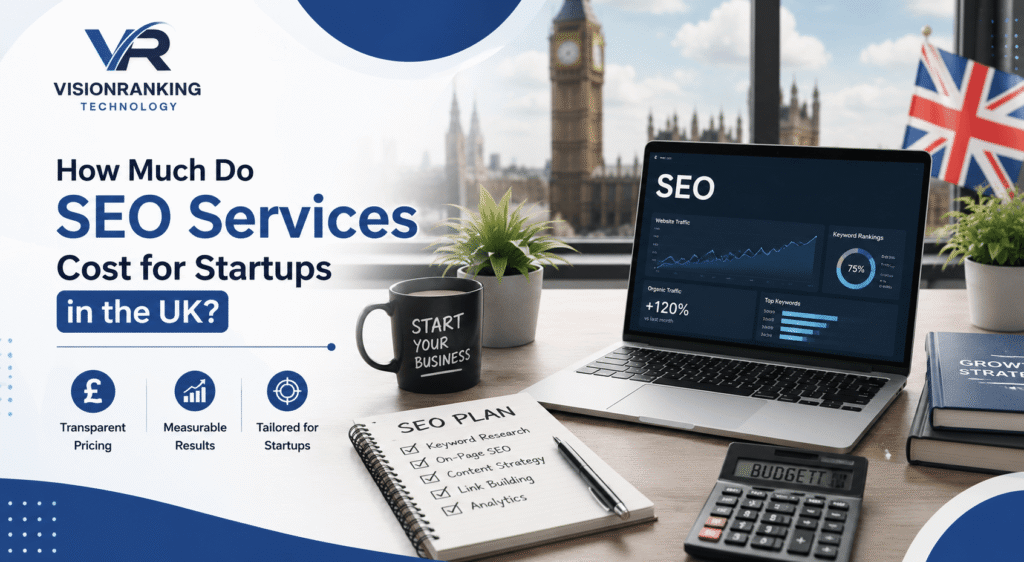
How Much Do SEO Services Cost for Startups in the UK?
📌 Key Takeaways
- SEO Costs: Startup SEO budgets in the UK depend on website requirements, competition and business goals.
- Right Strategy: Focus on commercial keywords that attract potential customers.
- Long-Term Growth: SEO builds organic visibility and reduces dependence on paid advertising.
- AI Search: AEO, GEO and AI Overviews are important considerations in modern SEO strategies.
- Choose Wisely: Partner with an SEO agency that offers transparent pricing, customised strategies and regular reporting.
Starting a business in the UK involves several financial decisions. You need to invest in product development, marketing, technology, customer acquisition and business operations. Building online visibility is another important part of this investment. This is where SEO becomes valuable.
However, one question often comes up when startup founders plan their digital marketing budget: How much do SEO services cost for startups in the UK?
The answer depends on your business model, website condition, target audience, competition and growth objectives. A startup targeting a small local market will have different SEO requirements from a technology company trying to attract customers across the UK.
In general, a startup should consider SEO as a long-term customer acquisition investment rather than a one-time marketing expense. A well-planned SEO strategy helps your business reach potential customers when they search for relevant products or services, build brand credibility and generate enquiries through organic search.
Working with the right SEO agency for startups also helps you avoid unnecessary marketing expenses. Instead of investing in activities without a clear direction, you receive a strategy based on your business goals, target keywords and available budget.
In this guide, we explain UK startup SEO pricing, the factors affecting costs, different service packages, expected deliverables and how to choose a reliable SEO partner.
SEO Services for Startups Cost in the UK
For most startups, SEO costs depend on the amount of work required and the level of competition in their industry. A business with a newly launched website might need technical improvements, keyword research and essential landing pages. An established startup entering a competitive UK market might require a broader strategy covering content, authority building and conversion optimisation.
The following figures provide an indicative budgeting guide, not fixed market rates or Vision Ranking’s published package prices.
| SEO service level | Indicative monthly budget | Suitable for |
| Basic startup SEO | £300 to £600 | New startups with limited website requirements |
| Growth-focused SEO | £600 to £1,500 | Startups targeting consistent organic growth |
| Competitive SEO campaign | £1,500 to £3,000 | Startups competing in established markets |
| Advanced SEO campaign | £3,000+ | Businesses targeting multiple services or markets |
UK SEO providers publish different starting prices and service scopes. Published pricing guides also show considerable variation between entry-level retainers and more comprehensive agency campaigns.
Important: These figures are indicative planning ranges. Actual costs depend on the scope, deliverables, agency experience, website condition and competition. VAT, content production, development work and additional tools might also affect the final budget.
What Should a Startup Expect from Each Budget?
1. Basic SEO: £300 to £600 per month
This level suits startups with a relatively small website and a limited number of products or services.
Typical activities include:
- Initial website review and keyword research.
- Basic on-page SEO recommendations.
- Title tags and meta description optimisation.
- Essential technical SEO checks.
- Google Search Console monitoring.
- Initial content and internal linking recommendations.
This option provides a starting point for building organic visibility. However, startups competing in demanding industries might need additional resources.
2. Growth-Focused SEO: £600 to £1,500 per month
This budget offers more room for ongoing SEO activities and a structured growth strategy.
Typical activities include:
- Detailed keyword research and competitor analysis.
- Technical SEO improvements.
- Service page and landing page optimisation.
- Regular SEO content planning and optimisation.
- Internal linking improvements.
- Relevant backlink acquisition.
- Search performance tracking and reporting.
- Conversion-focused recommendations.
For startups looking to generate enquiries and establish their presence in a defined market, this level provides a more balanced approach.
3. Competitive SEO: £1,500 to £3,000 per month
Startups operating in competitive sectors often need broader SEO coverage.
This campaign might include:
- Advanced technical SEO.
- Content strategy and topic clusters.
- Multiple landing page optimisations.
- Commercial and transactional keyword targeting.
- Industry-specific content development.
- Quality link-building activities.
- AEO and GEO recommendations.
- Conversion rate optimisation.
- Detailed performance reporting.
4. Advanced SEO: £3,000+ per month
This level suits startups with ambitious expansion plans, multiple product categories or several target markets.
Activities might cover international SEO, large-scale content planning, complex technical SEO, digital PR, advanced analytics and ongoing optimisation across multiple website sections.
The right budget is the one that supports your business priorities without putting unnecessary pressure on your operating expenses.
Need help deciding your SEO budget? Request a Free Website Audit from Vision Ranking to understand your website’s current requirements and potential SEO opportunities.
What Factors Affect SEO Pricing for Startups?
Two startups operating in the same industry might receive different SEO quotations. Their websites, competition, target markets and business objectives are rarely identical.
Understanding the following factors helps you evaluate an SEO proposal more accurately.
1. Website Size and Current Condition
A startup with a five-page website has different optimisation requirements from a SaaS platform with hundreds of feature, integration and product pages.
The agency needs to review:
- Website structure and navigation.
- Existing technical issues.
- Indexed and non-indexed pages.
- Page loading performance.
- Mobile usability.
- Duplicate content and broken links.
- Existing keyword rankings and organic traffic.
A website with serious technical issues might require additional work before the agency focuses on content expansion and link building.
2. Industry Competition
The level of competition directly affects the resources required for an SEO campaign.
For example, a startup offering a specialised software solution to a narrow business audience might find opportunities through specific commercial keywords.
However, a fintech startup targeting broad financial services searches will face different competition and trust requirements.
A good SEO agency for startups evaluates keyword difficulty, search intent, existing competitors and the commercial value of each opportunity before recommending a budget.
3. Target Audience and Location
Your target market also influences SEO costs.
A startup targeting customers in Manchester might need a different strategy from a company targeting customers throughout the UK.
International expansion adds further requirements, such as:
- Country-specific keyword research.
- International landing pages.
- Appropriate URL structures.
- Hreflang implementation where relevant.
- Localised content.
- International search performance monitoring.
The more markets and audiences you target, the more planning and optimisation your campaign requires.
4. Content Requirements
Content plays an important role in helping search engines and potential customers understand your products and services.
A startup with limited website content might need new service pages, product descriptions, industry pages, comparison articles and FAQs.
Content requirements also depend on the complexity of your offering. A technical B2B product needs more detailed explanations than a straightforward consumer service.
5. Backlink and Brand Authority Requirements
New startups often have limited brand recognition and few established references from relevant websites.
Building authority requires a consistent approach to relevant industry publications, digital PR opportunities, useful resources and quality backlinks.
The cost depends on the difficulty of acquiring relevant links, research requirements and the quality of the opportunities.
Avoid agencies that focus exclusively on backlink numbers without explaining relevance and quality.
What Is Included in SEO Packages for Startups?
SEO packages should reflect the actual requirements of your business rather than offer identical deliverables to every customer.
Before selecting a package, understand which activities the agency will perform, how often it will perform them and how the work connects with your business objectives.
Here is a comparison of common SEO services:
| SEO activity | Business purpose |
| Keyword research | Identify relevant search opportunities |
| Technical SEO | Improve crawling, indexing and website health |
| On-page SEO | Improve page relevance and search visibility |
| Content marketing | Address customer questions and buying intent |
| Link building | Develop relevant website authority |
| Local SEO | Reach customers in targeted locations |
| AEO | Improve content structure for answer-based searches |
| GEO | Improve content clarity for AI-generated search experiences |
| Analytics and reporting | Measure visibility, traffic and enquiries |
Why Customised SEO Packages Matter
Consider a SaaS startup launching a new project management platform.
Its immediate requirement might be to improve visibility for product-related searches, feature keywords and industry-specific queries.
A local professional services startup, however, might need location pages, Google Business Profile optimisation and service-focused content.
Both businesses need SEO, but their priorities are different.
A reliable startup SEO company should recommend a package based on these differences instead of selling unnecessary activities.
Why Do Startups Need Professional SEO Services?
Many startup founders initially depend on paid advertising, social media campaigns and personal networks to acquire customers. These channels support early growth, but a business also needs a sustainable way to reach people who actively search for its solutions.
SEO helps establish this foundation.
1. Build Brand Visibility in Your Target Market
When people search for products or services related to your business, your website needs relevant pages that explain what you offer.
SEO helps improve the visibility of these pages and introduces your brand to potential customers during their research process.
2. Attract More Relevant Website Visitors
High website traffic does not always mean business growth.
For example, a startup selling business automation software needs visitors who are interested in automation solutions, not people searching for unrelated technical information.
A focused keyword strategy helps attract visitors whose requirements match your products or services.
3. Generate Qualified Business Enquiries
SEO supports lead generation by connecting your website with people who are researching, comparing or evaluating potential solutions.
A well-optimised service page should explain:
- The problem your product or service solves.
- Who should use your solution.
- Your main features and benefits.
- Why customers should consider your business.
- How potential customers can contact you.
Clear information and relevant calls to action help visitors take the next step.
4. Reduce Long-Term Dependence on Paid Advertising
Paid advertising often stops generating traffic when the campaign budget runs out.
Organic search works differently. Pages that earn and maintain search visibility can continue attracting relevant visitors without paying for every individual click.
However, SEO still requires ongoing investment in content, technical improvements, authority and performance monitoring.
5. Build Trust Before Customers Contact You
Potential customers often research a startup before making a purchasing decision.
They might check its website, services, customer reviews, expertise, case studies and business information.
A well-maintained website with useful content and clear company information helps establish credibility during this process.
Which Startups Need SEO Services?
SEO is relevant to different startup models, but the strategy should reflect how each business acquires customers.
SaaS Startups
Software companies need visibility for product features, integrations, use cases and software comparisons.
For example, a startup offering customer relationship management software might target searches related to CRM platforms for small businesses, sales automation and customer management solutions.
SEO helps connect product pages and supporting content with users researching these solutions.
Technology Startups
Technology startups often provide specialised products, software development or technical solutions.
Their SEO strategy should explain complex services in language potential customers understand.
Technical articles, solution pages, industry-specific landing pages and commercial keyword targeting help communicate their expertise.
E-commerce Startups
E-commerce businesses need visibility for product categories, individual products and transactional searches.
Their campaigns often require product page optimisation, category structure improvements, internal linking and technical SEO.
B2B Startups
B2B companies often deal with longer buying cycles and multiple decision-makers.
Their SEO strategy should target business requirements, industry problems, commercial searches and solution-related queries.
Detailed service pages, case studies and educational resources support customers during their evaluation process.
Fintech and Professional Service Startups
Businesses offering financial technology or professional services need clear, accurate and trustworthy information.
Their content should explain services, limitations, expertise and relevant business details. SEO should support credibility rather than rely on unsupported promotional claims.
How Does an SEO Agency for Startups Deliver Results?
SEO involves several connected activities. Completing one audit or publishing a few articles is rarely enough to build a sustainable organic search presence.
A structured campaign connects technical improvements, keyword targeting, content development and authority building with measurable business objectives.
Here is how the process typically works.
Step 1: Website and Business Analysis
The first step is understanding your business, products, target customers and growth objectives.
An SEO agency reviews your existing website and identifies opportunities and problems affecting organic search performance.
This includes checking website structure, indexing, existing content, keyword visibility and technical health.
Step 2: Keyword Research and Search Intent Analysis
Keyword research should focus on the searches your potential customers make before choosing a product or service.
For example, a startup offering accounting software might target:
- Accounting software for small businesses.
- Cloud accounting software for startups.
- Business accounting automation.
- Accounting software pricing.
- Best accounting solution for growing companies.
The agency should separate informational, commercial and transactional keywords to create a suitable content and landing page strategy.
Step 3: Technical SEO Improvements
Technical SEO provides the foundation for search engine crawling and indexing.
The agency reviews important elements such as:
- XML sitemap and robots.txt.
- Canonical tags and redirects.
- Broken links and indexing issues.
- Mobile usability.
- Core Web Vitals.
- Website architecture.
- Structured data where appropriate.
These improvements help search engines access and understand your website.
Step 4: On-Page SEO and Landing Page Optimisation
Your website pages should communicate your offerings clearly and target relevant search intent.
The agency works on title tags, meta descriptions, heading structures, keyword placement, image alt text, internal links and content recommendations.
For startups, commercial landing pages deserve particular attention because they help turn relevant visitors into enquiries.
Step 5: Content Development and Optimisation
A consistent content strategy helps establish your startup’s relevance across important industry topics.
Depending on your business, this might involve:
- Service and product pages.
- Industry-specific landing pages.
- Educational blog articles.
- Product comparison content.
- Case studies and success stories.
- Frequently asked questions.
Content should address genuine customer requirements and support purchasing decisions.
Step 6: Link Building and Authority Development
The agency identifies relevant opportunities to strengthen your website’s authority.
This might include industry publications, business directories, digital PR, useful industry resources and relevant editorial links.
Quality and relevance should remain the priorities.
Step 7: Performance Monitoring and Reporting
Regular reporting helps business owners understand whether the campaign is moving in the right direction.
Important performance indicators include:
- Organic clicks and impressions.
- Keyword rankings.
- Organic landing page traffic.
- Qualified enquiries.
- Conversion rates.
- Indexed pages.
- Referring domains and backlinks.
- Relevant AI search visibility observations.
Google Search Console and Google Analytics 4 provide useful information for evaluating organic search performance and website engagement.
What Results Should Startups Expect from SEO?
One of the biggest mistakes startup founders make is expecting immediate results from SEO.
SEO is a continuous process. The time required to see improvements depends on your website’s history, technical condition, competition, content quality and the resources invested.
A realistic campaign should focus on gradual improvements rather than guaranteed rankings or fixed traffic targets.
The following table illustrates a possible campaign progression. It is a planning framework, not a guaranteed timeline.
| Campaign period | Main SEO priorities | Expected focus |
| Months 1 to 2 | Audit, keyword research, technical fixes | Build a strong foundation |
| Months 3 to 4 | On-page SEO, content and landing pages | Improve relevance and indexing |
| Months 5 to 6 | Content expansion and authority building | Develop search visibility |
| Months 7 to 9 | Performance analysis and optimisation | Identify growth opportunities |
| Months 10 to 12 | Strategy refinement and expansion | Strengthen organic lead generation |
Some technical improvements might produce earlier benefits, while competitive keywords and broader organic growth often require more time.
A responsible startup SEO consultant should explain what has improved, which activities remain pending and where the next investment should go.
Looking for a realistic SEO growth plan? Talk to Vision Ranking about your current website performance and business objectives.
SEO vs Paid Advertising: Which Is Better for Startups?
Both SEO and paid advertising support customer acquisition, but they work differently.
Startups should understand their strengths before allocating the marketing budget.
| Comparison | SEO | Paid Advertising |
| Traffic source | Organic search | Paid placements |
| Payment model | Ongoing SEO investment | Advertising budget |
| Traffic continuity | Can continue after individual tasks are completed | Generally stops when ads stop |
| Initial visibility | Usually takes time | Can begin shortly after launch |
| Long-term value | Builds organic search assets | Depends on continued ad spend |
| Customer intent | Targets relevant search queries | Targets audiences and search queries |
| Best use | Sustainable organic growth | Immediate campaign exposure |
For an early-stage startup, combining SEO and paid advertising often makes sense when the budget allows.
Paid campaigns provide opportunities to test messaging and landing pages, while SEO builds organic visibility over time.
The right balance depends on your customer acquisition targets, cash flow and business model.
Common SEO Mistakes Startups Should Avoid
Limited budgets make it important for startups to prioritise the right activities.
Some common mistakes increase costs without creating meaningful business value.
1. Choosing Keywords Based Only on Search Volume
High-volume keywords are not always commercially valuable. A keyword with lower search demand but stronger purchasing intent might generate better enquiries.
2. Buying Cheap Backlinks
Low-quality link-building schemes can create unnecessary search risks. Focus on relevant and credible websites rather than bulk backlink numbers.
3. Ignoring Technical SEO
Publishing content without addressing important crawling, indexing or website structure problems can limit its effectiveness.
4. Publishing Content Without a Strategy
Random blog publishing often creates disconnected pages with limited business value. Every important content asset should serve a defined search intent and connect with relevant services.
5. Expecting Immediate Rankings
SEO requires consistent work. Expecting first-page rankings within a few weeks creates unrealistic expectations and often leads to poor decisions.
6. Ignoring Website Conversions
More organic traffic does not automatically mean more customers. Your website also needs clear service information, trust signals, contact options and relevant calls to action.
7. Measuring Only Keyword Rankings
Rankings matter, but business owners should also monitor enquiries, organic conversions, qualified traffic and landing page performance.
Red Flags While Choosing a Startup SEO Company
Choosing an SEO partner is an important decision, especially when your startup has a limited marketing budget.
Before signing an agreement, watch for these warning signs.
| Red flag | Why it matters |
| Guaranteed number-one rankings | No agency controls Google’s ranking decisions |
| Extremely cheap bulk SEO packages | The work might lack depth or quality |
| No initial website audit | Recommendations might not address your actual requirements |
| Unclear deliverables | You might not know what your monthly fee covers |
| Guaranteed traffic or leads | Business outcomes depend on several factors |
| No reporting process | You cannot properly evaluate campaign progress |
| Irrelevant backlink promises | Link quantity does not establish quality |
| Long contracts without clear terms | You might face unnecessary commitment |
A trustworthy agency explains its approach, limitations, deliverables and reporting process before starting the campaign.
It should also be willing to discuss what SEO is unlikely to achieve within your available budget.
Questions to Ask Before Hiring an SEO Agency for Startups
Before choosing an agency, ask questions that help you understand its working process and suitability for your business.
1. What will your SEO strategy include?
Ask for a clear breakdown of technical SEO, keyword research, content, on-page optimisation and link building.
2. Will you customise the campaign for my startup?
Your strategy should reflect your products, business model, audience and competition.
3. How will you measure SEO performance?
Discuss organic traffic, qualified enquiries, keyword visibility, conversions and reporting frequency.
4. How much time will the campaign require?
The agency should provide realistic expectations based on your website and industry.
5. Who will manage my SEO campaign?
Understand who handles strategy, implementation, content and reporting.
6. Will I receive regular reports?
Ask for reporting access and clarification about the performance indicators included.
7. Do you include AEO and GEO in your strategy?
Ask how the agency approaches answer-based and AI-powered search visibility alongside traditional SEO.
8. What happens if my business expands into another market?
Your SEO strategy should have room to evolve as your products, audience and geographical reach grow.
How Are SEO, AEO and GEO Important for Startup Growth?
Search behaviour continues to evolve. People now use traditional search engines, AI-powered search experiences and conversational platforms to research products and services.
For startups, this creates additional opportunities to communicate their expertise and reach potential customers.
Three related approaches deserve attention.
Search Engine Optimisation (SEO)
SEO focuses on improving your website’s visibility in organic search results.
It includes technical optimisation, keyword research, on-page improvements, content development and authority building.
Answer Engine Optimisation (AEO)
AEO focuses on helping users find clear and relevant answers to their questions.
For example, a startup offering HR software might create useful content explaining how employee management software supports growing businesses.
Clear headings, informative answers, relevant FAQs and structured information help users understand the offering.
Generative Engine Optimisation (GEO)
GEO focuses on improving how your business information is presented and understood across AI-generated search and response experiences.
This involves clear service descriptions, useful supporting content, relevant brand information and consistent website information.
What About Google AI Overviews?
Google’s official guidance explains that existing SEO fundamentals remain relevant to AI Overviews and AI Mode. Pages need to meet the normal technical requirements for Google Search and provide helpful, reliable, people-first content. There are no additional technical requirements or special schema markups specifically required for inclusion.
For startups, the practical priorities include:
- Publishing original and useful information.
- Making important website content accessible to search engines.
- Creating clear product and service explanations.
- Organising content with meaningful headings.
- Strengthening relevant internal links.
- Maintaining accurate business information.
- Monitoring search visibility and performance.
No agency should promise guaranteed placement in AI Overviews, ChatGPT or other AI-generated responses.
Why Choose Vision Ranking for Startup SEO Services?
Vision Ranking understands that startups need a search strategy aligned with their current resources and future business goals.
Our approach focuses on building organic visibility, improving website performance and attracting relevant audiences rather than chasing rankings without a clear business purpose.
We develop customised SEO strategies based on your website, industry, target audience and growth objectives.
Business-Focused SEO Strategy
We research your products, services, customers and market before recommending SEO priorities.
Our goal is to connect search opportunities with your actual business requirements.
Technical and On-Page SEO Expertise
We identify website issues affecting search engine crawling, indexing and page relevance.
Our recommendations cover technical improvements, website structure, metadata, headings, internal links and landing page optimisation.
Content Strategy and Keyword Research
We identify keywords based on search intent, competition and commercial relevance.
Our content planning focuses on useful service pages, product pages, industry content and supporting resources.
SEO, AEO and GEO Integration
We consider traditional organic search alongside answer-based and AI-powered search experiences.
This helps prepare your website for changing search behaviour while maintaining strong SEO fundamentals.
Transparent Performance Reporting
We monitor campaign performance through relevant search and website metrics.
Our reporting approach helps you understand keyword visibility, organic traffic, indexing, backlink development and enquiries where conversion tracking is available.
Scalable SEO Solutions
Your SEO requirements will change as your startup grows.
We adapt campaign priorities to support new services, additional landing pages, expanding target markets and changing customer requirements.
Explore our SEO Services for Startups to understand how Vision Ranking approaches organic growth for emerging businesses.
Our Process for Working with Startups
We follow a structured process to keep your SEO campaign organised and aligned with your business objectives.
- Initial Consultation
We discuss your startup, services, target audience, marketing objectives and current challenges.
- Website Audit and Analysis
We review your website’s technical health, existing content, keyword visibility and optimisation requirements.
- Keyword Research and Strategy
We prepare a targeted keyword list based on search intent, commercial value and competition.
- SEO Recommendations and Approval
We share the proposed optimisation plan and discuss implementation priorities with your team.
- On-Page and Technical Implementation
We work on approved website improvements and coordinate with your development team when required.
- Content and Authority Development
We strengthen relevant pages, plan supporting content and identify suitable link-building opportunities.
- Monitoring and Reporting
We review performance, identify new opportunities and refine the campaign based on available data.
Our focus is to build a long-term working relationship in which your SEO strategy develops alongside your startup.
Business Benefits of Investing in Professional SEO
Professional SEO services offer benefits beyond improved keyword rankings.
For startups, the value comes from developing a stronger online presence and connecting with potential customers through relevant searches.
The main business benefits include:
- Better market visibility: Help potential customers find your products and services.
- Relevant organic traffic: Attract visitors searching for solutions related to your business.
- Qualified enquiries: Connect with people researching or considering your offerings.
- Brand credibility: Present useful information that supports customer confidence.
- Long-term marketing value: Develop website content and organic visibility that continue supporting your business.
- Competitive positioning: Target relevant search opportunities within your industry.
- Scalable growth: Expand your SEO strategy as your business enters new markets or introduces new products.
- Better marketing insights: Understand which pages, topics and search queries attract your target audience.
The value of SEO should ultimately be assessed through its contribution to business objectives, not through traffic growth alone.
Final Thoughts: How Much Should Your Startup Invest in SEO?
The cost of SEO services for startups in the UK depends on your business requirements, competition, website condition and growth objectives.
A startup with a limited budget should focus on essential technical improvements, commercial keyword targeting and important landing pages. As the business grows, its SEO investment can expand to include content marketing, authority building, AEO, GEO and wider market targeting.
The most important decision is choosing an SEO partner who understands your business and provides a clear strategy for achieving your objectives.
At Vision Ranking, we focus on practical SEO strategies that help startups build online visibility, reach relevant audiences and develop long-term organic growth opportunities.
Whether you are launching a new business, expanding a SaaS product or targeting customers across the UK, our team is ready to discuss your SEO requirements.
Ready to build your startup’s organic presence?
Frequently Asked Questions About SEO Services for Startups
1. How much do SEO services cost for startups in the UK?
SEO services for startups in the UK generally require a monthly budget based on the website’s size, industry competition and campaign requirements. An indicative planning budget ranges from £300 to £1,500 per month for basic to growth-focused campaigns. More competitive campaigns often require £1,500 or more.
2. Are SEO packages for startups worth the investment?
Yes. SEO packages help startups build organic visibility, attract relevant visitors and generate business enquiries. The investment becomes more valuable when the campaign targets commercial keywords and supports actual customer acquisition goals.
3. How long does startup SEO take to show results?
SEO timelines vary depending on website history, competition, technical health and content quality. Some improvements might appear within the first few months, while meaningful organic traffic and lead growth often require several months of consistent optimisation.
4. Should a new startup hire an SEO agency or a freelancer?
Both options have advantages. A freelancer might suit a startup requiring specific SEO support or consultancy. An SEO agency is worth considering when your business needs coordinated technical SEO, content development, keyword strategy, link building and performance reporting.
5. What should an SEO agency for startups include in its packages?
A suitable package should include keyword research, technical SEO, on-page optimisation, content planning, internal linking, relevant link building and performance reporting. Additional requirements might include local SEO, AEO and GEO, depending on the business model.
6. Is SEO better than paid advertising for startups?
SEO and paid advertising serve different purposes. Paid advertising supports immediate campaign visibility, while SEO builds organic search visibility over time. Startups with sufficient marketing budgets often benefit from combining both channels.
7. Do startups need a dedicated startup SEO consultant?
A startup SEO consultant helps businesses identify relevant search opportunities, prioritise optimisation activities and plan campaigns around available resources. A dedicated consultant is particularly useful when founders need strategic direction without hiring a full internal SEO team.
8. Can SEO help a startup compete with established businesses?
Yes. Startups can target specific customer requirements, specialised services and long-tail keywords where relevant opportunities exist. A focused strategy helps smaller businesses build visibility without relying exclusively on highly competitive industry keywords.
9. Do SEO services for startups include AI search optimisation?
They can. Depending on the agency’s scope, startup SEO campaigns might include AEO and GEO recommendations to improve content clarity and relevance across answer-based and AI-powered search experiences. However, no agency can guarantee visibility in AI-generated results.
10. How do I choose the right startup SEO company in the UK?
Evaluate the company’s SEO experience, strategic approach, deliverables, reporting process and understanding of your industry. Ask for a website audit, realistic expectations and a customised proposal before making a decision.