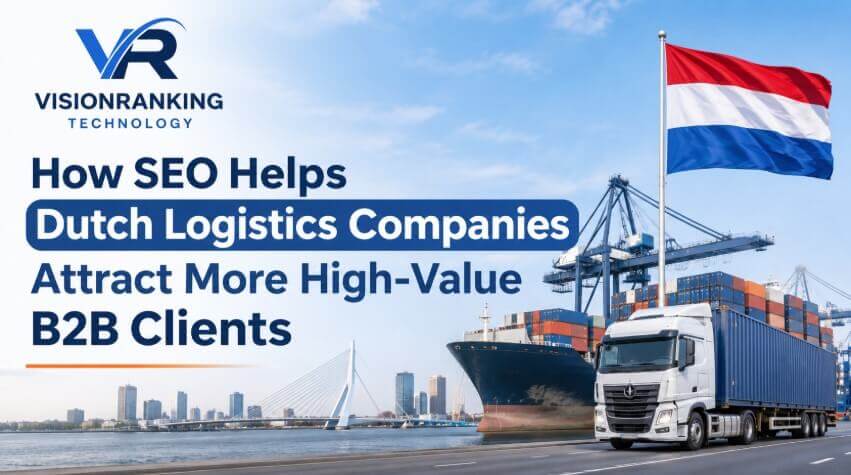
How SEO Helps Dutch Logistics Companies Attract More High-Value B2B Clients
📌 Key Takeaways
- SEO helps Dutch logistics companies connect with procurement managers, supply chain professionals and businesses actively searching for logistics partners.
- Service-specific and location-focused landing pages attract more relevant commercial traffic than broad logistics keywords alone.
- Industry-focused content helps demonstrate expertise and address the practical concerns of potential B2B customers.
- Technical SEO, website usability and clear service information make it easier for search engines and prospective clients to understand a business.
- Local SEO and multilingual content can improve visibility across different Dutch regions and international markets.
- Measuring qualified enquiries, organic conversions and commercial search performance provides a clearer picture of SEO effectiveness than traffic growth alone.
The Netherlands is one of Europe’s most important logistics and distribution hubs, connecting international businesses through major seaports, airports, road networks and inland waterways. For logistics companies operating in this market, attracting the right business clients requires more than competitive pricing and reliable transportation services. It also requires a strong online presence that makes their capabilities visible to potential customers.
Search Engine Optimisation (SEO) helps Dutch logistics companies reach businesses actively searching for freight forwarding, warehousing, supply chain management, transportation and international distribution services. By targeting relevant commercial searches, developing informative industry content and improving website performance, logistics providers can attract decision-makers who are researching potential long-term partners.
However, generating valuable enquiries is not simply about increasing website traffic. A logistics company needs to appear in searches that reflect its actual services, operational capabilities, geographical coverage and ideal customer requirements. A focused B2B marketing strategy can help businesses connect their online visibility with the needs of professional buyers and decision-makers.
A well-planned SEO strategy can help businesses build this visibility, establish credibility and create more opportunities to attract high-value B2B clients across the Netherlands and international markets.
Why Is SEO Important for Logistics Companies in the Netherlands?
SEO is important for Dutch logistics companies because it improves their visibility when businesses search online for transportation, freight, warehousing and supply chain solutions. It helps logistics providers reach potential customers during the research and supplier-selection stages.
The Dutch logistics market serves a broad range of industries, including manufacturing, retail, e-commerce, pharmaceuticals, agriculture and international trade. These businesses often require specialised logistics partners rather than general transportation providers.
The Netherlands also has a particularly important position in European freight movement. According to Statistics Netherlands (CBS), Dutch seaports handled nearly 575 million tonnes of cargo in 2025, with approximately 77% passing through the Rotterdam port area. This highlights the scale and importance of the country’s maritime logistics infrastructure.
For logistics providers, this creates opportunities to reach businesses involved in international shipping, distribution, storage and supply chain operations.
However, potential clients do not necessarily know which logistics company can meet their requirements. They often begin with searches such as:
- Freight forwarding companies in the Netherlands
- International logistics services for manufacturers
- Third-party logistics providers for e-commerce
- Warehousing and distribution services in Rotterdam
- Temperature-controlled transportation providers
- European road freight and transportation companies
If a logistics company’s website does not appear for relevant searches, potential customers may discover alternative providers instead.
SEO helps businesses become discoverable at these important decision-making moments.
1. Target High-Intent Keywords That Attract Business Buyers
Keyword research is one of the most important foundations of an effective logistics SEO strategy.
However, targeting every keyword related to transportation or logistics is unlikely to produce valuable business enquiries. The focus should be on identifying search terms that reflect the services a company provides and the requirements of its potential customers.
A person searching for a definition of freight forwarding has different intentions from a procurement manager looking for an international freight forwarding partner.
Understanding this distinction helps logistics companies prioritise commercially relevant keywords.
Focus on service-specific search terms
Instead of relying exclusively on broad keywords such as “logistics company” or “transport services”, businesses should identify searches connected to individual services.
Examples include:
| Service category | Relevant search terms |
| Freight forwarding | International freight forwarding Netherlands |
| Warehousing | Commercial warehousing services Netherlands |
| Road transport | European road freight services |
| Contract logistics | Contract logistics providers Netherlands |
| Third-party logistics | 3PL services for e-commerce businesses |
| Cold chain logistics | Temperature-controlled logistics Netherlands |
| Supply chain management | Supply chain management services |
These keywords help communicate what a logistics company actually offers.
For example, a business specialising in pharmaceutical transportation should not rely entirely on general freight-related searches. It should also develop relevant visibility around temperature-controlled transportation, pharmaceutical distribution and specialised handling requirements, provided these services are genuinely available.
Understand commercial search intent
Not every search visitor is ready to contact a logistics provider. Some are researching industry concepts, while others are comparing suppliers or looking for quotations.
A useful keyword strategy considers different stages of the buying journey.
Informational searches
Examples:
- How does international freight forwarding work?
- What is contract logistics?
- How can businesses improve warehouse distribution?
These searches provide opportunities to attract potential customers through educational content.
Commercial investigation searches
Examples:
- Best logistics providers for manufacturing companies
- International freight forwarding services Netherlands
- Warehouse management companies in Rotterdam
These searches indicate that users may be evaluating potential providers.
Transactional searches
Examples:
- Request a freight forwarding quote
- Hire a third-party logistics provider
- Contact an international transport company
These searches are particularly valuable because they often indicate a stronger intention to engage with a service provider.
A balanced SEO strategy should address all three stages while prioritising keywords that align with the company’s commercial objectives.
2. Build Dedicated Service Pages for Different Logistics Requirements
A logistics website should make it easy for potential customers to understand its services without searching through general descriptions.
One common website limitation is presenting every logistics solution on a single page. Although this provides an overview of the business, it may not adequately address the different requirements of individual customer groups.
Dedicated service pages create clearer entry points for relevant searches.
Create pages around individual services
A logistics provider offering multiple solutions could develop dedicated pages for:
- International freight forwarding
- Road transportation
- Sea freight services
- Air freight solutions
- Warehousing and storage
- Third-party logistics
- Contract logistics
- Supply chain management
Each page should explain the specific service, its intended business applications and the company’s capabilities.
For example, an international freight forwarding page could cover:
- Available transportation methods.
- Import and export shipping requirements.
- Geographic coverage.
- Types of cargo handled.
- Coordination with transportation partners.
- Documentation and customs-related support, where applicable.
- How businesses can request a quotation.
The objective is to give potential clients enough relevant information to understand whether the provider is suitable for their requirements.
Connect services with specific industries
Logistics requirements can differ significantly between industries.
A manufacturing company may prioritise dependable component transportation and inventory coordination. An e-commerce business may focus on order fulfilment, warehousing and distribution capacity.
Similarly, pharmaceutical businesses may require specialised temperature-controlled transportation and appropriate handling procedures.
Where a company genuinely serves these industries, dedicated industry pages can explain how its services address their operational requirements.
This approach helps attract more relevant searches and gives potential customers a clearer understanding of the provider’s suitability.
However, businesses should avoid creating multiple nearly identical pages with only the industry name changed. Each page should contain genuinely useful, industry-specific information.
3. Improve Local SEO to Reach Businesses Across Dutch Logistics Hubs
Local SEO helps logistics companies improve their visibility for searches associated with specific geographical locations.
Although many logistics contracts involve international operations, buyers frequently research providers based on their location, warehouse facilities, transportation routes or proximity to important distribution centres.
Focus on relevant logistics regions
A logistics provider should identify geographical areas that genuinely reflect its operational presence and service coverage.
Some important logistics locations include:
- Rotterdam: An important international maritime freight and distribution centre.
- Amsterdam: Relevant to air cargo, maritime activities and regional distribution.
- Schiphol: A major hub for international air freight.
- Venlo: An important location for cross-border distribution and European logistics operations.
- Tilburg: Associated with warehousing, transportation and regional distribution activities.
These locations offer different commercial opportunities depending on the company’s services.
For example, a freight forwarder operating through Rotterdam may benefit from content focused on international sea freight and port-related logistics requirements.
A warehousing provider serving Venlo could instead prioritise searches related to storage, fulfilment and cross-border distribution.
Optimise the Google Business Profile
A properly maintained Google Business Profile can support local visibility and help businesses discover relevant company information.
Logistics companies with eligible physical business locations should ensure their profiles contain:
- Accurate business name and contact information.
- Correct business address or eligible service-area details.
- Relevant business categories.
- Clear descriptions of available services.
- Updated business hours.
- Genuine photographs of facilities and operations.
- Authentic customer reviews and appropriate responses.
Consistency between the business website and online business listings also helps customers verify important company information.
For businesses researching digital marketing support, the Vision Ranking – Digital Marketing Company Google Business Profile provides another way to discover the company’s business information.
It is important to remember that local SEO should reflect genuine business locations and service coverage. Creating misleading location pages or listing addresses where a company has no legitimate presence can undermine trust.
4. Use Industry-Focused Content Marketing to Build B2B Trust
High-value B2B clients rarely make logistics decisions based on a single website visit.
Selecting a logistics partner can involve reviewing service capabilities, delivery requirements, operational reliability, industry knowledge and long-term suitability.
Content marketing gives logistics companies an opportunity to address these considerations before a potential customer makes contact.
Rather than publishing generic articles about transportation, businesses should create content around the specific challenges their customers experience.
Develop content around real customer questions
Useful content topics for Dutch logistics companies include:
- How to choose an international freight forwarding partner.
- What businesses should consider when selecting a warehousing provider.
- How third-party logistics services support e-commerce operations.
- Factors affecting international freight transportation costs.
- How supply chain visibility improves business operations.
- What manufacturers should consider when outsourcing logistics.
- How to evaluate logistics providers for cross-border distribution.
These topics attract readers who are researching operational challenges and potential solutions.
For example, an article explaining how to evaluate a 3PL provider can help e-commerce businesses understand important considerations such as fulfilment capacity, inventory management, order processing and distribution coverage.
The article can then direct interested readers towards the company’s relevant 3PL service page.
Businesses can also improve the usefulness of their content by following practical content optimisation approaches for modern search experiences, particularly when structuring information around customer questions and search intent.
Demonstrate expertise through useful information
Strong industry content should provide meaningful information rather than simply repeat promotional statements.
A useful article should explain:
- The business problem being discussed.
- Why the problem matters to logistics operations.
- What potential solutions are available.
- Which factors businesses should evaluate.
- When professional logistics support may be appropriate.
Where possible, companies should incorporate genuine operational insights, relevant examples, service documentation and information from qualified industry professionals.
This approach gives potential customers a stronger reason to trust the information and consider the company as a possible service provider.
5. Develop a Multilingual SEO Strategy for International B2B Clients
The Netherlands has a strong international trading position, making multilingual communication particularly relevant for logistics providers serving customers across European and global markets.
Although English is widely used in international business, Dutch-language searches remain important for reaching local companies and decision-makers.
Businesses targeting multiple markets should consider how their website communicates with different language audiences.
Create useful Dutch and English content
A company targeting Dutch businesses could develop:
- Dutch-language service pages for local customers.
- English-language pages for international clients.
- Location-specific content for relevant Dutch logistics regions.
- Industry-specific information for different customer groups.
The language should reflect the audience’s actual search behaviour and business requirements.
Direct translation alone is not always sufficient. Search terminology, industry expressions and customer expectations can differ between markets.
For example, a keyword that performs well in an English-language freight forwarding campaign may not have an equivalent Dutch search phrase with the same commercial intent.
Keyword research should therefore be conducted separately for each language.
Implement appropriate international SEO elements
Websites targeting multiple languages should also have a technically sound international SEO structure.
Important considerations include:
Hreflang implementation: Hreflang annotations help search engines understand the intended language and regional audience of alternative page versions.
Dedicated language URLs: Separate URLs for different language versions make website organisation clearer.
Consistent translations: Important service details, contact information and business terminology should remain accurate across language versions.
Internal linking: Visitors should be able to navigate between relevant language versions without confusion.
Canonical tags: Each language page should have an appropriate canonical configuration to avoid incorrectly consolidating separate language versions.
A well-planned multilingual structure helps businesses serve different audiences while maintaining a clear website architecture.
6. Strengthen Technical SEO and Website Performance
Even useful content and relevant keywords may struggle to deliver results if a website has technical problems.
Technical SEO focuses on making a website accessible, understandable and efficient for search engines and visitors.
For logistics companies, website performance is particularly important because prospective B2B customers may need to review several service pages, operational details and company documents before making a decision.
Improve website speed and mobile usability
A website should load efficiently across desktop computers, tablets and smartphones.
Important areas to review include:
- Image compression and appropriate image formats.
- Browser caching and resource optimisation.
- Mobile-responsive website design.
- Unnecessary scripts and third-party resources.
- Core Web Vitals.
- Navigation and page accessibility.
Large images of warehouses, vehicles and transportation facilities can affect loading performance if they are not optimised.
Businesses should retain useful visual information while ensuring that images do not unnecessarily slow down important landing pages.
Make important pages easy to crawl and index
Search engines need to discover and understand a website’s important pages.
A technical SEO review should examine:
- XML sitemap configuration.
- Robots.txt directives.
- Canonical tags.
- Broken internal links.
- Redirect chains.
- Duplicate or thin pages.
- Indexation problems.
- Structured data implementation.
For example, if a company’s main freight forwarding page is accidentally excluded from indexing, potential customers may struggle to discover it through organic search.
Regular technical monitoring helps identify these problems before they affect important commercial pages for extended periods.
Use structured data where appropriate
Structured data provides additional information about website content in a format that search engines can interpret.
Depending on the page and business, relevant schema types may include:
- Organization.
- LocalBusiness, where applicable.
- Service.
- BreadcrumbList.
- Article.
Structured data should accurately represent visible website information and follow the relevant implementation guidelines.
It does not guarantee enhanced search appearances, but correct implementation can help search engines understand important business and content details.
Businesses looking to understand how technical foundations contribute to website visibility can also review SEO and website optimisation guidance covering important digital marketing considerations.
7. Build Website Authority Through Relevant Backlinks
Backlinks are links from external websites pointing towards a business website.
They can help search engines discover content and provide additional context about a company’s online presence.
For Dutch logistics companies operating in competitive B2B markets, a relevant backlink strategy can support broader SEO efforts.
However, the quality and relevance of links are more important than simply accumulating a large number.
Focus on relevant industry websites
Potential link-building opportunities include:
- Logistics and supply chain publications.
- Transportation industry websites.
- Relevant Dutch business publications.
- Manufacturing and trade industry platforms.
- Professional industry associations.
- Relevant business directories.
- Authoritative websites publishing logistics-related research.
For example, a logistics company publishing an informative guide about warehouse distribution may be able to attract relevant editorial references from websites discussing supply chain management.
Similarly, original research, useful industry explanations and genuinely valuable resources can create opportunities for natural citations.
Businesses interested in understanding different approaches can explore quality SEO link-building strategies and consider how relevance, editorial quality and natural link acquisition apply to their own market.
Avoid low-quality link-building practices
Businesses should be cautious about:
- Purchasing large quantities of unrelated backlinks.
- Using automated link-building networks.
- Publishing repetitive guest posts on irrelevant websites.
- Creating excessive directory listings.
- Using manipulative exact-match anchor text.
These approaches may create an unnatural backlink profile without delivering meaningful business value.
A sustainable strategy should prioritise relevant publications, useful content and genuine industry relationships.
8. Optimise Landing Pages to Convert Organic Visitors into B2B Enquiries
Attracting relevant visitors is only one part of successful SEO.
A logistics website must also help prospective customers take the next step.
If a procurement manager visits a service page but cannot understand the company’s capabilities or find a straightforward enquiry option, an opportunity may be lost.
Conversion optimisation focuses on making this journey clearer.
Include the information business buyers need
A well-structured logistics landing page should communicate:
- Services offered.
- Industries served.
- Geographical coverage.
- Transportation or storage capabilities.
- Relevant operational information.
- Business contact details.
- How to request a quotation.
Where applicable, companies can also provide information about cargo handling, shipment tracking, insurance arrangements, certifications and service limitations.
However, these details should only be included when they accurately reflect the company’s actual operations.
Use clear calls to action
Potential customers should not have to search for ways to contact a provider.
Useful calls to action include:
- Request a Logistics Quote
- Discuss Your Freight Requirements
- Contact Our Logistics Team
- Request a Warehousing Consultation
Enquiry forms should request relevant information without becoming unnecessarily complicated.
For example, a freight quotation form might ask for the shipment origin, destination, cargo type and approximate shipment requirements.
This helps the business understand the enquiry and assess whether it matches its services.
Build trust through transparent information
B2B buyers often need reassurance before discussing a potential contract.
Logistics providers can strengthen confidence by presenting genuine information such as:
- Company background.
- Operational capabilities.
- Relevant industry experience.
- Actual service locations.
- Verified certifications.
- Authentic customer testimonials, where available.
- Clear contact and company information.
The objective is to help prospective customers make informed decisions rather than rely on exaggerated promotional claims.
Building these trust signals also connects with broader E-E-A-T principles for establishing online credibility, particularly the importance of accurate information, demonstrable expertise and trustworthy business details.
9. Measure SEO Performance Through Qualified Leads, Not Just Traffic
A successful SEO campaign should contribute to business objectives, not simply increase website visits.
For logistics providers, a smaller number of relevant enquiries may be more valuable than a substantial increase in visitors who have no commercial interest in the services offered.
Performance measurement should therefore combine search visibility, website engagement and lead quality.
Important SEO performance indicators
| Performance metric | What it helps measure |
| Organic impressions | How frequently website pages appear in search results |
| Organic clicks | Visitors arriving through unpaid search results |
| Commercial keyword rankings | Visibility for relevant service-related searches |
| Landing page conversions | Enquiries generated by important service pages |
| Qualified leads | Enquiries matching the company’s target customers |
| Organic conversion rate | The proportion of organic visitors completing a desired action |
| Backlink quality | Relevance and credibility of referring websites |
Google Search Console can help monitor impressions, clicks, search queries and indexing performance.
Google Analytics 4 can help businesses understand website engagement, traffic sources and configured conversion events.
These tools become more valuable when their data is connected to actual sales enquiries.
Evaluate lead quality alongside organic growth
Consider a logistics company that receives enquiries from two different types of visitors.
One group consists of individuals looking for occasional, low-volume transportation. The other includes manufacturing businesses researching ongoing freight and warehousing partnerships.
If the company’s main commercial objective is to secure long-term B2B contracts, the second group may be more valuable.
This is why SEO reporting should distinguish between general website enquiries and leads that match the company’s target market.
Regular analysis helps businesses identify which services, keywords, landing pages and content topics are attracting the most relevant prospects.
10. How Vision Ranking Can Support SEO Growth for Dutch Logistics Companies
Building organic visibility in the logistics sector requires a coordinated approach to keyword research, content development, website optimisation and authority building.
A logistics business should not treat these activities as separate tasks. They need to work together to attract relevant visitors and guide potential customers towards meaningful enquiries.
This is where a structured digital marketing strategy becomes valuable.
Vision Ranking provides SEO and digital marketing services that can support businesses looking to improve their online visibility and organic search performance. Its broader digital marketing strategies for traffic, trust and business growth also highlight the importance of combining different marketing activities with clear business objectives.
Its SEO approach covers several important areas.
Keyword research and search intent analysis
Identifying relevant search terms helps businesses understand how potential customers search for their services.
For Dutch logistics providers, this can involve researching service-specific keywords, commercial search intent, industry terminology and geographical search opportunities.
The objective is to prioritise relevant search opportunities rather than pursue traffic without a clear business purpose.
On-page SEO and content optimisation
On-page optimisation improves how individual website pages communicate their relevance to users and search engines.
This can include:
- Title tag and meta description optimisation.
- Heading structure improvements.
- Content organisation.
- Keyword mapping.
- Internal linking.
- Image optimisation.
- Service page improvements.
Content development can also help businesses address customer questions and communicate their industry-specific capabilities more effectively.
Technical SEO
Technical optimisation helps identify issues that affect website crawling, indexing and performance.
Depending on the website’s requirements, this may include sitemap reviews, robots.txt checks, canonicalisation, website structure, broken links and page performance improvements.
Off-page SEO and link building
Relevant backlinks can support website authority and improve opportunities for discovery.
A quality-focused approach to link building prioritises relevant websites, useful content and appropriate industry connections.
Performance monitoring and reporting
SEO should be reviewed regularly to understand what is working and where further improvements are needed.
Monitoring search visibility, keyword performance, organic traffic and enquiries helps businesses make more informed decisions about their digital marketing priorities.
Companies interested in exploring these services can review SEO services for Dutch logistics companies and assess how different optimisation activities may support their business objectives.
The appropriate strategy will depend on the company’s existing website, service portfolio, target audience, competition and available resources.
Conclusion
For Dutch logistics companies, SEO offers an opportunity to reach business buyers who are actively researching transportation, freight forwarding, warehousing and supply chain solutions.
However, achieving meaningful results requires more than ranking for broad logistics keywords.
Businesses need to understand their target customers, identify commercially relevant search terms, develop dedicated service pages and publish useful industry content. Technical SEO, local visibility, multilingual optimisation and relevant link building further support a stronger online presence.
Most importantly, SEO performance should be evaluated through the quality of enquiries and their relevance to the company’s commercial objectives.
A well-structured strategy can help logistics providers improve their discoverability, communicate their capabilities and create more opportunities to develop valuable B2B relationships.
If your logistics business is looking to strengthen its organic visibility, attract relevant business enquiries and improve its digital marketing performance, connect with Vision Ranking to explore suitable SEO and digital marketing solutions.
Frequently Asked Questions
1. How does SEO help logistics companies generate B2B leads?
SEO helps logistics companies appear in relevant search results when businesses look for freight forwarding, warehousing, transportation and supply chain services. By targeting commercial keywords, creating useful service pages and improving website usability, logistics providers can attract relevant visitors and encourage potential customers to submit enquiries.
2. Which SEO keywords should Dutch logistics companies target?
Dutch logistics companies should focus on keywords related to their actual services, locations and target industries. Examples include international freight forwarding Netherlands, warehousing services Rotterdam, European road transport, 3PL services Netherlands and supply chain management providers. Keyword selection should consider commercial intent, competition and relevance rather than search volume alone.
3. Is local SEO important for logistics businesses in the Netherlands?
Yes. Local SEO helps logistics providers improve their visibility for searches associated with relevant locations such as Rotterdam, Amsterdam, Venlo and Tilburg. Optimising eligible Google Business Profiles, creating useful location-specific content and maintaining accurate business information can help potential customers discover relevant providers.
4. How can content marketing attract high-value logistics clients?
Content marketing attracts potential clients by addressing their operational questions and business challenges. Articles about freight forwarding, warehousing, international shipping, inventory management and supply chain efficiency can reach decision-makers during their research process. Useful content also provides opportunities to introduce relevant services naturally.
5. Should logistics companies create separate SEO pages for each service?
Yes, when those services represent genuinely different offerings and have distinct customer requirements. Dedicated pages for freight forwarding, warehousing, road transportation and contract logistics allow businesses to explain each service in detail and target relevant search intent without combining unrelated information on a single page.
6. How long does SEO take to generate results for logistics companies?
SEO timelines vary depending on website condition, competition, keyword difficulty, content quality and the scope of optimisation. Some technical and on-page improvements may produce earlier changes, while establishing consistent organic visibility and generating qualified enquiries generally requires sustained effort over several months. There is no guaranteed ranking or lead-generation timeframe.
7. Do Dutch logistics companies need a multilingual SEO strategy?
A multilingual strategy can be beneficial for logistics companies targeting both Dutch businesses and international customers. Dutch-language content can address local search behaviour, while English-language pages can reach international buyers. Each language version should have appropriate keyword research, accurate translations and a technically sound website structure.
8. How can logistics businesses measure the success of an SEO campaign?
Businesses should monitor organic clicks, impressions, commercial keyword performance, landing page conversions and qualified enquiries. Google Search Console and Google Analytics 4 can provide useful performance data. Connecting organic enquiries with lead management or sales records offers a clearer understanding of SEO’s contribution to business opportunities.
9. Can SEO help small logistics companies compete with larger providers?
Yes. Smaller logistics companies can target specialised services, specific industries and relevant geographical markets instead of competing exclusively for broad national keywords. Demonstrating genuine expertise, developing useful service pages and building relevant website authority can help smaller providers reach customers whose requirements match their capabilities.