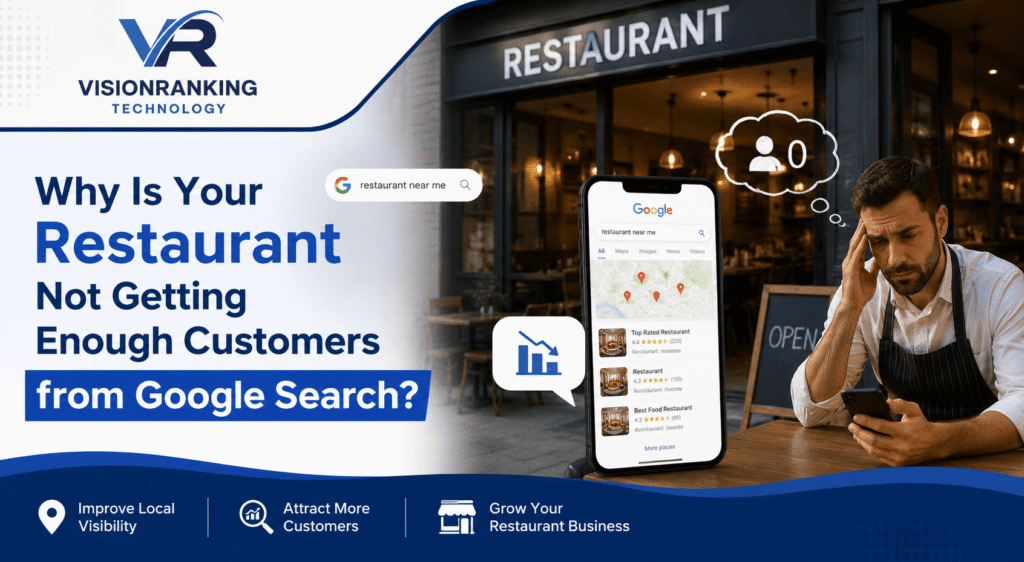
Why Is Your Restaurant Not Getting Enough Customers from Google Search?
📌 Key Takeaways
- Improve Your Google Visibility: Optimise your website and Google Business Profile to help potential customers find your restaurant through relevant local searches.
- Target the Right Keywords: Focus on cuisine-specific, location-based, and service-related keywords to attract customers with genuine dining intent.
- Strengthen Your Local SEO: Maintain accurate business information, collect genuine customer reviews, and improve your presence on Google Maps.
- Optimise Your Website: Improve mobile usability, loading speed, menu visibility, website content, and reservation options to convert visitors into customers.
- Invest in Long-Term SEO: Work with a reliable restaurant SEO company like Vision Ranking to improve organic visibility, local search presence, and qualified customer enquiries through SEO, AEO, and GEO strategies.
Running a restaurant or café in the United Kingdom requires more than serving good food and providing excellent customer service. You also need to make sure potential customers find your business when they search online for places to eat, local restaurants, takeaway options, or specific cuisines.
Think about a customer searching for an Italian restaurant in Manchester, a family-friendly café in Birmingham, or a Sunday brunch restaurant in London. They will usually explore the businesses appearing in Google Search and Google Maps before deciding where to visit.
If your restaurant does not appear in these results, potential customers might choose another establishment, even when your food, service, and dining experience are better.
This is one of the main reasons restaurant owners invest in professional restaurant SEO services. Search engine optimisation helps restaurants improve their online visibility, attract relevant local visitors, and turn website traffic into enquiries, reservations, takeaway orders, and visits.
However, ranking on Google requires more than adding restaurant-related keywords to your website. Your Google Business Profile, website structure, location relevance, customer reviews, technical performance, and online reputation all influence your visibility.
At Vision Ranking, we understand the challenges restaurant and café businesses face when competing for local customers. Our SEO strategies focus on improving search visibility, strengthening your digital presence, and attracting people who are actively looking for your services.
In this guide, we explain why your restaurant might not be getting enough customers from Google Search and how a structured SEO strategy can help address these challenges.
1. Why Is Your Restaurant Not Appearing in Google Search Results?
One of the biggest challenges for restaurant owners is limited visibility when potential customers search for relevant dining options.
Your restaurant might have an attractive website, a popular menu, and positive customer feedback. However, these strengths will not generate consistent online enquiries if customers cannot find your business.
Several factors contribute to poor restaurant search visibility.
Common reasons include:
- Your website does not target relevant restaurant and location-based keywords.
- Your Google Business Profile is incomplete or poorly maintained.
- Your website has technical SEO problems.
- Your restaurant has limited local online authority.
- Your website content does not answer customer questions.
- Your business has insufficient or inconsistent online reviews.
- Your competitors have stronger local search visibility.
- Your website does not provide a good mobile experience.
For example, consider a restaurant operating in Birmingham. A potential customer searches for an Indian restaurant in Birmingham city centre. If your website does not clearly communicate your location, cuisine, menu, and dining experience, Google might struggle to understand how relevant your business is to the search.
This does not mean your restaurant lacks quality. It means your online presence needs improvement.
Professional SEO identifies these visibility gaps and develops a strategy around your restaurant’s location, cuisine, services, and business objectives.
Want to understand why your restaurant is not attracting enough visitors from Google? Book a free consultation with Vision Ranking.
2. Your Restaurant Website Is Not Targeting the Right Keywords
Keyword targeting plays an important role in attracting customers through search engines.
Many restaurant websites focus only on their business name or general terms such as restaurant, café, or food. These keywords do not always reflect what potential customers are searching for when choosing a place to eat.
Customers use different search phrases depending on their location, preferences, budget, and dining requirements.
For example:
| Customer search | Search intent | Business opportunity |
| Italian restaurant in London | Local discovery | Attract nearby diners |
| Best family restaurant in Leeds | Commercial research | Generate family bookings |
| Vegan café near me | Local and specific | Reach vegan customers |
| Private dining restaurant Manchester | Service-specific | Generate private dining enquiries |
| Sunday brunch in Birmingham | Occasion-based | Increase weekend reservations |
| Restaurant with outdoor seating | Feature-based | Attract customers seeking outdoor dining |
A restaurant SEO strategy should consider these different search behaviours.
How the right keywords help your restaurant
- Reach customers searching for your cuisine.
- Improve visibility for location-based searches.
- Attract visitors looking for specific dining experiences.
- Promote profitable services such as private dining and catering.
- Connect website content with customer search intent.
For example, a restaurant offering Italian food, private dining, and outdoor seating should not rely on a single homepage to target every service.
Dedicated website sections can provide more relevant information and help Google understand the different experiences your restaurant offers.
A professional restaurant SEO company will research search demand, assess keyword competition, and map relevant terms to the appropriate website pages.
The objective is not to attract every website visitor. It is to attract people who have a genuine interest in visiting or ordering from your restaurant.
3. Your Google Business Profile Is Not Generating Enough Local Customers
Google Business Profile is one of the most important online assets for restaurants and cafés.
When people search for nearby restaurants, Google often displays local business listings through Google Maps and local search results.
These listings help customers evaluate businesses before visiting their websites.
Customers typically look for:
- Restaurant location and directions.
- Opening and closing times.
- Customer ratings and reviews.
- Food and restaurant photographs.
- Menu information.
- Contact details.
- Website and reservation links.
- Available services and dining options.
If your profile contains outdated information, missing photographs, incorrect opening hours, or incomplete business details, customers might hesitate before choosing your restaurant.
Google explains that local search rankings are influenced by relevance, distance, and prominence. Complete and accurate Business Profile information helps Google understand how closely a business matches a customer’s search.
What should your restaurant’s Google Business Profile include?
| Profile element | Why it matters |
| Accurate business name | Establishes business identity |
| Correct address | Helps customers find your restaurant |
| Updated opening hours | Reduces confusion before visits |
| Primary and secondary categories | Communicates your business type |
| Restaurant photographs | Shows your food and dining environment |
| Menu information | Helps customers evaluate food options |
| Customer reviews | Builds trust and provides customer feedback |
| Reservation and website links | Encourages customer actions |
| Regular updates | Keeps business information current |
An optimised profile should represent your actual business accurately. Adding unrelated categories or misleading information does not create a sustainable local SEO strategy.
At Vision Ranking, our restaurant SEO approach includes Google Business Profile optimisation to strengthen local visibility and make essential business information easier for customers to access.
4. Your Restaurant Website Is Not Converting Visitors into Customers
Getting visitors to your website is only one part of the customer acquisition process.
Imagine that your restaurant website receives relevant traffic from Google, but visitors leave without checking your menu, contacting your team, or making reservations.
This indicates a possible conversion problem.
Customers visiting a restaurant website usually want quick answers. They should not have to search through multiple pages to find basic information.
Your website should make the following details easy to access:
- Food menu and pricing.
- Restaurant address and location.
- Opening hours.
- Reservation options.
- Telephone number.
- WhatsApp or enquiry options, where relevant.
- Food photographs.
- Customer testimonials.
- Special dining experiences.
- Delivery and takeaway information, if offered.
Common website problems that affect conversions
- Unclear calls to action: Visitors should understand how to reserve a table, contact the restaurant, or place an order.
- Poor mobile navigation: Customers frequently search for restaurants using mobile devices. Complicated menus and small buttons create unnecessary friction.
- Missing menu information: Customers want to understand your food options and prices before visiting.
- Slow-loading pages: Delayed loading affects the browsing experience and can contribute to visitors leaving your website.
- Outdated content: Incorrect opening times, old menus, and broken reservation links reduce customer confidence.
A restaurant website should work as a customer acquisition channel rather than simply an online brochure.
Our SEO strategy considers website visibility and conversion opportunities together. This helps ensure your search traffic has a clear route towards contacting or visiting your business.
5. Your Restaurant Has Weak Local SEO Signals
Restaurant businesses depend heavily on local customers. Someone searching for a café in Bristol is unlikely to travel across the country for an ordinary coffee.
This makes local SEO particularly important for restaurants, cafés, takeaways, and other food businesses.
Local SEO helps your restaurant become more relevant to customers searching within your service area.
However, creating a location page and adding a city name is not enough.
Your local search presence should provide consistent and useful information about your business.
Important local SEO elements include:
- Accurate business information across relevant online directories.
- Location-specific website content.
- Google Business Profile optimisation.
- Relevant customer reviews.
- Local backlinks and business mentions.
- Consistent contact information.
- Clear location and service details.
- Internal links connecting relevant website pages.
For restaurants operating in multiple locations, each establishment should have accurate location information and a properly managed local presence.
For example, a restaurant brand with branches in London, Reading, and Oxford should provide customers with relevant information about each branch.
Creating duplicate location pages with only city names changed is not a good long-term approach. Each page should provide genuinely useful information about the relevant establishment.
How Vision Ranking helps: We assess your restaurant’s local search presence and identify opportunities to improve location relevance, business information, website content, and local authority.
6. Your Competitors Have Better Online Visibility
Your restaurant might offer excellent food and service, but customers searching online have limited knowledge of your business.
They compare the information available through Google Search, Maps, restaurant websites, photographs, and reviews.
If other local restaurants have stronger search visibility, more relevant website content, and better-maintained business profiles, they might receive more attention from potential customers.
Consider the following example:
A customer searches for a family restaurant in Manchester.
They see three businesses with:
- Clear restaurant descriptions.
- Updated menus.
- High-quality photographs.
- Accessible reservation options.
- Consistent business information.
- Detailed customer reviews.
Your restaurant appears further down the search results with an incomplete profile and limited website information.
The customer has little reason to explore your business further.
How competitor analysis helps
A professional SEO strategy evaluates the search landscape to identify:
- Which keywords other local restaurants are targeting.
- What type of content appears for important searches.
- How competing businesses manage their Google Business Profiles.
- Which local websites mention or link to competing restaurants.
- Where your website has stronger and weaker visibility.
- Which search opportunities align with your business objectives.
This analysis helps identify realistic opportunities without copying another restaurant’s marketing strategy.
The focus should remain on building your own online authority and communicating your restaurant’s unique value.
7. Your Website Content Does Not Answer Customer Questions
Customers search for more than restaurant names and cuisine types.
They ask questions before choosing where to eat.
For example:
- Which restaurants offer vegetarian food in London?
- Where can I find a family-friendly café in Leeds?
- Does this restaurant offer private dining?
- Which restaurants have outdoor seating in Manchester?
- Where can I book a restaurant for a birthday celebration?
- Does the restaurant offer gluten-free menu options?
If your website does not address relevant questions, it misses opportunities to connect with customers during their decision-making process.
Content opportunities for restaurants
| Content type | Example |
| Cuisine pages | Authentic Italian Food in London |
| Location pages | Visit Our Restaurant in Manchester |
| Service pages | Private Dining and Event Reservations |
| Menu content | Vegetarian and Vegan Menu Options |
| Informational blogs | How to Choose a Restaurant for a Family Celebration |
| FAQs | Do You Offer Gluten-Free Dining Options? |
The content must reflect the restaurant’s actual services. Never publish claims about dietary options, accessibility, ingredients, or facilities without confirming them with the business.
A structured content strategy helps establish topical relevance and gives search engines clearer information about your restaurant.
It also supports Answer Engine Optimisation (AEO), where content addresses specific questions in a clear and useful format.
Need help identifying content gaps? Request a free restaurant website SEO audit from Vision Ranking.
8. Your Restaurant Website Has Technical SEO Problems
Technical SEO affects how search engines access, understand, and index your website.
Even a well-designed restaurant website can struggle with organic visibility when important technical problems remain unresolved.
Some problems are difficult to identify without a proper website audit.
Technical SEO issues to investigate
1. Crawling and indexing problems
Search engines need to access your important website pages. Incorrect robots.txt directives, noindex tags, or internal linking issues can prevent important pages from appearing in search results.
2. Broken links and error pages
Broken menu links, missing location pages, and incorrect redirects create a poor experience for customers and search engines.
3. Slow website performance
Large food images, unnecessary scripts, and poorly optimised website resources affect loading performance.
4. Mobile usability issues
A restaurant website should work properly across smartphones, tablets, and desktop devices.
5. Duplicate content
Similar location pages, repeated descriptions, and incorrect canonical tags can create unnecessary duplication.
6. Missing structured data
Relevant Restaurant or LocalBusiness structured data helps search engines understand important business details.
Google supports Restaurant structured data with information such as business name, address, cuisine, menu, telephone number, and opening hours.
Structured data does not guarantee enhanced search appearances, but accurate implementation helps communicate relevant information.
At Vision Ranking, our technical SEO process identifies these issues and prioritises changes according to their potential impact on website accessibility, search visibility, and user experience.
9. Your Restaurant Is Not Building Enough Trust Through Online Reviews
Customer reviews influence how people evaluate restaurants before making a reservation or visiting.
When customers compare local dining options, they often consider ratings, written feedback, and photographs shared by previous visitors.
A restaurant with limited feedback might receive less attention than a business with a more established online reputation.
However, review management should focus on genuine customer experiences rather than artificially increasing review numbers.
How reviews support restaurant marketing
- Help potential customers evaluate your restaurant.
- Provide feedback about food quality and service.
- Highlight customer satisfaction.
- Strengthen your online reputation.
- Help your business understand areas requiring improvement.
- Contribute to the prominence signals Google considers in local rankings.
Restaurants should respond professionally to positive and negative reviews.
For negative feedback, acknowledge the customer’s concern and provide an appropriate response. Avoid arguments or sharing private customer information.
You should also make it easy for genuine customers to leave feedback without offering incentives in exchange for positive reviews.
A consistent reputation management strategy supports customer confidence and complements your wider local SEO campaign.
10. Your Restaurant Is Not Prepared for AI Search and Google AI Overviews
Customer search behaviour continues to evolve.
People increasingly use conversational searches and AI-powered search experiences to find information about local businesses, dining options, and specific services.
For example, instead of searching only for “Italian restaurant London”, a customer might ask:
- Which Italian restaurants in London are suitable for a family dinner?
- Where can I find an affordable restaurant with vegetarian options?
- Which restaurants offer private dining for corporate events?
- What are some good restaurants for a birthday celebration in Birmingham?
These searches require websites to communicate information clearly and accurately.
Google AI Overviews and AI Mode provide AI-generated search experiences with links to relevant supporting websites.
However, appearing in these experiences is not guaranteed. Google confirms that established SEO fundamentals remain important for its AI search features.
How should restaurants prepare for AI search?
- Publish accurate and detailed restaurant information.
- Create useful content around customer questions.
- Maintain consistent business information.
- Ensure important website content is accessible to search engines.
- Use relevant structured data that matches visible website content.
- Strengthen your website’s internal linking.
- Maintain an updated Google Business Profile.
- Build genuine online authority and customer trust.
This is where SEO, AEO, and GEO work together.
SEO strengthens your website’s search visibility. AEO focuses on providing clear answers to relevant questions. GEO focuses on making your business information and expertise easier to understand across generative search experiences.
At Vision Ranking, we consider these developments as part of a wider search visibility strategy rather than treating AI search as a replacement for traditional SEO.
11. What Are the Business Benefits of Professional Restaurant SEO Services?
Restaurant SEO is a long-term investment in your online presence.
The objective is to connect your restaurant with people who are actively searching for relevant dining experiences.
A properly planned SEO campaign supports several business objectives.
| Business benefit | Potential business impact |
| Better Google visibility | More opportunities to reach potential customers |
| Local SEO improvements | Stronger relevance for location-based searches |
| Google Maps optimisation | Improved local discovery opportunities |
| Targeted keyword strategy | More relevant organic website visitors |
| Website optimisation | Better customer navigation and enquiries |
| Content development | Greater visibility for cuisine and service searches |
| Review management | Stronger customer confidence |
| Technical SEO | Improved crawling, indexing, and website experience |
| AI search readiness | Better preparation for evolving search behaviour |
| Conversion optimisation | Clearer paths towards reservations and enquiries |
Who should invest in restaurant SEO?
Professional SEO is relevant to different types of hospitality businesses, including:
- Independent restaurants.
- Fine dining establishments.
- Cafés and coffee shops.
- Italian, Indian, Chinese, and other cuisine-specific restaurants.
- Family restaurants.
- Fast-casual dining businesses.
- Takeaway and delivery restaurants.
- Cloud kitchens.
- Restaurant chains.
- Restaurants offering private dining and event facilities.
Whether you operate one restaurant or manage multiple locations, your strategy should reflect your business model and target customers.
12. How Does Vision Ranking Help Restaurants Get More Customers from Google?
At Vision Ranking, we provide specialised restaurant SEO services designed around your business objectives, location, cuisine, and customer acquisition requirements.
We understand that restaurant owners want measurable business progress rather than reports filled with rankings that have little connection to actual enquiries.
Our approach combines technical optimisation, local SEO, content development, authority building, and conversion-focused improvements.
Our restaurant SEO services include:
Local SEO and Google Business Profile Optimisation
We assess your local presence and improve relevant business information, categories, services, photographs, and location signals.
Keyword Research and Search Intent Analysis
We identify relevant keywords based on cuisine, restaurant services, location, and customer search behaviour.
On-Page SEO
We optimise website titles, meta descriptions, headings, page content, internal links, image alt text, and other important on-page elements.
Technical SEO
We review website crawling, indexing, redirects, broken links, mobile usability, loading performance, and structured data.
Restaurant Content Marketing
We develop relevant website content around menus, cuisines, locations, dining experiences, and customer questions.
Link Building and Online Authority
We work on relevant website mentions and quality link-building opportunities to strengthen your website’s authority.
AEO and GEO Optimisation
We improve the clarity and structure of your website information to support visibility across traditional and emerging search experiences.
Our recommendations depend on your restaurant’s current website condition, competition, target locations, and campaign objectives.
Our Process: How We Approach Restaurant SEO
A structured process helps ensure your SEO campaign focuses on the right priorities.
| Stage | Our activities | Main objective |
| 1. Website Audit | Technical and on-page analysis | Identify existing problems |
| 2. Keyword Research | Cuisine and location-based keyword research | Find relevant search opportunities |
| 3. Competitor Analysis | Review local search competitors | Identify visibility gaps |
| 4. SEO Strategy | Prepare a campaign roadmap | Set business-focused priorities |
| 5. On-Page SEO | Optimise website pages | Improve keyword relevance |
| 6. Local SEO | Improve Google Business Profile and local presence | Strengthen local discovery |
| 7. Content Development | Create relevant website content | Address customer searches |
| 8. Off-Page SEO | Build relevant website authority | Strengthen online credibility |
| 9. Performance Monitoring | Review rankings, traffic, and enquiries | Evaluate campaign progress |
We also monitor changes in organic search performance and adjust the strategy according to the results and business priorities.
Interested in improving your restaurant’s online visibility? Talk to our SEO experts and discuss your requirements.
13. Common Restaurant SEO Mistakes You Should Avoid
Many restaurants invest time and money in website development and digital marketing but overlook important SEO requirements.
Some mistakes affect visibility, while others reduce the number of customers who take action after visiting the website.
Here are some common issues restaurant owners should avoid.
1. Targeting Only Broad Keywords
Using general terms such as restaurant or café without considering cuisine and location limits your ability to target relevant searches.
2. Ignoring Google Business Profile
An outdated or incomplete business profile weakens your local online presence.
3. Publishing Duplicate Location Pages
Changing only the city name across multiple pages does not create useful location-specific content.
4. Buying Low-Quality Backlinks
Unrelated and manipulative link-building practices introduce unnecessary SEO risks.
5. Ignoring Mobile Users
A difficult mobile experience creates barriers for customers looking for menus, directions, and reservations.
6. Publishing Content Without a Strategy
Blogging without keyword research or a clear customer objective often produces little commercial value.
7. Neglecting Reviews
Ignoring customer feedback leaves an important part of your online reputation unmanaged.
8. Expecting Immediate Results
SEO requires ongoing work, monitoring, and adjustments. Promises of guaranteed first-page rankings or instant customer growth should be treated with caution.
Avoiding these mistakes helps establish a stronger foundation for sustainable search visibility.
14. Red Flags to Watch for When Choosing a Restaurant SEO Company
Choosing the right agency is an important business decision.
Not every agency understands the local search requirements and customer acquisition challenges of restaurant businesses.
Before hiring a restaurant SEO company, look for the following warning signs.
| Red flag | Why you should be cautious |
| Guaranteed first-page rankings | No agency controls Google’s ranking decisions |
| Guaranteed customer numbers | Customer demand and conversion rates depend on multiple factors |
| Unclear SEO deliverables | You might not know what work is being completed |
| No initial website audit | Important technical and content problems might remain unidentified |
| Cheap bulk backlinks | Poor-quality links introduce unnecessary risks |
| No reporting process | You cannot properly evaluate campaign progress |
| Generic SEO strategy | Your cuisine, location, and business model require individual consideration |
| Long-term contracts without transparency | You should understand the work, terms, and reporting expectations |
A trustworthy agency should explain its strategy, deliverables, reporting process, and realistic expectations before starting a campaign.
15. Questions to Ask Before Hiring a Restaurant SEO Agency
Before investing in SEO, ask questions that help you understand the agency’s approach and suitability for your restaurant.
1. Do you understand restaurant and café SEO?
The agency should understand location-based searches, cuisine keywords, Google Business Profile, restaurant menus, and reservation-focused customer journeys.
2. What is included in your SEO package?
Ask for a clear breakdown of technical SEO, keyword research, on-page optimisation, local SEO, content, and link-building activities.
3. How will you measure campaign performance?
Discuss organic traffic, keyword visibility, Google Business Profile performance, relevant enquiries, calls, and reservation-related conversions where tracking is available.
4. Will you optimise our Google Business Profile?
Local search optimisation should form part of the strategy for restaurants that depend on nearby customers.
5. How do you approach AI search visibility?
Ask how the agency prepares website content and business information for conversational search and Google AI Overviews without relying on unsupported ranking promises.
6. How often will we receive reports?
Understand how frequently the agency reviews campaign performance and communicates completed work.
7. Will we retain access to our website and analytics accounts?
Your business should retain ownership and appropriate access to its website, Google Business Profile, Google Analytics, and Search Console.
At Vision Ranking, we believe transparency and a clear understanding of campaign activities are essential for building long-term client relationships.
What Results Should You Expect from Restaurant SEO?
Restaurant owners should understand that SEO does not produce identical results for every business.
The time required to improve visibility depends on several factors:
- Your website’s existing SEO condition.
- Competition within your target locations.
- The number of services and locations you want to promote.
- Your website’s content quality.
- Existing domain authority and local reputation.
- Technical problems requiring attention.
- The consistency of SEO implementation.
Early improvements might include better technical health, stronger keyword targeting, and improved business information.
Over time, a consistent strategy aims to improve relevant keyword visibility, organic traffic, local discovery, and qualified customer enquiries.
However, higher rankings do not automatically guarantee more restaurant bookings. Your menu, pricing, location, reviews, website experience, and reservation process also influence customer decisions.
This is why Vision Ranking focuses on search visibility alongside the factors that help convert potential customers into actual business opportunities.
The most valuable outcome is a stronger online presence that supports your restaurant’s long-term customer acquisition goals.
Conclusion: Make Your Restaurant Easier to Find on Google
If your restaurant is not receiving enough customers through Google Search, the problem might involve more than keyword rankings.
Incomplete Google Business Profile information, weak local SEO, technical website issues, poor content targeting, limited online authority, and an ineffective website experience can all affect your ability to attract potential customers.
A structured SEO strategy addresses these challenges by improving how search engines understand your business and how customers interact with your website.
At Vision Ranking, we help restaurants, cafés, and hospitality businesses strengthen their online presence through technical SEO, local search optimisation, content development, Google Business Profile management, and AI search readiness.
Whether you want to attract more local customers, improve Google Maps visibility, promote specific cuisines, or generate more reservation enquiries, our team will work towards a strategy aligned with your business objectives.
Stop losing potential customers to restaurants with stronger online visibility.
Contact Vision Ranking to discuss your restaurant’s SEO requirements.
- Book a Free Consultation: Discuss your restaurant’s growth objectives with our team.
- Request a Free SEO Audit: Identify website and local search optimisation opportunities.
- Talk to Our Experts: Get a tailored SEO strategy for your restaurant or café.
Frequently Asked Questions About Restaurant SEO Services
1. Why is my restaurant not appearing on Google?
Your restaurant might have limited visibility because of incomplete Google Business Profile information, weak local SEO, technical website issues, poor keyword targeting, or insufficient online authority. A professional SEO audit helps identify the problems affecting your search presence.
2. How do restaurant SEO services help attract more customers?
Restaurant SEO services improve your website’s visibility for relevant cuisine, location, and service-related searches. They also support Google Maps visibility, improve website content, and create better opportunities for customers to contact your restaurant, make reservations, or visit your establishment.
3. How long does restaurant SEO take to show results?
SEO timelines depend on website condition, competition, location, and the scope of optimisation. Some technical improvements appear earlier, while stronger organic visibility and consistent customer enquiries require ongoing work. No agency should guarantee a fixed ranking timeline.
4. Is local SEO important for restaurants in the UK?
Yes. Local SEO helps restaurants reach customers searching for dining options within specific towns, cities, and neighbourhoods. Google Business Profile optimisation, accurate business information, relevant local content, and customer reviews support local search visibility.
5. What is the difference between restaurant SEO and general SEO?
Restaurant SEO focuses on the search behaviour and customer acquisition requirements of food businesses. It includes cuisine-specific keywords, local search optimisation, Google Business Profile management, menu visibility, location pages, restaurant-related content, and reservation-focused website improvements.
6. How much do restaurant SEO services cost in the UK?
Restaurant SEO costs depend on the number of locations, website condition, competition, target keywords, and required deliverables. A single-location café has different requirements from a restaurant chain operating across multiple UK cities. Request a tailored proposal based on your business objectives.
7. Does Google Business Profile help restaurants get more customers?
Google Business Profile helps customers find important information about your restaurant through Google Search and Maps. Accurate opening hours, photographs, reviews, contact details, menu information, and location details improve the customer discovery experience.
8. Can SEO help a new restaurant attract customers?
Yes. SEO helps new restaurants establish an online presence through website optimisation, keyword targeting, local search visibility, and Google Business Profile management. Building authority and visibility takes time, so SEO should form part of a wider customer acquisition strategy.
9. Does restaurant SEO help with Google AI Overviews?
Restaurant websites can become eligible for supporting links in relevant Google AI search experiences when they meet Google’s technical requirements and search policies. Helpful content, accurate business information, clear website structure, and established SEO fundamentals support this approach. Inclusion is never guaranteed.
10. Why should I hire Vision Ranking for restaurant SEO services?
Vision Ranking provides restaurant-focused SEO strategies covering keyword research, technical optimisation, local SEO, Google Business Profile management, content development, link building, and AI search readiness. Our approach focuses on your business objectives, relevant search visibility, and long-term growth rather than unrealistic ranking promises.