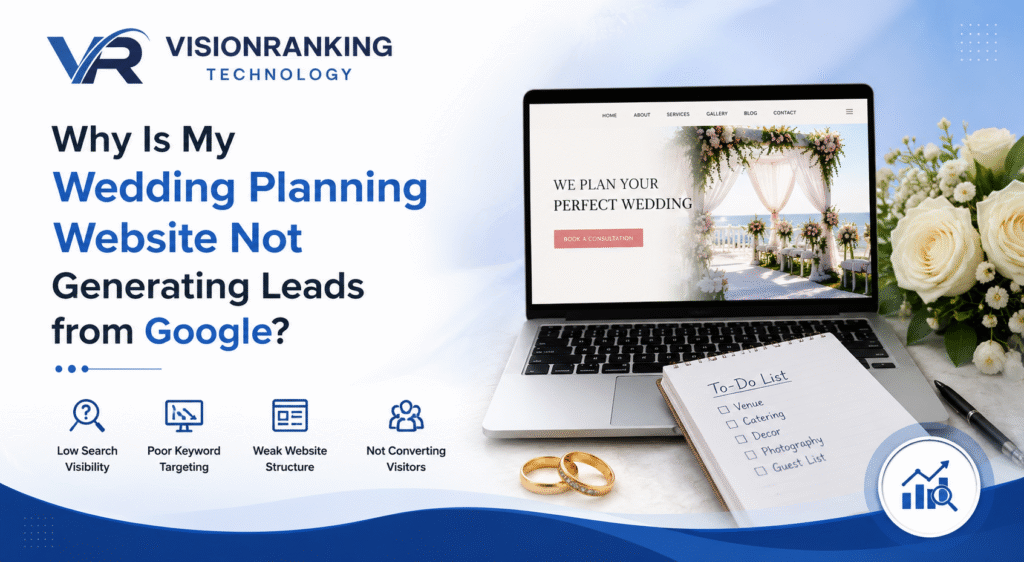
Why Is My Wedding Planning Website Not Generating Leads from Google?
📌 Key Takeaways
- Target the Right Keywords: Focus on SEO for wedding planners and relevant London-based searches to attract potential clients actively looking for your services.
- Improve Your Service Pages: Provide clear service information, genuine testimonials, wedding portfolios, and strong calls to action to encourage enquiries.
- Strengthen Local SEO: Optimise your Google Business Profile, maintain accurate business information, and improve your website’s relevance to your target locations.
- Build Trust and Improve Conversions: Address technical SEO issues, simplify contact forms, and showcase real wedding experiences to help visitors feel confident about contacting your business.
- Invest in Long-Term SEO Growth: Combine SEO, AEO, GEO, and AI search readiness to improve search visibility, attract relevant traffic, and support qualified lead generation.
Your wedding planning website might look professional, showcase beautiful celebrations, and explain your services clearly. However, if enquiries from Google remain low, your website might not be reaching the right audience or giving potential clients enough reasons to contact you.
For wedding planners, venue owners, photographers, videographers, and other wedding professionals, online visibility plays an important role in attracting new business. Couples often research different suppliers, compare portfolios, check reviews, explore packages, and shortlist businesses before making a booking.
If your website does not appear for relevant searches, or visitors leave without enquiring, you miss opportunities to connect with people who are actively planning their weddings.
The problem is not always the quality of your services. Your website might have technical SEO issues, weak service pages, limited local visibility, insufficient trust signals, or a poor enquiry experience. Sometimes, the website attracts visitors who are unlikely to become paying customers.
This is where SEO for wedding planners becomes important. A well-planned SEO strategy helps your business reach relevant audiences, communicate your expertise, and turn organic search traffic into qualified enquiries.
At Vision Ranking, we help businesses improve search visibility, strengthen website performance, and build a digital presence that supports long-term growth. For wedding businesses in London, our approach focuses on attracting potential clients who are actively looking for relevant wedding services.
1. Why Is Your Wedding Planning Website Not Generating Leads?
Several factors influence whether your website generates enquiries from Google. A website might receive traffic without attracting suitable customers, or it might have strong content but struggle to appear in relevant search results.
Understanding the underlying problem is the first step towards improving performance.
Common reasons include:
- Your website does not rank for searches related to your wedding services.
- Your service pages target broad keywords instead of specific customer needs.
- Your Google Business Profile does not provide enough relevant information.
- Your website lacks convincing testimonials, portfolio examples, and trust signals.
- Your contact forms are difficult to complete or request too much information.
- Your website attracts visitors from locations you do not serve.
- Technical issues prevent search engines from accessing important pages.
- Your content does not answer the questions potential customers ask before booking.
- Your website does not clearly explain what makes your services suitable for a particular wedding.
For example, a London wedding planner might receive visitors searching for general wedding inspiration. However, the business needs enquiries from couples seeking professional planning services in London.
These audiences have different intentions.
A successful SEO strategy considers both search visibility and the likelihood of conversion. The objective is to connect your business with people whose requirements match your services.
Need help identifying why your website is underperforming? Request a free SEO audit from Vision Ranking to review potential visibility, content, technical, and conversion issues.
2. Your Website Is Not Targeting the Right Wedding Keywords
Keyword targeting influences which searches lead potential customers to your website.
If your website mainly uses broad terms such as wedding planning, wedding ideas, or beautiful weddings, it might attract visitors who are researching inspiration rather than looking for a supplier.
Your website needs a clear keyword strategy based on the services you offer, the locations you cover, and the searches customers use when comparing providers.
Focus on commercial search intent
Commercial keywords often indicate a stronger connection between the search and a potential purchase.
For example, wedding businesses might target searches such as:
- SEO for wedding planners
- Wedding planner in London
- Wedding planning services in London
- SEO for wedding venues
- Wedding venue hire in London
- SEO for wedding businesses
- Wedding videographer in London
- SEO for wedding videographers
- Wedding event management services
- Luxury wedding planning services in London
These examples serve different business purposes. A wedding planning company needs keywords related to planning services, while a venue needs searches connected to venue availability, facilities, capacity, and location.
Similarly, a wedding videographer needs visibility for relevant videography services rather than general wedding planning terms.
Match keywords to the right pages
Each important service should have a relevant landing page with useful information and a clear enquiry path.
| Business type | Relevant search focus | Recommended website content |
| Wedding planners | Wedding planning services in London | Planning packages, services, process, portfolio, and consultation options |
| Wedding venues | Wedding venues in London | Capacity, venue features, facilities, availability enquiries, and event photographs |
| Wedding videographers | Wedding videographer in London | Film portfolio, coverage options, editing services, and booking information |
| Wedding photographers | Wedding photography services | Portfolio, photography styles, packages, and booking process |
| Wedding decorators | Wedding decoration services in London | Decoration themes, previous setups, venue transformations, and service details |
| Wedding event companies | Wedding event management services | Planning capabilities, coordination services, event types, and client testimonials |
The right keyword strategy helps search engines understand the purpose of each page. It also gives potential customers a more relevant experience after clicking through from Google.
Business benefit: Better targeting helps your website attract visitors whose requirements align with your services, improving the opportunity to generate qualified enquiries.
3. Your Service Pages Do Not Give Customers Enough Information
A website homepage introduces your business, but it should not carry the entire responsibility for generating enquiries.
Potential customers often want specific information before contacting a wedding supplier. They need to understand what you offer, whether you work in their preferred location, how your services fit their requirements, and why they should consider your business.
If your website provides only a short paragraph about your services, visitors might struggle to make an informed decision.
What should a wedding service page include?
A strong service page should communicate:
- The services you provide and the types of weddings you support.
- The locations you serve, including relevant London areas.
- Your planning process and what clients should expect.
- Examples of previous weddings or events.
- Genuine customer reviews and testimonials.
- Information about packages or pricing, where appropriate.
- Answers to common booking questions.
- Clear calls to action, such as requesting a consultation.
Consider a wedding planning company that offers full-service planning, partial planning, and on-the-day coordination.
If all three services appear in one short paragraph, potential clients might not understand the differences. Separate service sections or dedicated pages help visitors identify the option that matches their needs.
The same principle applies to venues, videographers, decorators, and other wedding professionals.
Your content should demonstrate practical expertise rather than repeat generic descriptions of wedding services.
For businesses targeting London, location relevance also matters. Explain which areas you serve and provide useful information about your experience with local venues and event requirements.
However, avoid creating multiple nearly identical location pages simply by replacing the name of one London area with another. Each location page should offer meaningful, distinct information.
Our recommendation: Review your main service pages before investing heavily in additional content. Improving existing pages often provides a clearer foundation for SEO growth.
4. Your Website Is Not Building Enough Trust
Choosing a wedding supplier involves a significant personal and financial commitment. Couples want confidence in the people responsible for an important event.
Search visibility alone does not establish this confidence. Your website needs to demonstrate experience, reliability, professionalism, and a clear understanding of customer expectations.
This is where experience, expertise, authoritativeness, and trustworthiness, commonly referred to as E-E-A-T, become useful considerations for content quality.
E-E-A-T is not a single ranking factor or a guarantee of higher rankings. It is a framework used in Google’s search quality guidance to evaluate qualities associated with helpful and trustworthy content.
Demonstrate real experience
Your website should provide evidence of the work your business performs.
Useful trust-building elements include:
- Original photographs and videos from completed weddings.
- Case studies explaining the services delivered.
- Genuine testimonials from previous clients.
- Information about your team and professional experience.
- Details about your planning or booking process.
- Clear contact information and business details.
- Answers to common concerns about coordination, timing, and service delivery.
For example, a wedding planner might publish a case study about coordinating a wedding across multiple suppliers at a London venue.
The case study could explain the client’s requirements, the planning challenges, the coordination involved, and how the team managed the event.
This provides more useful evidence than a generic statement claiming the company offers exceptional wedding planning services.
Make testimonials meaningful
Short, genuine reviews help visitors understand what working with your business feels like.
Where clients have given permission, testimonials can explain how your team handled communication, scheduling, supplier coordination, or unexpected changes.
Never invent reviews, client experiences, or business achievements. Trust depends on credible information.
For wedding businesses competing for enquiries in London, these details can help distinguish your services from other options a customer is considering.
5. Your Website Has Weak Local SEO Signals
Wedding services are often location-dependent. Couples usually want suppliers who serve their preferred area, while venue owners and other businesses need visibility among customers searching within their relevant market.
Local SEO for wedding businesses helps improve visibility for searches with a geographic connection.
For a London wedding planner, relevant searches might include a wedding planner in London, a wedding coordinator in a particular area, or a specialist wedding service near a preferred venue.
Your website and business listings should communicate where you operate and which services you provide.
Improve your Google Business Profile
Your Google Business Profile can help eligible businesses appear in relevant local search results and Google Maps.
Its usefulness depends on your business type, eligibility, service area, competition, and the relevance of the search.
Important profile information includes:
- Accurate business name, address, or service area, as applicable.
- Appropriate primary and additional categories.
- A clear description of your services.
- Current contact details and website information.
- Genuine photographs of your work.
- Relevant service information.
- Authentic customer reviews and professional responses.
Business eligibility matters. A wedding venue with a customer-facing location has different profile requirements from a wedding planner operating from a private home without receiving customers there.
Service-area businesses should follow Google’s guidelines rather than display an ineligible address.
Build location relevance across your website
Your website should also explain your London coverage naturally.
For example, a wedding planning service page might discuss the types of venues your team works with across London, provided the information accurately reflects your operations.
Relevant local references, useful venue-related content, and consistent business details support a clearer understanding of your services.
Avoid creating low-quality pages for every neighbourhood or adding location names where they do not provide value.
Business benefit: A stronger local presence helps eligible wedding businesses reach relevant customers who prefer to work with suppliers in their area.
6. Technical SEO Problems Might Be Limiting Your Visibility
Sometimes, the content on your website is useful, but technical issues prevent search engines from accessing, understanding, or indexing important pages properly.
These issues are particularly important when a business has recently redesigned its website, added new service pages, changed URLs, or migrated to a different platform.
Technical issues worth investigating
A technical SEO review should examine:
- Indexing and crawlability: Important service pages should be accessible to search engines. Incorrect robots directives, accidental noindex tags, or blocked resources can interfere with visibility.
- Canonical tags: Canonical settings should identify the preferred version of a page when duplicate or similar URLs exist.
- Redirects: When URLs change, appropriate redirects help users and search engines reach the correct destination.
- Mobile usability: Your website should remain easy to navigate on smartphones, where many customers browse wedding suppliers.
- Page speed and Core Web Vitals: Slow loading and poor interaction performance can frustrate visitors. Core Web Vitals help assess loading performance, responsiveness, and visual stability.
- Internal links: Important service pages should receive relevant internal links from suitable pages across your website.
- Structured data: Appropriate structured data helps search engines interpret eligible information. It must accurately reflect visible page content and follow applicable guidelines.
- XML sitemap: Your sitemap should include relevant canonical URLs and remain accessible to search engines.
A technical audit should prioritise problems based on their likely business impact rather than produce a long list of minor warnings.
For example, a missing meta description deserves a different level of urgency from an important service page accidentally blocked from indexing.
Technical SEO also requires context. A website does not automatically rank higher because every audit tool reports a perfect score.
The goal is to remove meaningful barriers to search visibility and provide a reliable experience for potential customers.
Talk to Vision Ranking about reviewing the technical health of your website and identifying the issues most relevant to your lead generation goals.
7. Your Website Receives Traffic but Visitors Do Not Enquire
A website might rank for relevant keywords and attract visitors without producing enough enquiries.
This usually requires a different investigation from a website with little organic visibility.
If qualified visitors arrive but leave without contacting your business, the issue might involve page relevance, trust, pricing clarity, usability, or the enquiry process.
Common conversion problems
Visitors might leave because:
- They cannot find the services relevant to their wedding.
- Your website does not explain what happens after an enquiry.
- Contact details are difficult to locate.
- Forms request too much information.
- Important pages load slowly on mobile devices.
- Portfolio images do not reflect the services being promoted.
- The website lacks genuine reviews or examples of previous work.
- Calls to action are vague or difficult to understand.
- Pricing information is too limited for visitors to assess suitability.
Make the next step clear
Your website should guide interested visitors towards a practical next step.
Depending on your business, useful options include:
- Request a wedding planning consultation.
- Enquire about venue availability.
- Discuss your wedding photography requirements.
- Request information about wedding videography packages.
- Ask about event coordination services.
The wording should reflect the actual service being offered.
A wedding venue should make its availability enquiry process clear. A wedding planner might offer an initial consultation, while a videographer might invite visitors to discuss their wedding date and coverage requirements.
The enquiry form should collect enough information to qualify a lead without creating unnecessary friction.
For example, a wedding planning form might ask about the proposed date, location, type of service required, and approximate budget range where appropriate.
These details help your team understand whether an enquiry fits your services.
Measure meaningful conversions
Google Analytics 4 and suitable enquiry tracking help businesses assess which pages and channels contribute to enquiries.
Where possible, track meaningful actions such as:
- Completed contact forms.
- Qualified consultation requests.
- Calls from relevant landing pages.
- Venue availability enquiries.
- Enquiries that progress into sales conversations.
A submitted form does not automatically represent a qualified lead. Your reporting should distinguish between total enquiries, suitable prospects, and confirmed bookings.
This distinction helps you evaluate SEO according to business outcomes rather than traffic alone.
8. Your Content Strategy Does Not Match the Customer Journey
Couples rarely make every wedding-related decision during a single search.
Some are exploring planning options. Others have chosen a date and venue. Some are comparing suppliers, while others are ready to request a quotation.
Your website should address these different stages without losing focus on your commercial services.
Connect informational content with service pages
Useful content might address topics such as:
- What does a wedding planner manage?
- What should couples ask before booking a wedding venue?
- What is included in professional wedding videography?
- How does wedding day coordination work?
- What should couples consider when comparing wedding planning packages?
The purpose is to answer relevant questions and establish your expertise.
However, a wedding business should not publish blog articles solely to increase its page count.
Each article needs a clear audience, a useful purpose, and a relationship with the services your company provides.
For example, an article discussing the responsibilities of a wedding planner could link naturally to your wedding planning service page. Readers who want professional support then have a relevant next step.
Similarly, a guide to choosing a wedding venue could connect to suitable venue pages or enquiry options.
Avoid content that attracts the wrong audience
A wedding planner does not necessarily benefit from attracting large numbers of readers searching for free decoration templates or general wedding inspiration.
Those topics might suit a publication focused on DIY weddings, but they might have limited commercial relevance to a premium planning business.
Before investing in a content campaign, consider whether the subject connects with your services, target customers, and business objectives.
A balanced strategy supports awareness while giving commercially relevant visitors a clear route towards an enquiry.
9. Your SEO Strategy Needs to Account for AI Search
Search behaviour continues to evolve. In addition to conventional Google results, users encounter AI-generated summaries, conversational search experiences, and answers from tools that interpret information from multiple sources.
Google AI Overviews and other AI-powered search experiences create additional reasons to maintain accurate, useful, well-structured website content.
However, appearance in AI-generated results is not guaranteed, and AI visibility should not replace the fundamentals of a sound SEO strategy.
How AEO and GEO relate to wedding businesses
Answer Engine Optimisation (AEO) focuses on making content useful and accessible for systems that answer questions.
Generative Engine Optimisation (GEO) focuses on improving how a brand and its content are represented in generative search experiences.
For wedding businesses, these approaches support a broader objective: helping potential customers find clear, credible information about your services.
Practical considerations include:
- Answering relevant questions directly.
- Explaining services and locations clearly.
- Publishing original examples of completed work.
- Maintaining consistent business information.
- Demonstrating professional experience.
- Organising pages with descriptive headings.
- Using relevant internal links.
- Keeping important business details accurate.
- Supporting claims with genuine evidence.
For example, a wedding planner’s website should clearly explain the difference between full-service planning and on-the-day coordination.
A venue page should provide accurate details about facilities, capacity, location, and available services.
A wedding videographer should explain coverage options and provide genuine examples of previous work.
These improvements benefit users regardless of whether they arrive through a conventional search result or an AI-assisted experience.
Vision Ranking helps businesses align SEO, AEO, GEO, and AI search readiness with their broader digital marketing objectives. Our approach focuses on clear information, relevant search intent, website quality, and sustainable visibility rather than promises of guaranteed AI citations.
10. Common SEO Mistakes Wedding Businesses Should Avoid
Several recurring mistakes limit the effectiveness of SEO campaigns in the wedding industry.
| Common mistake | Why it creates a problem | Better approach |
| Targeting only broad keywords | Search intent might not match your services | Build keyword groups around specific services and customer needs |
| Using one page for every service | Visitors struggle to find relevant information | Develop clear service sections or dedicated pages where justified |
| Repeating location keywords unnaturally | Content becomes difficult to read and offers little value | Include accurate, useful location information naturally |
| Publishing generic blog posts | Articles attract limited relevant traffic or enquiries | Prioritise subjects connected to your audience and services |
| Ignoring technical SEO | Important pages might be difficult to crawl or index | Review technical health and prioritise meaningful issues |
| Neglecting reviews and portfolio content | Visitors have less evidence to evaluate your business | Display genuine testimonials and relevant examples of work |
| Measuring success through traffic alone | Reports overlook lead quality and commercial outcomes | Track qualified enquiries and progression towards bookings |
| Expecting immediate results | SEO performance develops over time and varies by market | Use realistic milestones and regular performance reviews |
| Building irrelevant backlinks | Links might provide little value and create risk if manipulative | Prioritise relevant, legitimate, editorially appropriate links |
| Ignoring mobile conversion paths | Visitors encounter friction when contacting your business | Test forms, calls to action, and navigation on mobile devices |
Avoiding these mistakes requires a strategy that considers your website, search demand, competition, customer expectations, and internal sales process.
The best priorities will depend on your current website and the issues affecting its performance.
11. How SEO for Wedding Businesses Supports Long-Term Growth
SEO is most valuable when it supports a business objective rather than operating as an isolated marketing activity.
For wedding businesses, the objective often involves attracting suitable enquiries, building trust before the first conversation, and creating a more consistent source of potential customers.
Key business benefits
Greater visibility for relevant searches
Well-targeted pages improve your opportunity to appear when potential customers search for services your business offers.
More relevant website traffic
A clear keyword strategy helps connect your website with audiences whose requirements align with your services.
Stronger local presence
Relevant local SEO work helps eligible businesses improve their visibility among customers searching for wedding services in their target locations.
Improved customer confidence
Useful service information, genuine reviews, and examples of previous work help visitors evaluate your business before making contact.
Better website conversion opportunities
Clear calls to action, relevant landing pages, and a straightforward enquiry process reduce avoidable friction.
Long-term organic visibility
Useful content and a technically sound website provide a foundation for sustained search performance. Results still depend on competition, demand, website quality, and ongoing investment.
More informed marketing decisions
Analytics and enquiry tracking help you understand which services, pages, and search themes contribute to business opportunities.
SEO compared with paid advertising
SEO and paid advertising serve different purposes, and the right balance depends on your goals.
| Factor | Organic SEO | Paid search advertising |
| Visibility | Earned through organic search performance | Purchased through advertising campaigns |
| Timeframe | Often requires sustained work before meaningful gains | Campaigns can begin generating visibility after launch |
| Traffic costs | No direct payment for each organic click, although SEO requires investment | Advertisers generally pay for clicks or other campaign-defined actions |
| Longevity | Useful rankings and content can continue attracting visitors, although performance changes | Traffic generally declines when campaigns stop |
| Control | Rankings depend on search engine systems and competition | Greater control over budgets, targeting, and campaign settings |
| Best use | Building long-term organic visibility and relevant traffic | Supporting immediate demand, testing offers, and targeted campaigns |
Many wedding businesses benefit from using both channels when their budgets and business objectives support it.
SEO should not be evaluated solely by how quickly it produces enquiries. It should also be assessed by the quality of opportunities it attracts and its contribution to sustainable business growth.
12. Our Process for Improving Wedding Website Leads
At Vision Ranking, we approach SEO as an ongoing business growth activity. The work begins with understanding your objectives and identifying the factors limiting your current performance.
Step 1: Website and business assessment
We review your website, existing services, target locations, and current search performance.
The objective is to understand where your website stands and which problems deserve attention first.
Step 2: Keyword research and search intent analysis
We identify relevant search opportunities around your services and London target market.
Keyword selection considers customer intent, service relevance, competition, and the commercial value of attracting particular audiences.
Step 3: Technical SEO audit
We review crawlability, indexing, canonical settings, internal links, redirects, mobile usability, page performance, and other relevant technical elements.
Findings are prioritised according to their likely effect on search visibility and website performance.
Step 4: On-page SEO and content improvements
We assess important landing pages, title tags, meta descriptions, headings, service information, internal links, and content relevance.
Where required, we recommend improvements that help search engines interpret your pages and give visitors the information they need.
Step 5: Local SEO improvements
For eligible businesses, we review Google Business Profile information, local relevance, business details, reviews, and relevant location pages.
The strategy reflects the actual areas your business serves.
We identify useful content opportunities and develop a plan to strengthen your website’s topical relevance.
Where appropriate, we also assess legitimate link-building opportunities and other ways to improve your online authority.
Step 7: Conversion and enquiry tracking
We review calls to action, contact forms, landing-page usability, and available analytics.
Where suitable tracking is available, we use the data to understand which pages and activities contribute to enquiries.
Step 8: Reporting and ongoing improvement
We monitor relevant performance indicators and use the findings to refine the strategy.
Reporting should explain what changed, which activities were completed, what the data indicates, and which actions deserve attention next.
Request a free SEO audit from Vision Ranking to discuss your website’s current performance and identify a practical starting point.
13. Why Choose Vision Ranking for SEO for Wedding Planners?
Choosing an SEO agency involves more than comparing monthly packages or promises of higher rankings.
You need a partner who understands your business objectives, communicates clearly, and builds a strategy around the customers you want to attract.
Vision Ranking provides SEO and digital marketing services designed to improve search visibility and support business growth.
Our approach focuses on:
- Business-focused keyword targeting: We align search opportunities with your services, target locations, and commercial objectives.
- Technical SEO expertise: We assess technical barriers and prioritise improvements based on their relevance to your website.
- Content and on-page optimisation: We help make service pages more relevant, informative, and useful to potential customers.
- Local SEO support: We assess opportunities to improve local visibility for eligible businesses.
- AI search readiness: We consider AEO, GEO, and AI-powered search experiences as part of a broader search strategy.
- Transparent reporting: We focus on meaningful performance indicators and explain the work completed.
- Long-term planning: We adapt priorities as your website, competition, and business objectives evolve.
Wedding businesses have different needs. A venue looking to attract corporate events alongside weddings requires a different strategy from a wedding planner focusing on full-service planning for private clients.
We consider these differences when assessing keyword opportunities, service pages, content requirements, and conversion paths.
Our aim is to help you build a website that supports your business beyond a single campaign or short-term ranking target.
Explore our SEO services for event and wedding businesses and SEO services in London to understand how our services relate to your objectives.
14. Red Flags to Watch for When Choosing an SEO Agency
The right agency should explain its strategy clearly and set expectations based on your website and market.
Be cautious when an agency makes claims without explaining the work required to achieve them.
Important warning signs include:
- Guaranteed first-page rankings within a fixed period.
- Promises of a specific number of leads without supporting evidence.
- Reporting focused entirely on keyword positions.
- Little interest in your services, target audience, or sales process.
- Generic strategies that ignore your website’s existing performance.
- Unclear descriptions of link-building methods.
- Recommendations to create large numbers of repetitive location pages.
- No explanation of how conversions or qualified enquiries will be measured.
- Limited communication about completed work and upcoming priorities.
- Requests for exclusive ownership of your website or essential analytics accounts.
An SEO agency should explain what it plans to do, why those activities matter, and how progress will be assessed.
It should also acknowledge uncertainty. Search performance depends on multiple factors, and no responsible provider can guarantee a particular ranking or lead volume for every business.
Before signing an agreement, ensure you understand the scope of work, reporting arrangements, responsibilities, and how your business will retain access to its digital assets.
15. Questions to Ask Before Hiring an SEO Agency
A short discussion with a potential agency helps you evaluate whether its approach matches your business requirements.
Consider asking:
1. How will you identify the right keywords for my wedding business?
The agency should explain how it evaluates search intent, service relevance, target locations, and commercial opportunities.
2. Will you review my website before recommending a strategy?
A meaningful proposal should reflect your current website and its performance rather than rely entirely on a standard package.
3. How will you improve my service pages?
Look for an explanation of keyword targeting, content quality, internal linking, and conversion opportunities.
4. How will you measure qualified enquiries?
Ask how the agency distinguishes relevant enquiries from general traffic and low-quality submissions.
5. What role will local SEO play in the campaign?
The answer should reflect your business model, eligible Google Business Profile setup, and target service areas.
6. How will you report progress?
You should understand which metrics will be monitored and how the agency will explain changes in performance.
7. How do you approach AI search readiness?
The agency should discuss useful content, clear business information, and broader SEO fundamentals rather than promise guaranteed inclusion in AI-generated answers.
8. What happens if results do not improve as expected?
A suitable partner should explain how it investigates performance, reassesses priorities, and adjusts its recommendations.
These questions help you evaluate the quality of the proposed strategy before committing to a long-term relationship.
16. What Results Should You Expect from Wedding SEO?
SEO results depend on your starting position, website condition, target keywords, competition, location, content quality, and available resources.
A newly launched wedding planning website faces different challenges from an established company with years of useful content and an existing search presence.
For this reason, a reliable SEO strategy should begin with an assessment rather than an arbitrary promise about rankings or lead numbers.
A realistic performance framework
| Stage | Primary focus | What to evaluate |
| Initial assessment | Identify technical, content, and targeting issues | Audit findings, current rankings, existing traffic, and enquiry tracking |
| Early implementation | Address priority issues and improve important pages | Completed fixes, indexing status, page quality, and tracking accuracy |
| Ongoing optimisation | Strengthen relevant visibility and improve landing pages | Search impressions, relevant clicks, engagement, and conversion activity |
| Long-term development | Refine the strategy using performance data | Qualified enquiries, lead quality, booking progression, and organic contribution |
These are planning stages, not guaranteed deadlines. Some technical corrections can be implemented quickly, while competitive keyword growth and meaningful lead generation often require sustained work.
It is also important to recognise that seasonal demand affects wedding businesses. Search interest, enquiries, and bookings might vary according to wedding dates, booking cycles, budgets, and customer preferences.
A decline in enquiries does not automatically indicate an SEO failure. The investigation should consider search visibility, website conversions, seasonality, competition, and the quality of incoming leads.
The most useful outcome is a better understanding of what drives qualified enquiries and which activities deserve further investment.
Conclusion: Turn Your Wedding Website into a Better Source of Qualified Enquiries
If your wedding planning website is not generating enough leads from Google, the solution starts with identifying the underlying problem.
Your website might need stronger keyword targeting, more useful service pages, better local visibility, technical corrections, clearer trust signals, or a simpler enquiry process. In some cases, several of these issues contribute to the same problem.
A focused strategy for SEO for wedding planners helps your business reach relevant audiences and provide the information they need before making contact.
The same principles apply to wedding venues, videographers, photographers, decorators, and other wedding professionals. Each business needs a strategy that reflects its services, target customers, location, and commercial priorities.
At Vision Ranking, we help businesses evaluate their search performance, improve website visibility, and develop strategies aligned with long-term growth. Our approach combines SEO fundamentals with relevant local search, conversion optimisation, and AI search readiness.
You do not need to invest in every possible SEO activity at once. You need a clear understanding of your current position and a prioritised plan based on your business goals.
Ready to improve your website’s lead generation performance?
- Book a Free Consultation to discuss your SEO objectives.
- Request a Free Audit to identify potential technical, content, and visibility issues.
- Talk to Our Experts about a strategy for your wedding business in London.
Contact Vision Ranking to discuss the next steps for your website.
Frequently Asked Questions
1. Why is my wedding planning website not getting leads from Google?
Your website might struggle to generate leads because it does not rank for relevant keywords, attracts the wrong audience, lacks useful service information, or makes contacting your business difficult. Technical SEO issues and weak local visibility also affect performance. Reviewing search data, landing pages, and enquiry tracking helps identify the main causes.
2. How does SEO for wedding planners help generate enquiries?
SEO for wedding planners improves the opportunity for your website to appear when potential clients search for relevant planning services. It combines keyword research, technical optimisation, useful content, local SEO, internal linking, and conversion improvements. The objective is to attract relevant visitors and make it easier for them to enquire about your services.
3. How long does SEO take to generate leads for a wedding business?
The timeframe varies according to your website’s current condition, competition, target keywords, and the work required. Some technical improvements are completed quickly, while stronger organic visibility often requires sustained optimisation. An initial audit helps establish priorities and a realistic framework for evaluating progress.
4. Is local SEO important for wedding planners in London?
Yes. Local SEO helps eligible businesses improve their visibility for searches related to their services and operating areas. Accurate business information, a suitable Google Business Profile, relevant service pages, and genuine customer reviews support local search visibility. The strategy should reflect the locations your business genuinely serves.
5. What is the difference between SEO for wedding venues and SEO for wedding planners?
SEO for wedding venues focuses on searches related to venue hire, facilities, capacity, location, and availability. SEO for wedding planners focuses on planning services, coordination, packages, and professional support. Both require relevant keywords, useful landing pages, trust signals, and clear enquiry paths, but their content and conversion goals differ.
6. How much does SEO for wedding businesses cost?
SEO costs depend on your website’s size, competition, target locations, required services, and campaign scope. A website requiring technical corrections and improvements to a few key pages has different needs from a business targeting multiple locations and service categories. A website assessment helps establish an appropriate scope and budget.
7. Does SEO for wedding videographers require a different strategy?
Yes. Wedding videographers need content that highlights their filming services, portfolio, coverage options, editing style, and booking process. Search targeting should reflect the services and locations they offer. Image and video presentation, page performance, and clear enquiry options also help visitors evaluate the business.
8. How do Google AI Overviews affect wedding business SEO?
Google AI Overviews provide AI-generated summaries for some searches. Clear, accurate, useful content helps search systems understand a business’s services and expertise, although inclusion is not guaranteed. Strong technical SEO, relevant content, trustworthy business information, and appropriate page structure remain important parts of an effective search strategy.
9. How do I measure whether my wedding SEO campaign is successful?
Measure performance through relevant organic traffic, search visibility, qualified enquiries, contact form submissions, calls, and progression towards bookings. Google Search Console helps assess search impressions and clicks, while Google Analytics 4 and suitable conversion tracking help evaluate website activity. Assess lead quality alongside traffic and rankings.
10. Why should I hire an SEO agency for my wedding business?
An SEO agency helps identify technical issues, evaluate keyword opportunities, improve service pages, strengthen local visibility, and develop a structured optimisation plan. The right agency also provides transparent reporting and connects its recommendations to your business objectives. Choose a provider that sets realistic expectations and explains how it measures progress.