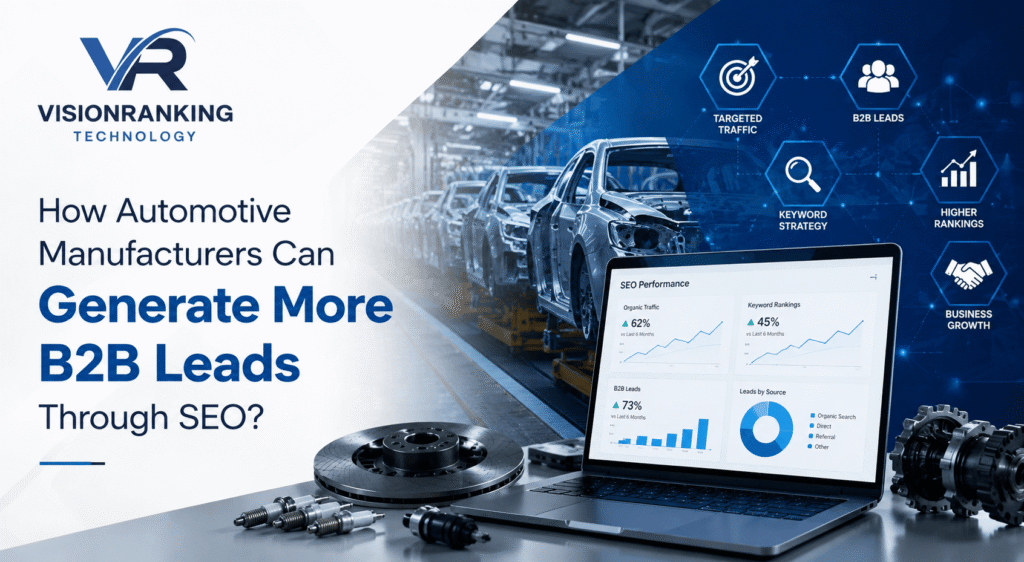
How Automotive Manufacturers Can Generate More B2B Leads Through SEO?
📌 Key Takeaways
- Target the Right B2B Buyers: Automotive SEO helps manufacturers reach procurement managers, distributors, OEMs, and businesses searching for relevant products and services.
- Focus on Commercial Keywords: Target relevant search terms to attract potential customers who are actively researching automotive suppliers and manufacturing services.
- Optimise Your Website for Enquiries: Improve product pages, technical information, internal links, and calls to action to turn relevant visitors into business leads.
- Prepare for AI Search: Combine SEO, AEO, and GEO strategies to improve content clarity and strengthen your website’s readiness for Google AI Overviews and AI-powered search experiences.
- Choose Vision Ranking for Strategic SEO Support: A structured SEO strategy helps automotive businesses improve search visibility, build credibility, and create more opportunities to generate qualified B2B enquiries.
Automotive manufacturers need a reliable way to reach potential customers, build supplier credibility, and generate business enquiries. Whether your company manufactures automotive components, supplies specialist parts, provides engineering services, or works with original equipment manufacturers (OEMs), your online visibility plays an important role in attracting new business.
Many procurement managers, purchasing directors, engineers, and distributors research potential suppliers through search engines before making contact. They compare manufacturing capabilities, review product specifications, assess supplier experience, and look for businesses that match their requirements.
If your website does not appear for relevant searches, potential customers might choose another supplier before they even learn about your business.
This is where automotive SEO services help. A focused search engine optimisation strategy improves your website’s visibility for relevant searches, strengthens your online presence, and creates more opportunities to attract qualified B2B enquiries.
However, generating traffic alone is not enough. Your website needs to reach the right audience and give prospective customers a clear reason to contact your company.
At Vision Ranking, we help businesses improve their search visibility through technical SEO, keyword research, on-page optimisation, content strategy, and conversion-focused improvements. Our goal is to connect your business with relevant audiences and support measurable lead generation.
If your automotive business wants to attract more potential customers through Google and emerging AI-powered search experiences, the right SEO strategy provides a strong starting point.
Why Automotive Businesses Need SEO to Generate More B2B Leads
The automotive industry includes manufacturers, component suppliers, engineering companies, equipment providers, wholesalers, and specialist service businesses. Each serves different customers, but they share a common challenge: reaching buyers who need their products or capabilities.
Traditional business development methods remain valuable. However, relying exclusively on referrals, trade exhibitions, existing relationships, and outbound sales limits the opportunities to reach businesses researching suppliers online.
SEO helps your business appear when potential customers search for products, manufacturing capabilities, and relevant services.
Consider a UK-based automotive component manufacturer supplying precision-engineered parts to industrial customers. The company has the equipment, technical expertise, and production capacity to handle new projects, but its website receives few relevant enquiries.
The problem might involve limited search visibility, weak product pages, insufficient technical information, or keywords that do not match buyer intent.
A targeted SEO campaign identifies these gaps and develops a strategy around the company’s commercial objectives.
For automotive businesses, SEO supports several important goals:
- Reaching procurement managers and potential B2B customers.
- Improving visibility for relevant product and manufacturing searches.
- Attracting businesses looking for specialist suppliers.
- Communicating manufacturing capabilities and technical expertise.
- Building trust before a prospect contacts your sales team.
- Generating relevant enquiries and quotation requests.
- Creating an additional source of leads alongside paid advertising and outbound sales.
The objective is to attract potential customers whose requirements match your products and services, rather than pursuing website traffic without commercial value.
Want to identify opportunities for your automotive business? Vision Ranking provides SEO support focused on search visibility, qualified traffic, and lead generation. Request a consultation to discuss your website and business goals.
Which Automotive Businesses Can Benefit From SEO Services?
Automotive SEO is relevant to companies throughout the automotive supply chain. The strategy should reflect the products you sell, the customers you serve, and the type of enquiries your sales team wants to receive.
| Automotive business | SEO focus | Potential business opportunity |
| Automotive component manufacturers | Product and component manufacturing searches | Enquiries from manufacturers and procurement teams |
| OEM suppliers | Manufacturing capabilities and supplier-related searches | Original equipment supply opportunities |
| Precision engineering companies | CNC machining and precision component searches | Custom engineering projects |
| Electric vehicle component manufacturers | EV components and associated engineering searches | Electric vehicle supply chain enquiries |
| Automotive parts wholesalers | Wholesale and bulk supply searches | Trade and distributor enquiries |
| Automotive equipment manufacturers | Industrial equipment and production machinery searches | Equipment sales enquiries |
| Automotive material suppliers | Material specifications and industrial applications | Bulk purchasing enquiries |
| Automotive contract manufacturers | Outsourced manufacturing and production capabilities | New manufacturing contracts |
Each business requires a different keyword and content strategy.
For example, a component manufacturer targeting OEM procurement teams should focus on production capabilities, technical specifications, quality requirements, and supplier suitability. A wholesaler might prioritise product availability, bulk orders, and distribution partnerships.
An SEO campaign should reflect these differences instead of using the same approach for every automotive company.
Vision Ranking works with businesses to identify relevant search opportunities and align website optimisation with their lead generation priorities.
Target the Right Automotive Keywords to Attract Potential Buyers
Keyword research helps establish how potential customers search for your products and services. For automotive businesses, the value lies in identifying relevant searches that align with commercial requirements.
A broad keyword might attract visitors looking for general automotive information. A more specific search might come from a purchasing manager evaluating suppliers for an upcoming project.
These searches represent different opportunities for your business.
Commercial keywords
Commercial keywords indicate that users are researching suppliers, evaluating services, or preparing to make a purchasing decision.
Depending on your business, relevant examples include:
- Automotive manufacturers UK
- Automotive component manufacturers
- Automotive parts suppliers UK
- Automotive engineering services
- Automotive contract manufacturing
- Precision automotive component suppliers
- Automotive manufacturing companies
- Automotive OEM suppliers
These keywords should be assessed against your actual products, target audience, search demand, and competition before they become campaign priorities.
Product-specific keywords
Product-specific searches connect potential buyers with businesses offering the components or materials they need.
Examples include automotive metal component manufacturers, automotive plastic injection moulding, precision-engineered brackets, automotive wiring harness manufacturing, and electric vehicle component suppliers.
A dedicated page for an important product or manufacturing capability gives your business an opportunity to address specific search intent.
Long-tail keywords
Some B2B buyers search using detailed technical requirements, materials, applications, or production methods.
These longer searches might attract fewer visitors, but they can be commercially relevant when they closely match your offering.
For instance, a manufacturer specialising in custom precision components benefits from content explaining its actual capabilities rather than relying exclusively on a broad term such as automotive parts.
How Vision Ranking approaches keyword research
Our SEO strategy considers:
- Your products and manufacturing capabilities.
- Your ideal customer profile.
- The search terms potential buyers use.
- Commercial intent and relevant search opportunities.
- Existing keyword rankings and website content.
- Opportunities to improve product pages and create supporting content.
The outcome is a prioritised keyword strategy designed around your business rather than a generic list of search terms.
If your website attracts visitors but struggles to generate relevant enquiries, a keyword and landing page review helps identify where search intent and your current content do not align.
Optimise Your Website to Turn Search Visibility Into Enquiries
Ranking for relevant keywords is only one part of lead generation. Once potential customers reach your website, they need enough information to decide whether your business is suitable for their requirements.
Many automotive websites focus on product names and brief descriptions without explaining manufacturing capabilities, technical specifications, or the next step for prospective buyers.
This creates uncertainty and gives visitors little reason to make contact.
A conversion-focused website should answer the questions buyers ask when evaluating a supplier.
What should your automotive website communicate?
- Product specifications: Explain relevant dimensions, materials, technical characteristics, and product applications.
- Manufacturing capabilities: Describe your production methods, customisation options, and ability to meet different project requirements.
- Quality processes: Present verified information about inspection procedures, testing, and applicable certifications.
- Supply capabilities: Explain relevant production volumes, order requirements, and delivery coverage where accurate.
- Industry experience: Include genuine project examples and relevant technical expertise.
- Clear contact options: Make it easy to request a quotation, discuss a project, or contact your sales team.
For example, a precision component manufacturer should explain which materials it works with, the manufacturing processes it offers, and the types of requirements it handles. A buyer should not need to submit an enquiry simply to find out whether the company offers the required service.
These improvements help potential customers evaluate your business and give search engines more relevant information about your products and services.
Vision Ranking helps identify opportunities to improve landing pages so your website supports both organic search visibility and lead generation.
Use Content Marketing to Reach Decision-Makers
Content marketing helps automotive businesses answer the questions potential buyers ask before selecting a supplier.
In B2B manufacturing, purchasing decisions often involve several stakeholders. Procurement teams evaluate commercial suitability, engineers review technical requirements, and management assesses supplier reliability.
Your website content should support these different needs.
Relevant content topics include:
- How to Choose the Right Automotive Component Manufacturer
- What to Consider When Selecting an Automotive Parts Supplier
- Questions to Ask Before Outsourcing Automotive Manufacturing
- How to Evaluate an Automotive Supplier’s Manufacturing Capabilities
- What Procurement Teams Should Include in a Manufacturing RFQ
- Factors to Consider When Sourcing Precision Automotive Components
- How to Assess Quality Requirements When Selecting a Manufacturing Partner
These topics attract audiences researching supplier options while creating opportunities to introduce your products and services.
For example, an article about selecting an automotive component manufacturer can explain the importance of production capabilities, quality processes, technical documentation, and delivery requirements. It can then direct interested readers towards your manufacturing services and enquiry options.
The purpose is not to publish blogs simply to increase page count. Each article should support a relevant buyer need and contribute to your wider commercial strategy.
Why internal linking matters
Internal links connect your content with the pages where potential customers take action.
A useful structure might connect:
- Informational articles to relevant product pages.
- Product pages to technical documentation.
- Manufacturing service pages to case studies.
- Case studies to relevant service enquiries.
- Supporting content to quotation or consultation forms.
This makes your website easier to navigate and helps search engines understand the relationships between your pages.
Vision Ranking develops content strategies around relevant keywords, business priorities, and opportunities to turn organic visibility into enquiries.
Improve Technical SEO for Better Website Performance
Technical SEO helps search engines access, crawl, and understand your website. It also addresses issues affecting usability and the experience potential customers have when browsing your products and services.
Automotive manufacturers sometimes operate websites with large product catalogues, duplicated descriptions, outdated pages, technical PDFs, and complex navigation. Without regular monitoring, these issues can affect search performance.
A technical SEO campaign should examine the following areas.
- Crawling and indexing: Check whether important product and service pages are accessible and eligible for indexing.
- Website structure: Organise product categories and service pages into a logical hierarchy.
- Duplicate content: Review repeated descriptions and unnecessary URL variations.
- Page speed: Identify performance issues affecting loading times and user experience.
- Mobile usability: Check navigation, forms, and technical information across different screen sizes.
- Metadata: Improve page titles and descriptions to reflect page content and relevant search intent.
- Structured data: Implement suitable markup where appropriate and ensure it matches visible content.
- Internal links: Resolve broken links and improve navigation between related pages.
- Redirects and canonical tags: Ensure URL handling supports the intended website structure.
- Image optimisation: Improve image file sizes and provide meaningful alternative text where needed.
Technical SEO should also form part of website redesigns and new product launches. Protecting important URLs, implementing appropriate redirects, and checking indexing after launch help avoid preventable search visibility problems.
Vision Ranking reviews technical SEO priorities and recommends improvements based on the website’s condition, business objectives, and available implementation resources.
For automotive businesses planning a new website or an extensive redesign, involving an SEO team early helps align development decisions with search visibility and lead generation goals.
Build Trust Through Case Studies and Manufacturing Expertise
Automotive buyers need confidence in a supplier’s ability to meet technical, operational, and commercial requirements.
A website with strong search rankings still needs to demonstrate why a prospective customer should consider your business.
Trust-building content gives buyers evidence they can use during supplier evaluation.
Include genuine case studies
A case study should explain a real customer challenge, your company’s approach, the work completed, and the verified outcome.
For example, a manufacturer might describe how it produced a custom component to meet a customer’s technical specifications or supported a project requiring a particular production process.
Only include details your company can verify, and obtain permission before publishing confidential customer information.
Present relevant certifications and quality processes
Display current certifications where applicable and explain their scope accurately. Provide useful information about quality control, testing, and inspection procedures.
Avoid unsupported statements about compliance, production capacity, or industry approvals.
Demonstrate technical knowledge
Manufacturing expertise can be communicated through technical articles, product documentation, engineering insights, and explanations of your production capabilities.
These resources help buyers understand your business before they contact your sales team.
Improve company transparency
Include accurate company information, contact details, manufacturing capabilities, and relevant information about your team.
These details help potential customers assess whether your business is an appropriate supplier.
Trust-building content also supports Google’s emphasis on helpful, reliable information. It does not guarantee rankings, but it gives both users and search systems a clearer understanding of your expertise.
Vision Ranking recommendation: Make genuine experience, case studies, technical information, and customer evidence part of your website strategy. These elements support credibility while helping turn relevant visitors into enquiries.
Prepare Your Automotive Website for Google AI Overviews and AI Search
Search behaviour continues to evolve as users adopt conversational search and AI-assisted tools to research products, suppliers, and technical topics.
Google AI Overviews and other AI-powered search experiences create additional opportunities for useful, well-structured information to reach potential customers. However, visibility in these experiences is not guaranteed.
For automotive businesses, the priority is to build a strong SEO foundation and present information clearly.
Focus on clear and useful answers
Create content that answers relevant questions about your products, manufacturing methods, applications, and supplier requirements.
Use descriptive headings and direct explanations. Avoid vague statements that fail to communicate what your business offers.
Demonstrate first-hand experience
Publish accurate technical details, genuine case studies, verified capabilities, and insights from knowledgeable team members.
This helps buyers assess your expertise and gives search systems useful information about your business.
Keep business information consistent
Review company descriptions, contact details, product information, and other important business details across your website.
Inaccurate or conflicting information creates unnecessary confusion for potential customers.
Strengthen your website structure
Connect relevant product pages, service pages, technical resources, and supporting articles through logical internal links.
Make sure important content remains accessible to search engines and is not unintentionally blocked from crawling or indexing.
Understand SEO, AEO, and GEO
- SEO: Improves organic search visibility through technical optimisation, relevant content, and website improvements.
- AEO: Focuses on making information useful and accessible for answer-oriented search experiences.
- GEO: Focuses on visibility within generative search experiences.
These approaches overlap and should support a coherent search strategy rather than become isolated activities.
Vision Ranking considers AI search readiness alongside traditional SEO priorities, helping businesses improve the clarity, relevance, and accessibility of their online information.
Our focus remains on useful content, accurate business information, and qualified lead generation rather than promises of guaranteed AI Overview placement.
Improve Your Website’s Conversion Rate
An automotive website should do more than attract visitors. It should make the next step clear for a potential customer.
If a procurement manager visits your website and cannot find your product specifications, manufacturing capabilities, or contact information, the opportunity to generate an enquiry becomes weaker.
Conversion rate optimisation helps address these issues by improving the journey from the first website visit to a meaningful business enquiry.
Use relevant calls to action
Choose calls to action based on what the visitor needs.
| Visitor requirement | Recommended CTA |
| Product information | View Product Specifications |
| Manufacturing capabilities | Explore Our Services |
| Project discussion | Discuss Your Requirements |
| Component sourcing | Request a Quotation |
| Technical clarification | Contact Our Technical Team |
| Supplier evaluation | Speak to Our Experts |
Make enquiry forms practical
For B2B manufacturing, a form should collect enough information to help your team understand the enquiry without creating unnecessary barriers.
Depending on your business, relevant fields include:
- Name and business email.
- Company name.
- Product or service required.
- Estimated order quantity.
- Project requirements.
- Expected purchasing timeline.
- Technical drawings or supporting documents, where relevant.
The ideal form depends on the complexity of your sales process. A manufacturer handling customised projects might need more detail than a business supplying standard components.
Measure the enquiries that matter
Track organic visits, enquiry submissions, relevant phone calls, qualified requests for quotation, and sales opportunities.
Where reliable tracking is available, connect website activity with CRM data to understand which pages contribute to meaningful commercial outcomes.
This helps your business distinguish between general interest and enquiries that fit your target market.
Vision Ranking helps identify website improvements designed to support conversions alongside organic search performance.
Our Process for Automotive SEO Services
At Vision Ranking, we approach SEO as an ongoing process aligned with your business objectives. The work is planned around your website, target customers, commercial priorities, and current search performance.
Our process typically includes five stages.
Step 1: Website and business assessment
We review your existing website, target products, customer profile, technical performance, and current organic search visibility to identify potential growth opportunities.
Step 2: Keyword research and strategy
We identify relevant search terms, evaluate commercial intent, and map priority keywords to existing or planned landing pages.
Step 3: Technical and on-page optimisation
We identify technical issues and recommend improvements to metadata, page structure, internal linking, content relevance, and website accessibility.
Step 4: Content and lead generation improvements
We identify opportunities to strengthen product pages, create relevant supporting content, improve calls to action, and connect visitors with suitable enquiry options.
Step 5: Reporting and ongoing optimisation
We monitor search visibility, website performance, relevant keyword movements, and available lead data to guide the next phase of work.
The exact campaign scope depends on your website’s current condition, the number of products and services, competition, and the resources available for implementation.
Our goal is to provide a structured approach to SEO that supports your business priorities and creates opportunities for sustainable growth.
Common SEO Mistakes Automotive Businesses Should Avoid
Automotive companies sometimes invest in SEO without a clear connection between website activity and business development. Several common mistakes limit the effectiveness of these campaigns.
- Targeting irrelevant keywords: Broad keywords might attract visitors who have no intention of purchasing your products or services.
- Publishing thin product pages: Product pages with minimal information make it harder for buyers to evaluate technical suitability.
- Repeating descriptions across products: Similar content fails to communicate meaningful differences between products and applications.
- Ignoring technical SEO: Indexing problems, broken links, and poor website structure restrict the effectiveness of content and optimisation work.
- Publishing blogs without a strategy: Articles that do not address relevant buyer needs often contribute little to commercial lead generation.
- Neglecting internal links: Disconnected content makes it harder for visitors to discover relevant products and services.
- Using unclear calls to action: Potential customers need an obvious way to request information, discuss a project, or obtain a quotation.
- Expecting immediate results: SEO requires research, implementation, monitoring, and ongoing improvements. Results vary according to competition, demand, and website quality.
Measuring rankings without measuring leads: Keyword positions alone do not establish whether SEO is attracting commercially relevant enquiries.
A structured SEO audit helps identify which issues deserve attention first. Vision Ranking prioritises recommendations according to business relevance, likely impact, and implementation requirements.
How to Choose the Right Automotive SEO Agency
Choosing an SEO agency requires more than comparing monthly prices or reviewing promises about rankings. Your business needs a partner who understands how search visibility relates to your products, target buyers, and sales process.
When evaluating automotive SEO services, assess the agency’s process, reporting, communication, and approach to lead generation.
Questions to ask before hiring an agency
- How will you identify keywords relevant to our products and target buyers?
- How will you distinguish qualified B2B enquiries from general website traffic?
- What technical SEO issues will you investigate?
- How will you improve our product pages and manufacturing service pages?
- How will you measure organic leads and report campaign progress?
- How will you coordinate with our website developers and content team?
- How will you approach Google AI Overviews and other AI-assisted search experiences?
- What information and resources will you need from our business?
- How will you identify and prioritise new opportunities?
- How will you explain delays, challenges, and changes in performance?
A credible agency should explain its recommendations clearly and establish realistic expectations based on your website and market.
Red flags to watch for
Be cautious of agencies that guarantee specific rankings, promise immediate lead volumes, recommend generic content at scale, or focus exclusively on backlinks and keyword positions.
Other warning signs include unclear reporting, unsupported performance claims, and an unwillingness to explain the work being completed.
SEO involves variables outside an agency’s control. A professional approach relies on research, sound implementation, transparent communication, and ongoing evaluation.
Business Benefits of Investing in Automotive SEO
A well-planned SEO strategy supports several areas of business growth.
Reach new potential customers
Search visibility creates opportunities to reach businesses beyond existing contacts, referrals, and trade networks.
Attract more relevant enquiries
Commercial keyword targeting and detailed landing pages help connect your website with people searching for products and capabilities your business offers.
Strengthen supplier credibility
Accurate technical information, genuine case studies, and clear company details help prospects evaluate your business before making contact.
Support longer B2B buying journeys
Useful content gives procurement teams, engineers, and decision-makers information to review at different stages of supplier evaluation.
Diversify lead generation
SEO provides an additional channel alongside paid advertising, referrals, exhibitions, and outbound sales. This helps reduce dependence on any single source of business enquiries.
Build lasting value through content
Useful product pages and technical resources continue to support your online presence while they remain relevant, accessible, and accurate.
These benefits depend on effective implementation and market conditions. SEO is an ongoing investment, not a guarantee of a particular number of enquiries or sales.
What Results Should You Expect From Automotive SEO?
SEO results depend on your website’s existing performance, keyword competition, product demand, technical condition, and implementation quality.
The initial phase typically focuses on identifying problems, improving important pages, and establishing reliable tracking. As the campaign progresses, work expands to relevant content, keyword opportunities, and conversion improvements.
Vision Ranking evaluates progress across three areas.
| Performance area | What we monitor | Why it matters |
| Search visibility | Impressions, clicks, keyword positions | Shows how your website performs in organic search |
| Website engagement | Product page visits and enquiry actions | Indicates whether visitors engage with your offering |
| Lead generation | Qualified enquiries, RFQs, sales opportunities | Connects SEO activity with business development |
Google Search Console provides information about search impressions, clicks, and queries. Website analytics and CRM records help establish whether those visits contribute to enquiries and sales opportunities.
Some improvements appear earlier than others. Technical corrections might help search engines access important pages, while building visibility for competitive commercial keywords often requires sustained work.
Our focus is to identify realistic opportunities, monitor the results, and refine the strategy based on performance data.
If your automotive business is investing in SEO but struggling to generate qualified enquiries, Vision Ranking can help you assess the gaps and plan the next steps.
Why Choose Vision Ranking for Automotive SEO Services?
Automotive businesses need an SEO strategy built around their products, target customers, and commercial objectives. A generic approach to keywords and content does not address the specific challenges involved in reaching B2B buyers.
Vision Ranking helps businesses improve organic search visibility through technical optimisation, keyword research, on-page SEO, content planning, and ongoing performance monitoring.
Our approach focuses on the factors that support qualified lead generation.
- Business-focused SEO strategy: We align keyword priorities with your products, services, and ideal customer profile.
- Technical SEO improvements: We identify website issues affecting crawling, indexing, performance, and usability.
- Relevant content planning: We identify opportunities to strengthen product pages and create content around genuine buyer requirements.
- Conversion-focused optimisation: We review how visitors move from search results to product information and enquiry forms.
- AI search readiness: We consider how clear, accurate, well-structured content supports visibility across traditional and AI-assisted search.
- Ongoing performance monitoring: We use available search and website data to evaluate progress and identify further opportunities.
We understand that an automotive component manufacturer, an engineering company, and a parts wholesaler have different commercial requirements. Their SEO campaigns should reflect those differences.
Our objective is to help your business reach relevant audiences, strengthen its online presence, and create more opportunities for qualified enquiries. We prioritise practical recommendations and realistic expectations rather than guaranteed rankings or unsupported lead promises.
Ready to generate more B2B leads for your automotive business?
If your website is struggling to attract relevant buyers, your product pages are not performing as expected, or your business wants to strengthen its search visibility across the UK, Vision Ranking is ready to discuss your requirements.
Our team will help identify potential SEO opportunities based on your website, target market, and business goals.
Take the next step towards building a stronger online presence for your automotive business with Vision Ranking.
Frequently Asked Questions
1. What are automotive SEO services?
Automotive SEO services help automotive businesses improve their visibility in search engines for relevant products, manufacturing capabilities, and services. These services typically include keyword research, technical SEO, on-page optimisation, content strategy, internal linking, and performance monitoring.
For manufacturers, the objective is to reach relevant B2B buyers and generate qualified enquiries.
2. How do automotive manufacturers generate more B2B leads through SEO?
Manufacturers generate B2B leads by targeting commercially relevant keywords, improving product pages, publishing useful technical content, demonstrating genuine expertise, and providing clear enquiry options.
A successful strategy focuses on attracting businesses whose requirements match the manufacturer’s products and capabilities.
3. Why should automotive companies invest in SEO?
SEO helps automotive companies reach potential customers researching products and suppliers online. It supports search visibility, supplier credibility, and lead generation while complementing referrals, paid advertising, and outbound sales.
4. How long does automotive SEO take to produce results?
The timeframe varies according to website quality, competition, search demand, and implementation. Some technical improvements produce earlier changes, while meaningful growth in organic enquiries often requires several months of consistent work. Specific rankings and lead volumes cannot be guaranteed.
5. Which keywords should automotive manufacturers target?
Relevant keywords depend on your products, manufacturing processes, and target customers. Examples include automotive component manufacturers, automotive parts suppliers UK, automotive contract manufacturing, and precision automotive component suppliers.
Keyword research helps determine which opportunities best match your commercial goals.
6. Can SEO help automotive businesses reach customers across the UK?
Yes. SEO helps businesses target relevant searches across the United Kingdom through product pages, manufacturing service pages, and location-specific content where justified. Geographic targeting should reflect your actual service coverage and potential customer locations.
7. Does SEO improve visibility in Google AI Overviews?
A strong SEO foundation supports eligibility for visibility in AI-assisted search experiences. Clear content, relevant technical information, accessible pages, and genuine expertise help search systems understand your business. However, inclusion in Google AI Overviews is not guaranteed.
8. How does Vision Ranking measure SEO success?
Vision Ranking focuses on search visibility, organic traffic, relevant keyword performance, website engagement, and available enquiry data. Where reliable tracking exists, qualified enquiries and sales opportunities help assess the commercial contribution of SEO.
9. How much do automotive SEO services cost in the UK?
Costs depend on your website’s size, competition, technical requirements, content needs, and campaign scope. A website requiring extensive technical work and optimisation across many product pages typically needs a different level of investment from a smaller website with fewer requirements. A consultation helps establish an appropriate scope.
10. How do I get started with Vision Ranking?
Start by discussing your website, products, target customers, and lead generation goals with Vision Ranking. An initial assessment helps identify relevant opportunities and establish priorities for improving organic search performance.