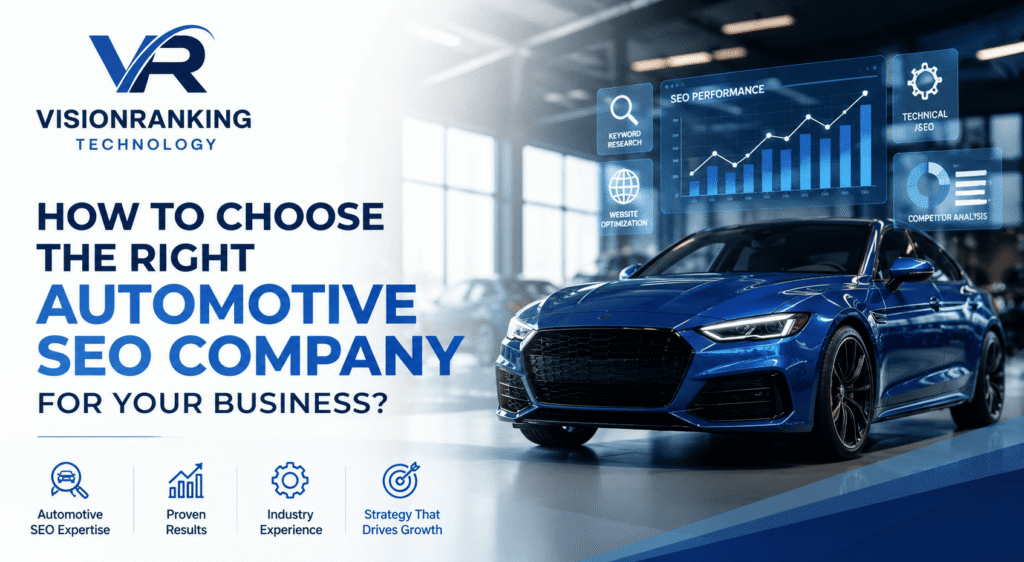
How to Choose the Right Automotive SEO Company for Your Business?
📌 Key Takeaways
- Choose an Automotive SEO Specialist: Select an agency that understands your automotive business, target audience, and commercial goals.
- Prioritise Technical and On-Page SEO: Improve website structure, page speed, indexation, content quality, and internal linking to support organic search visibility.
- Focus on Qualified Leads: Target relevant commercial keywords and track enquiries, conversions, and lead quality instead of relying on rankings alone.
- Prepare for AI Search: Strengthen website content, business credibility, and technical accessibility to support visibility across Google Search and AI-powered search experiences.
- Invest in Long-Term SEO Growth: Partner with an agency that provides transparent reporting, realistic expectations, and a strategy aligned with your business objectives.
The automotive industry in the United Kingdom has a competitive online market. Customers research vehicles, compare dealerships, search for trusted garages, source automotive components, and evaluate vehicle import services before contacting a business. If your website does not appear for relevant searches, potential customers often approach businesses with stronger search visibility.
This makes search engine optimisation an important part of long-term business growth. However, choosing the right agency requires more than comparing service packages or looking at keyword rankings. Your SEO partner needs to understand your automotive business, target audience, sales cycle, and commercial objectives.
Professional automotive SEO services help businesses improve organic search visibility, attract relevant website visitors, strengthen local presence, and generate enquiries from prospective customers. A well-planned strategy also considers technical website performance, useful content, conversion optimisation, and visibility in Google AI Overviews and conversational search.
For automotive businesses in the UK, the right SEO company should connect search performance with measurable business objectives. This guide explains what to evaluate before hiring an agency, which warning signs to avoid, and how Vision Ranking supports automotive businesses with a structured, business-focused SEO strategy.
Why Automotive Businesses Need Professional SEO Services
Automotive customers have different requirements depending on the products and services they need. Someone searching for a used car dealership has a different intention from a garage owner sourcing components or a vehicle importer arranging UK registration and clearance.
Your website needs to reach the right audience at the right stage of the buying journey.
Professional SEO helps automotive businesses improve their visibility for relevant searches through a combination of technical improvements, keyword targeting, useful content, local optimisation, and conversion-focused website development.
Key business benefits include:
- Greater organic visibility: Improve the website’s opportunities to appear for relevant automotive searches.
- More relevant enquiries: Attract people looking for your specific products, services, or expertise.
- Stronger local presence: Improve visibility for location-based searches where customers seek nearby automotive businesses.
- Better website experience: Address technical issues and navigation problems affecting visitors.
- Long-term marketing value: Build an organic search presence alongside paid advertising and other acquisition channels.
- Improved search credibility: Present clear service information, business details, expertise, and customer evidence.
- Readiness for AI-driven search: Structure useful information for conventional search results, Google AI Overviews, and conversational search experiences.
SEO does not guarantee rankings or sales. Results depend on competition, website condition, business reputation, service demand, and the quality of the campaign. The right agency establishes realistic priorities and measures progress against your business goals.
Choose an SEO Company With Automotive Industry Understanding
Automotive SEO is not a single, standardised service. Different businesses require different keyword strategies, website structures, content plans, and conversion paths.
For example, a vehicle dealership needs visibility for relevant vehicle categories, makes, models, and locations. An automotive parts supplier needs to reach buyers searching for specific components, technical specifications, or bulk sourcing opportunities.
Similarly, a vehicle import company might need enquiries from customers looking for import clearance, registration assistance, or vehicle compliance services.
Before selecting an agency, examine whether its proposed strategy reflects your business model.
A suitable automotive SEO partner should understand:
- Your primary products and services.
- Your ideal customer and geographical market.
- The difference between informational searches and purchase-focused searches.
- The search terms prospective customers use before contacting your business.
- The role of service pages, product pages, location pages, and supporting content.
- The conversion actions that matter, including calls, quote requests, bookings, and product enquiries.
An agency does not need to have worked exclusively with automotive companies to deliver a strong campaign. However, it should demonstrate a clear understanding of your market and explain how its strategy addresses your commercial requirements.
Before hiring an agency, ask for a sample keyword strategy based on your actual automotive services. Its proposed keywords should reflect the customers you want to attract, rather than simply targeting broad terms with high search demand.
Review the Agency’s Automotive SEO Strategy
A professional SEO company should explain how its work supports your business objectives. A list of deliverables without a clear strategy is not enough.
For instance, publishing blog articles every month might increase the amount of content on your website. However, if your service pages remain weak, your target keywords are poorly selected, or your enquiry process is difficult to use, the campaign might fail to generate the business opportunities you expect.
An effective automotive SEO strategy usually covers several areas.
Keyword research based on commercial intent
Keyword research identifies the terms your prospective customers use and the intent behind those searches.
An automotive SEO campaign might target:
- Automotive SEO services
- Automotive SEO company
- SEO for car dealerships
- SEO for automotive parts suppliers
- Vehicle import SEO services
- Local SEO for garages
- Automotive website optimisation
- Automotive parts supplier SEO
- SEO services for vehicle servicing businesses
These examples represent different search intents. The final keyword selection should reflect your services, target locations, website structure, and business priorities.
Service page optimisation
Your main service pages should clearly explain what you offer, who you serve, which problems you solve, and how customers request further information.
For an automotive company, this might include separate pages for vehicle imports, automotive components, dealership services, vehicle servicing, or commercial fleet solutions.
Content planning
Supporting content addresses customer questions, explains relevant processes, and helps prospective buyers assess their options. Each article should support a defined audience need and connect naturally with an appropriate service or product page.
Conversion optimisation
SEO traffic has limited commercial value if visitors struggle to contact your business. Your agency should review calls to action, enquiry forms, contact details, mobile usability, and the clarity of your service information.
A strong strategy connects these activities rather than treating them as unrelated monthly tasks.
Check Technical SEO and Website Performance Expertise
Technical SEO helps search engines discover, crawl, understand, and index your website. It also helps identify technical barriers affecting the user experience.
Automotive websites sometimes contain large inventories, product catalogues, multiple service categories, location pages, or filtered URLs. These structures require careful management to prevent duplicate content, inefficient crawling, and indexation problems.
Before choosing an agency, establish whether its technical SEO service covers the areas relevant to your website.
| Technical SEO area | Why it matters for automotive businesses |
| Crawlability and indexation | Helps search engines access and process important pages. |
| Website architecture | Makes products, services, and categories easier to navigate. |
| Canonical tags | Helps clarify preferred URLs when similar or duplicate pages exist. |
| Redirect management | Preserves useful URL relationships during website changes. |
| XML sitemap | Helps search engines discover important URLs. |
| Robots.txt | Provides crawling instructions for search engine bots. |
| Mobile usability | Supports customers researching services and products on mobile devices. |
| Page speed and Core Web Vitals | Helps identify loading, responsiveness, and visual stability issues. |
| Structured data | Provides eligible pages with additional machine-readable context. |
| Broken links and errors | Helps resolve navigation problems and technical obstacles. |
The agency should prioritise issues based on their impact, severity, and relevance to your website. Not every technical recommendation deserves immediate implementation.
For example, a dealership launching a redesigned inventory website might need URL mapping, redirect planning, indexation checks, and structured data validation before launch. An established automotive parts supplier with thousands of URLs might need closer attention to duplicate product pages, category architecture, and crawl efficiency.
Ask the agency to explain which issues need urgent attention, which improvements support long-term growth, and how it will verify completed work.
Evaluate Local SEO Capabilities for UK Automotive Businesses
Local search visibility matters for automotive businesses serving customers in specific towns, cities, and service areas.
Garages, vehicle repair centres, dealerships, tyre specialists, and automotive service providers often depend on customers searching for relevant services near their location.
Local SEO helps businesses improve their presence across location-based searches and eligible Google Maps results.
A suitable agency should assess:
- Google Business Profile accuracy and completeness.
- Business categories, services, contact details, and operating hours.
- Consistency of business information across relevant directories.
- Customer review acquisition and reputation management practices.
- Local landing pages for genuine service locations.
- Location-specific keyword opportunities.
- Internal links connecting location pages with relevant service pages.
- Local enquiry tracking and call measurement where appropriate.
For example, an independent garage serving customers in Birmingham needs a strategy relevant to its actual service area. Creating dozens of nearly identical location pages for towns it does not serve is unlikely to be a sound long-term approach.
Your agency should prioritise genuine local relevance and useful information instead of producing location pages solely to target additional keywords.
If your business serves customers throughout the UK, your strategy should distinguish national search opportunities from local demand. A national automotive parts supplier and a neighbourhood repair centre require different approaches.
Look for an Agency That Understands Content and Search Intent
Automotive customers often research a service or product before making a purchase decision. Your content should answer their questions while helping them understand why your business is a suitable option.
However, publishing a large number of generic articles is not a substitute for a relevant content strategy.
A professional agency should identify which pages support commercial searches, which articles answer research questions, and how both contribute to the customer journey.
For example, an automotive parts supplier might publish useful content explaining component compatibility, material specifications, maintenance requirements, or bulk procurement considerations. These articles should link naturally to relevant product categories or enquiry pages.
A vehicle import business might publish content addressing documentation requirements, registration procedures, clearance processes, and common customer concerns. Such content should be reviewed for accuracy, particularly when it discusses legal or regulatory requirements.
Your SEO partner should prioritise:
- Original content written for a defined audience.
- Accurate service and product information.
- Clear explanations of business processes.
- Relevant internal links to commercial pages.
- Evidence of genuine experience where available.
- Regular reviews of outdated or inaccurate information.
- Content updates based on search performance and customer needs.
The objective is to make your website a useful resource for prospective customers, not to increase its page count without a clear purpose.
Assess AI Search Readiness, AEO and GEO
Search behaviour continues to evolve as people use AI-powered search experiences and conversational tools to research businesses, compare solutions, and ask detailed questions.
Google AI Overviews, along with other AI-driven search experiences, creates additional reasons to make your website information clear, accurate, relevant, and accessible.
For automotive businesses, this means developing a search strategy that supports conventional search results while improving the clarity and usefulness of website content.
An agency offering Answer Engine Optimisation (AEO) and Generative Engine Optimisation (GEO) should explain how these activities fit into your wider SEO strategy.
Relevant activities include:
- Providing direct answers to important customer questions.
- Explaining products and services using clear, specific language.
- Maintaining accurate business information across relevant online properties.
- Publishing trustworthy content supported by genuine business experience.
- Improving internal links and website structure.
- Implementing appropriate structured data.
- Making important information accessible to search engines.
- Strengthening service pages with relevant FAQs, case studies, and testimonials where available.
For example, an automotive components supplier might need to explain product specifications, compatibility, ordering requirements, and delivery arrangements clearly. A vehicle servicing business might need useful information about service options, booking procedures, and the types of vehicles it supports.
These improvements help people and search systems understand the business more effectively.
However, no agency should promise guaranteed inclusion in Google AI Overviews or specific recommendations from AI assistants. Such placements depend on multiple factors outside an agency’s control.
Ask how the agency evaluates AI search visibility, what evidence it reports, and how it connects these activities with your wider organic search objectives.
Compare Reporting, KPIs and Business Outcomes
An SEO company should provide reporting that helps you understand campaign progress and make informed business decisions.
Keyword rankings matter, but they do not provide a complete picture of performance. A website might improve rankings for several low-intent searches without generating meaningful enquiries. Conversely, a smaller improvement in visibility for a highly relevant service term might create valuable sales opportunities.
Before signing an agreement, ask which KPIs the agency will track and how often it will report them.
| Performance metric | What it helps you understand |
| Organic impressions | How frequently your website appears in Google Search results. |
| Organic clicks | How many visits arrive through organic search results. |
| Relevant keyword rankings | Visibility for selected commercial and informational searches. |
| Landing page performance | Which pages attract organic visitors and how they perform. |
| Enquiry form submissions | The number of tracked enquiries generated through forms. |
| Organic phone enquiries | Calls attributed to organic search, where reliable tracking is available. |
| Qualified leads | Whether enquiries match your target customer profile. |
| Conversion rate | The proportion of measured visitors completing a defined action. |
| AI search visibility | Evidence of visibility in supported AI search experiences, where measurable. |
Google Search Console provides information about search impressions, clicks, click-through rates, and average positions. Google Analytics 4 helps analyse website engagement and configured conversion events. Additional CRM or call-tracking data might be required to assess lead quality and commercial outcomes.
Your reporting should also explain completed work, outstanding recommendations, technical issues, and priorities for the next reporting period.
What results should you expect?
SEO is a gradual process rather than an immediate sales channel. The timeline depends on your website’s starting condition, competition, authority, content quality, technical requirements, and the resources available for implementation.
Early work often focuses on research, auditing, technical corrections, and on-page improvements. Performance trends become easier to assess as search engines process changes and the campaign accumulates reliable data.
An experienced agency should provide an initial assessment, identify measurable milestones, and adjust the strategy based on actual performance.
Review Case Studies, Testimonials and Evidence of Experience
Before hiring an SEO company, review the evidence supporting its claims.
Case studies help you understand how an agency approaches problems, selects priorities, implements recommendations, and evaluates results. Testimonials provide additional context about communication, reliability, and the working relationship.
When reviewing case studies, look for details such as:
- The client’s industry and business objectives.
- The website’s initial challenges.
- The scope of SEO work performed.
- The measurement period and reporting methods.
- Changes in relevant organic traffic or rankings.
- Enquiry or conversion improvements, where documented.
- Challenges encountered and lessons learned.
A ranking screenshot alone does not establish the commercial value of a campaign. Strong evidence explains the context and distinguishes between work completed, observed performance changes, and outcomes directly attributed to SEO.
If an agency does not have a directly comparable automotive case study, ask it to explain how its experience with similar business models, technical websites, local SEO, or B2B lead generation applies to your requirements.
Your own website should also demonstrate credibility. Genuine testimonials, documented case studies, transparent contact details, clear service descriptions, and accurate business information help prospective customers evaluate your company.
These trust signals support a better customer experience and align with the broader principles of experience, expertise, authoritativeness, and trustworthiness associated with Google’s quality guidance.
Understand the Common Mistakes Businesses Make When Hiring an SEO Agency
Choosing an SEO partner based on incomplete information often creates unrealistic expectations and wasted marketing expenditure.
The following mistakes deserve particular attention.
Selecting the cheapest package
A low-cost package might cover a limited number of tasks without addressing the problems affecting your website. Compare the scope of work, expertise, reporting, implementation support, and expected business value rather than price alone.
Focusing exclusively on rankings
Ranking improvements matter when they relate to relevant searches. However, businesses also need to evaluate organic traffic quality, enquiries, conversion rates, and lead relevance.
Expecting immediate results
SEO requires research, implementation, monitoring, and refinement. Agencies promising guaranteed first-page rankings or instant organic growth should be approached cautiously.
Publishing content without a defined purpose
Content should address customer needs and support relevant commercial pages. Articles with no clear search intent, audience, or internal linking strategy might contribute little to business growth.
Ignoring technical SEO
A website with important crawling, indexation, navigation, or performance issues might struggle to benefit fully from content and link-building activities.
Failing to define qualified leads
An increase in enquiries is not automatically an increase in business opportunities. Automotive businesses should define which enquiries match their ideal customer profile.
For example, a supplier targeting bulk automotive component orders might receive numerous small retail enquiries. Lead volume alone would not accurately reflect campaign success.
Changing the website without an SEO migration plan
Website redesigns and platform migrations require careful planning. Changes to URLs, page content, internal links, redirects, and indexation settings might affect existing search visibility if handled poorly.
Avoid these problems by establishing clear objectives, responsibilities, reporting requirements, and communication procedures before the campaign begins.
Red Flags to Watch for When Choosing an Automotive SEO Company
A professional agency should explain its methods, acknowledge uncertainty, and provide a clear account of its work.
Be cautious when an agency displays the following warning signs.
| Red flag | Why it deserves attention |
| Guaranteed first-page rankings | Search engines determine rankings, and no agency controls every ranking factor. |
| Guaranteed AI Overview placement | AI search visibility is not guaranteed through a standard SEO package. |
| No initial website audit | The proposal might overlook existing technical or content problems. |
| Vague monthly deliverables | You might struggle to understand what work the agency performs. |
| Unexplained backlink packages | Link acquisition without appropriate quality controls introduces risk. |
| No conversion tracking discussion | Reporting might focus on visibility without evaluating business outcomes. |
| Identical strategy for every client | Different industries, audiences, and websites require different priorities. |
| Refusal to explain reporting | You need access to reliable performance information. |
| Requests to conceal questionable methods | Lack of transparency makes campaign risks harder to assess. |
| Pressure to sign a long contract immediately | You should have sufficient information to assess the proposed engagement. |
Ask the agency to explain its approach to link acquisition, content quality, technical changes, reporting access, and account ownership.
You should retain appropriate access to your website, analytics platforms, Search Console, Google Business Profile, and other important marketing assets. Confirm ownership and responsibilities before granting access or approving substantial changes.
Why Choose Vision Ranking for Automotive SEO Services?
Vision Ranking helps businesses improve their online visibility through structured SEO strategies focused on relevant search opportunities, website quality, and business growth.
For automotive businesses in the United Kingdom, the right campaign begins with understanding your services, customers, target locations, and commercial priorities. The strategy should reflect whether you operate a dealership, garage, automotive parts business, vehicle import company, fleet service, or another automotive organisation.
Our approach brings together several important areas.
Business-focused keyword research
We identify relevant search terms based on your services, audience, target locations, and commercial objectives. This helps establish priorities for service pages, category pages, location pages, and supporting content.
On-page SEO and service page improvements
We review page titles, meta descriptions, headings, content relevance, internal links, and other on-page elements. Recommendations focus on improving page clarity and relevance for target searches.
Technical SEO
We assess relevant technical issues affecting crawling, indexation, website architecture, redirects, canonical tags, structured data, and page performance. Recommendations are prioritised according to your website’s requirements.
Content strategy and internal linking
We develop content recommendations based on search intent and business goals. Relevant internal links help visitors move from informative articles to the services or products that meet their needs.
Local SEO
For eligible automotive businesses, our strategy includes Google Business Profile optimisation, local search opportunities, business information consistency, and location-specific website improvements.
AEO, GEO and AI search readiness
We assess opportunities to make your business information clearer and more useful across conventional search and emerging AI search experiences. The focus remains on accurate information, strong service pages, relevant content, and a technically sound website.
Reporting and continuous improvement
We review available search performance data, track agreed KPIs, and identify the next priorities. Recommendations evolve according to campaign progress, website changes, and business requirements.
Learn more about our automotive SEO services and our SEO services in the United Kingdom.
If you are evaluating SEO agencies, request an initial discussion about your website, target customers, and growth objectives. This provides a practical starting point for understanding which improvements deserve attention first.
Our Process for Automotive SEO Campaigns
A structured process helps establish priorities, coordinate implementation, and evaluate progress.
Step 1: Business and website discovery
We review your services, target audience, geographical focus, competitors in the search results, website structure, and existing marketing objectives.
The discovery stage helps establish which customers you want to reach and which actions matter most to your business.
Step 2: SEO audit and keyword research
We assess relevant technical, on-page, content, and search visibility issues. Keyword research identifies opportunities aligned with your services and audience.
The resulting recommendations form the basis of the initial campaign plan.
Step 3: Prioritisation and implementation planning
We organise recommendations according to importance, dependencies, available resources, and likely business impact.
Some changes might require developer support or approval from your internal team. Responsibilities should be clear before implementation begins.
Step 4: On-page and technical improvements
Depending on the audit findings, work might include page optimisation, internal linking, metadata updates, technical corrections, structured data improvements, and content recommendations.
Changes should be checked after implementation to confirm they work as intended.
We identify content opportunities that support relevant commercial pages and answer customer questions. Appropriate authority-building activities support the wider strategy without relying on manipulative link schemes.
Step 6: Performance monitoring and refinement
We evaluate agreed KPIs, review search performance trends, identify issues, and update campaign priorities.
This ongoing process helps keep SEO aligned with your business objectives as search demand, website requirements, and customer behaviour evolve.
Business Benefits of Investing in Automotive SEO
A well-managed SEO campaign supports several business objectives over time.
- Greater reach among relevant customers: Your website gains opportunities to appear for searches related to the products and services you provide.
- Improved lead quality: Better keyword targeting and clearer landing pages help attract visitors whose requirements match your offering.
- Stronger local discovery: Businesses serving specific locations gain opportunities to improve visibility for relevant local searches.
- Better website usability: Technical improvements, clearer navigation, and more useful content help customers understand your services and take the next step.
- Support for other marketing channels: Organic search insights inform content planning, landing page improvements, paid search campaigns, and customer research.
- More useful performance data: Tracking organic visits, enquiry actions, and qualified leads helps you make informed decisions about marketing priorities.
- Adaptability as search evolves: Clear information, technically accessible pages, useful content, and strong business credibility provide a sound foundation for conventional and AI-powered search experiences.
These benefits depend on effective execution and an appropriate strategy. SEO should be assessed alongside your sales process, customer service, market demand, and wider marketing activities.
Frequently Asked Questions About Automotive SEO Services
1. What are automotive SEO services?
Automotive SEO services help businesses in the automotive sector improve their organic search visibility. They typically include keyword research, technical SEO, on-page optimisation, content development, local SEO, internal linking, and performance reporting.
The precise scope depends on the business model, website condition, target market, and campaign objectives.
2. How do I choose the best automotive SEO company in the UK?
Look for an agency with a clear strategy, relevant experience, transparent reporting, technical SEO knowledge, and a strong understanding of your target customers. Review its proposed deliverables, measurement process, communication standards, and approach to qualified lead generation before making a decision.
3. How much do automotive SEO services cost in the UK?
Costs vary according to website size, competition, target locations, technical requirements, content needs, and the scope of work. A small local garage and a national automotive supplier typically require different levels of support.
Request a proposal based on your website and business objectives rather than choosing a package based on price alone.
4. How long does automotive SEO take to show results?
SEO timelines vary according to competition, website history, technical condition, implementation speed, and content quality. Early improvements might appear before more substantial growth, but meaningful performance evaluation requires consistent monitoring over time.
An agency should establish a baseline and explain the milestones it intends to track without promising guaranteed rankings.
5. Is local SEO important for automotive businesses?
Yes, local SEO is important for businesses serving customers within specific geographical areas. Garages, dealerships, repair centres, and tyre specialists benefit from accurate business information, relevant local pages, Google Business Profile optimisation, and a strong local customer experience.
National suppliers and businesses serving multiple markets need a strategy suited to their geographical reach.
6. Do automotive companies need a blog for SEO?
A blog is useful when it addresses relevant customer questions, supports commercial pages, and provides accurate information. Automotive businesses might publish content about product specifications, servicing considerations, import processes, or procurement requirements.
Publishing articles without a defined audience or business purpose is unlikely to provide the same value as a planned content strategy.
7. What is the difference between automotive SEO and local SEO?
Automotive SEO covers organic search optimisation across the business’s relevant website pages and markets. Local SEO focuses on improving visibility for location-based searches and eligible local search features.
A business might need both services, depending on its products, customers, and service area.
8. Can SEO help automotive businesses appear in Google AI Overviews?
SEO improvements support the broader goal of making business information useful, accessible, and understandable to search systems. Clear service pages, accurate content, strong internal linking, and appropriate technical implementation are relevant parts of this work.
However, no agency guarantees inclusion in Google AI Overviews or a particular position within AI-generated answers.
9. How do I measure the success of an automotive SEO campaign?
Measure progress using a combination of relevant keyword visibility, organic clicks, landing page performance, enquiries, conversion rates, and qualified leads. Google Search Console and Google Analytics 4 provide useful data, while CRM and call-tracking systems help assess commercial outcomes where properly configured.
The most relevant KPIs depend on your business model and objectives.
10. Why should I consider Vision Ranking for automotive SEO?
Vision Ranking offers SEO support covering keyword research, on-page optimisation, technical SEO, content planning, local SEO, and AI search readiness. Our approach focuses on understanding your business requirements and prioritising improvements based on your website and target market.
Contact our team to discuss your automotive website and identify opportunities for improving relevant search visibility and enquiry generation.
Conclusion: Choose an Automotive SEO Partner That Understands Your Business
Selecting the right automotive SEO company is an important decision for your long-term digital marketing strategy. The right partner should understand your audience, identify commercially relevant search opportunities, address technical barriers, develop useful content, and measure progress against business objectives.
Avoid choosing an agency solely because it offers the lowest price or promises rapid rankings. Instead, evaluate its strategy, transparency, implementation process, reporting, and approach to qualified lead generation.
Your SEO investment should support a clear business plan. Whether you operate a dealership, garage, automotive parts supplier, vehicle import company, or another automotive business in the UK, your campaign needs to reflect the customers you want to reach.
Vision Ranking provides SEO services designed around website requirements, relevant search opportunities, and long-term business objectives.
Ready to improve your automotive website’s search visibility?
Visit our automotive SEO services page or explore our UK SEO company page to learn more about our services.
Book a Free Consultation to discuss your business goals and explore the next steps for your automotive SEO strategy.