
How Google Business Profile Optimization Can Help Healthcare Providers in Germany?
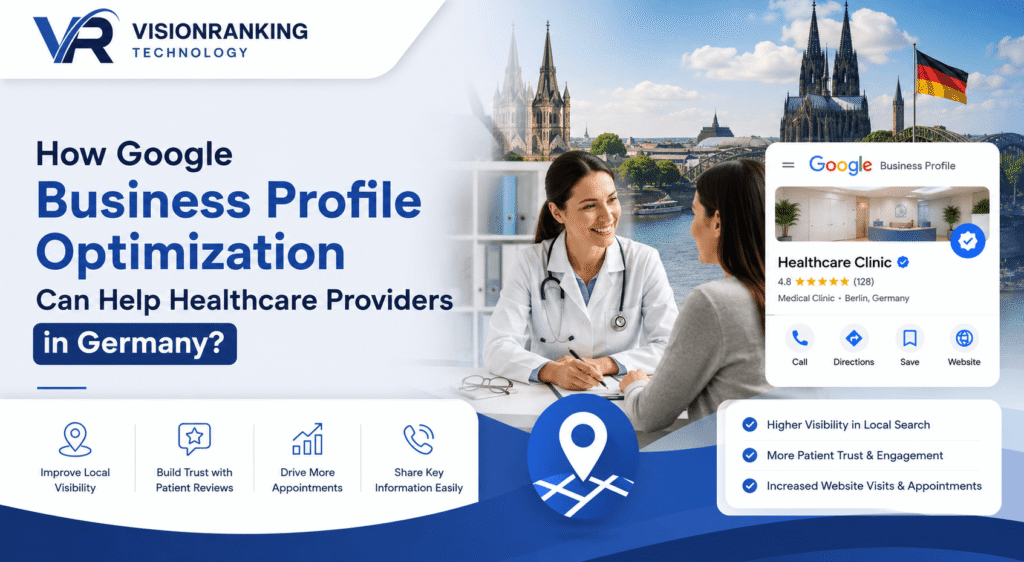
📌 Key Takeaways
- Improve Local Visibility: Google Business Profile optimization helps healthcare providers in Germany appear in relevant local searches and Google Maps results.
- Build Patient Trust: Accurate business information, professional photos and genuine patient reviews help prospective patients evaluate a healthcare practice.
- Strengthen Healthcare SEO: Combining profile optimization with relevant service pages, technical SEO and local keyword targeting supports a stronger online presence.
- Prepare for AI Search: SEO, AEO and GEO strategies help healthcare providers present clear, useful information for traditional search engines and evolving AI search experiences.
- Focus on Qualified Enquiries: Vision Ranking helps healthcare businesses improve their digital presence through tailored SEO strategies, ongoing performance monitoring and data-driven recommendations.
Introduction
When patients search online for a doctor, dentist, medical clinic, physiotherapy centre or other healthcare provider in Germany, they often look for nearby services, reliable information, patient reviews and convenient appointment options. Google Business Profile plays an important role in helping healthcare businesses appear in relevant local search results.
For healthcare providers, online visibility involves more than having a website. Patients need to find accurate contact details, understand the services offered, check the location and feel confident before contacting a practice. An incomplete or poorly managed Google Business Profile makes this process harder.
Google Business Profile optimization helps healthcare businesses present their services clearly, improve their local search presence and create a more trustworthy first impression. When supported by a broader SEO strategy, it also helps connect local searches with relevant website pages, service information and appointment enquiries.
Healthcare providers in Germany operate in a market where trust, privacy, clear communication and accurate business information matter. Whether you manage an independent medical practice in Berlin, a dental clinic in Munich or a specialist healthcare centre in Hamburg, a well-managed profile supports your wider digital marketing goals.
Vision Ranking helps healthcare businesses strengthen their online visibility through tailored SEO strategies, local search optimization and website improvements. Our approach focuses on helping the right patients find relevant services and making it easier for them to take the next step.
If your healthcare business wants to improve local visibility, start with a professional review of your current search presence. A free consultation with Vision Ranking can help identify opportunities for improvement.
1. What Is Google Business Profile Optimization for Healthcare Providers?
Google Business Profile is a business listing that allows eligible healthcare providers to manage how their practice appears on Google Search and Google Maps. It helps patients find essential details before deciding whether to contact a provider or visit a location.
For a healthcare business, an optimized profile should communicate accurate information about the practice, its location, contact details, opening hours and relevant services.
The goal is to make the information patients need easy to find while supporting the business’s broader local SEO strategy.
Key areas of Google Business Profile optimization include:
- Business information: Maintaining the correct practice name, address, phone number and website.
- Primary and secondary categories: Selecting categories that accurately describe the healthcare business.
- Healthcare services: Providing clear information about relevant services wherever supported by the profile.
- Photos: Using appropriate images of the premises, reception area, facilities and staff, with suitable permissions.
- Patient reviews: Encouraging genuine feedback and responding professionally without disclosing confidential information.
- Appointment information: Making relevant booking or contact options easy to find.
- Regular monitoring: Reviewing profile accuracy, performance and suggested changes.
Google explains that complete, accurate business information supports local visibility, although rankings also depend on factors such as relevance, distance and prominence. Profile optimization therefore improves the quality of a business’s local search presence without guaranteeing a particular ranking. Google’s local ranking guidance provides further details.
For healthcare providers seeking professional support, Vision Ranking’s healthcare SEO services combine local search improvements with website optimization and strategies designed around business goals.
2. Why Local SEO Matters for Healthcare Businesses in Germany
Healthcare searches often have a strong local intent. Patients may search for a general practitioner near their home, a dentist close to their workplace or a specialist clinic in a particular city.
In Germany, healthcare businesses serve different audiences depending on their location, specialty and appointment model. A physiotherapy practice in Frankfurt has different visibility requirements from a dental clinic in Stuttgart or a specialist centre in Düsseldorf.
A local SEO strategy helps healthcare businesses connect their services with the areas and search terms most relevant to their practice.
Reach patients searching for nearby services
Consider a person searching for a dentist in Munich. They need more than a list of websites. They also want to know where the clinic is located, whether it accepts appointments and how to contact the practice.
A well-maintained Google Business Profile presents these details in a convenient format.
Build confidence before the first appointment
Healthcare decisions involve trust. Patients often examine a practice’s website, location, available services and public reviews before making contact.
Consistent information across the profile and website helps reduce uncertainty and presents the business more professionally.
Support location-based search visibility
A healthcare provider might have a strong website but limited visibility for searches within its immediate service area. Local SEO helps align the profile, website content and business information with relevant local searches.
However, a profile cannot overcome every limitation. Distance, competition, service relevance and the quality of the wider online presence all influence the outcome.
Connect online searches with business enquiries
Better visibility is valuable when it leads to meaningful actions. Depending on the practice, these actions include phone calls, appointment requests, website visits and enquiries about available services.
Vision Ranking evaluates these business outcomes alongside visibility metrics to help healthcare providers understand whether their search strategy supports practical goals.
3. Which Healthcare Providers Benefit from Google Business Profile Optimization?
Google Business Profile optimization is relevant to many eligible healthcare businesses with physical locations or qualifying service-area operations.
Medical practices and general practitioners
Accurate opening hours, contact information, location details and appointment links help patients find a suitable practice and understand how to make contact.
Dental clinics and dentists
Local visibility helps dental practices connect with patients searching for routine dental care, preventive services and specific treatments offered by the clinic.
Physiotherapy and rehabilitation centres
Clear service descriptions, accessible location information and accurate hours help prospective patients understand the services available.
Specialist clinics and diagnostic centres
A focused local SEO strategy helps communicate the clinic’s actual specialty and connect relevant searches with detailed service pages.
Eye care and other eligible healthcare providers
Appropriate categories, accurate contact details and clear service information help patients distinguish one type of healthcare provider from another.
Multi-location healthcare groups also benefit from a coordinated strategy. Each eligible location needs accurate information, a clear relationship with the relevant website page and a management process that keeps details consistent.
Healthcare organizations should review Google’s eligibility and practitioner-specific policies before creating or changing profiles. Separate listings are not appropriate for every department, professional or service.
4. Essential Google Business Profile Optimization Strategies for Healthcare
An effective strategy goes beyond filling in basic fields. Healthcare providers need accurate information, relevant service descriptions, a reliable website and a consistent approach to managing their public presence.
Keep business information accurate
The practice name, address, phone number, opening hours and website should reflect the real business.
Healthcare providers should review these details whenever the practice moves, changes its contact information or adjusts its appointment schedule. Holiday hours and temporary closures also deserve attention.
Inaccurate information creates avoidable problems. A patient who arrives at the wrong address or calls an outdated number might choose another provider instead.
Google also advises businesses to use their real-world name rather than adding extra keywords to the listing. Keyword-stuffed business names risk violating profile guidelines.
Select relevant business categories
Categories help Google understand what type of business a listing represents.
A healthcare practice should use the most specific available category that accurately describes its primary activity. Additional categories should represent genuine services or business types, not unrelated keywords.
Choosing an unsuitable category to attract more searches might bring irrelevant visibility while confusing prospective patients.
Present healthcare services clearly
Service information should reflect what the practice genuinely offers. A general practitioner, dental clinic and physiotherapy centre each require different descriptions.
The website should provide more detailed information about the treatments or services offered, including relevant qualifications, eligibility requirements and appointment arrangements where appropriate.
This creates a stronger connection between the profile and the website. Patients who need more detail have a clear next step.
Add appropriate photographs
Useful images help people understand what to expect when visiting a practice.
Depending on the business, suitable images include:
- The exterior and entrance of the practice.
- Reception and waiting areas.
- Treatment rooms and facilities.
- Staff photographs approved for public use.
- Accessibility features and visitor facilities.
Images should represent the real location and remain current. Healthcare providers should obtain the necessary permissions before publishing photographs of staff or patients and should never expose patient records, screens or identifying information.
Make contact and appointment options clear
Patients should not need to search through multiple pages to find the next step.
Where supported, relevant profile links should direct users to the correct appointment page or contact destination. The linked page should work properly on mobile devices and explain how the practice handles appointment requests.
If online booking is unavailable, the website should clearly state how patients can contact the practice.
Review profile updates regularly
Google might update business information based on other sources or suggested edits. Healthcare providers should periodically review the profile to identify incorrect hours, changed contact information or other unexpected edits.
Ongoing monitoring is particularly important for practices with multiple locations, changing schedules or several people managing their online presence.
5. How Patient Reviews Influence Local Search and Trust
Patient reviews are an important part of a healthcare practice’s public online presence. They offer prospective patients insight into other people’s experiences, including communication, appointment management, waiting times and the general service environment.
Reviews should be managed ethically. Healthcare providers must balance professional communication with the responsibility to protect patient confidentiality.
Encourage genuine patient feedback
A practice might invite patients to leave honest feedback after an appointment. The request should be neutral and should not depend on whether the patient is satisfied.
Google permits businesses to request genuine reviews but prohibits incentives in exchange for reviews and other forms of fake engagement. Review requests should follow the platform’s current policies.
Respond without disclosing patient information
A public response should remain professional, concise and respectful.
For example, if a review raises a concern about waiting times, the practice might acknowledge the feedback and invite the reviewer to contact the office privately. It should not confirm that the person was a patient or discuss their appointment, treatment or medical history.
This is especially important in Germany, where health information receives strong privacy protection.
Treat feedback as a business improvement signal
Repeated comments about difficulty finding the entrance, unclear booking instructions or communication delays might point to operational issues.
Review monitoring should therefore support service improvements, not focus solely on obtaining higher ratings.
Important: Never promise a particular star rating or purchase reviews as part of an SEO campaign. A credible strategy prioritizes authentic feedback, appropriate responses and a better patient experience.
6. Healthcare SEO in Germany: Google Business Profile and Website Optimization
A Google Business Profile and a healthcare website serve different purposes. The profile provides concise business information, while the website explains the practice, its services and the information patients need before contacting the provider.
The two should work together.
| Optimization area | Google Business Profile | Healthcare website |
| Local visibility | Supports discovery through Google Search and Maps | Supports local organic search visibility |
| Business details | Shows contact information, hours and location | Provides complete contact and location information |
| Service information | Summarizes relevant business offerings | Explains individual services in greater depth |
| Patient trust | Displays public reviews and business photos | Presents credentials, staff information and relevant policies |
| Appointment journey | Provides supported contact or booking links | Explains appointment procedures and handles enquiries |
| Technical SEO | Requires accurate profile management | Requires crawlability, mobile usability, page performance and suitable structured data |
A strong healthcare SEO campaign aligns these elements rather than treating them as separate tasks.
For example, a physiotherapy practice in Cologne might have a profile that identifies the correct business category and address. Its website should then provide a dedicated page explaining physiotherapy services, the practice’s location, appointment procedures and relevant professional information.
If the profile links to a generic homepage with no clear service details, patients might struggle to find the information they need.
Build useful location and service pages
Healthcare businesses serving several locations should create pages only when each page offers meaningful, location-specific information.
A page for a clinic in Berlin should reflect the actual services and contact details of that location. Replacing the city name across multiple otherwise identical pages provides little value to patients.
For healthcare providers operating in Germany, content should also consider the language needs of the intended audience. German-language pages are often important for local patient acquisition, while English content might serve international residents or other specific audiences.
Language choices should reflect actual business needs rather than assumptions about every patient in a city.
Strengthen technical SEO
Technical problems affect how search engines access and understand website content.
A healthcare SEO review should assess:
- Mobile usability and page loading performance.
- Indexing and crawlability of important service pages.
- Internal links between healthcare services and location pages.
- Appropriate title tags, headings and meta descriptions.
- Accurate business contact information.
- Suitable structured data where applicable.
- Broken appointment links and other conversion barriers.
Google’s official documentation explains how eligible local businesses use structured data to communicate details such as their name, address and business information. Structured data should match the visible content and follow Google’s requirements. It does not guarantee a richer search appearance or a higher ranking.
For businesses seeking a coordinated strategy, Vision Ranking’s SEO services in Germany provide a relevant starting point for discussing market-specific website and search optimization requirements.
7. How SEO, AEO, GEO and AI Search Support Healthcare Visibility
Patients increasingly use different search experiences to research healthcare providers. Alongside conventional Google searches, they might use conversational queries, AI-assisted search features or detailed questions about available services.
Healthcare businesses need useful, accurate information across their website and local profiles to support these changing search habits.
Search Engine Optimization (SEO)
SEO improves the website’s ability to appear for relevant searches. For healthcare providers, this includes local keywords, service pages, technical performance, internal linking and useful content.
The objective is to connect relevant searches with the services the practice genuinely provides.
Answer Engine Optimization (AEO)
AEO focuses on presenting clear answers to relevant questions. Healthcare websites benefit from well-structured information about services, appointment procedures, accepted payment arrangements where applicable and common administrative questions.
Content should remain accurate and avoid giving misleading medical advice or making unsupported treatment claims.
Generative Engine Optimization (GEO)
GEO focuses on making information easier for generative search systems to interpret and potentially reference in responses.
For healthcare providers, useful foundations include consistent business details, clear service descriptions, credible professional information and relevant pages that explain the practice’s expertise.
AI search readiness
Google AI Overviews and conversational search experiences introduce additional ways for people to explore information. Their visibility systems differ from traditional local results, and inclusion is not guaranteed.
Healthcare providers should focus on accessible, useful and trustworthy content rather than relying on shortcuts designed to influence AI systems.
A joined-up strategy brings these areas together:
- Google Business Profile optimization for local business discovery.
- SEO for relevant service and location searches.
- AEO for clearly structured answers to patient questions.
- GEO for understandable, well-supported information.
- Technical SEO to support crawling, indexing and website usability.
Vision Ranking incorporates relevant SEO, AEO and GEO considerations into its digital marketing approach, with recommendations based on the healthcare provider’s audience, services and existing search performance.
8. Common Google Business Profile Mistakes Healthcare Providers Should Avoid
Even established healthcare practices sometimes overlook issues that weaken their online presence. These problems often arise when profile management is handled irregularly or without a broader SEO plan.
Common mistakes include:
- Outdated contact information: Patients encounter incorrect phone numbers, addresses or opening hours.
- Incorrect categories: The profile describes the business too broadly or selects categories that do not match its core services.
- Keyword-stuffed business names: Extra service terms or city names are added to the real-world business name in an attempt to improve rankings.
- Duplicate listings: Multiple profiles create confusion about which location or business information is correct.
- Generic website pages: Profile visitors land on pages that do not explain the service they searched for.
- Unmanaged reviews: Questions and complaints remain unanswered, or responses disclose confidential information.
- Irrelevant photographs: Images do not represent the real practice or contain information that should remain private.
- Unsupported claims: Website content promises outcomes, uses misleading credentials or makes claims without suitable evidence.
- Neglected performance tracking: The practice monitors impressions but does not assess calls, appointment enquiries or the quality of incoming leads.
Google’s profile guidelines address accurate representation, appropriate categories and duplicate listings. Businesses should review the official requirements before making significant changes.
A professional audit helps identify which issues deserve attention first. This is particularly useful for healthcare organizations where inaccurate information or poor communication affects patient confidence.
9. Business Benefits of Professional Healthcare SEO Services
Google Business Profile optimization is most useful when it supports measurable business objectives. The value differs between a small medical practice, a specialist clinic and a healthcare organization operating across several German cities.
Improved local discovery
Accurate profile information and relevant website content help search engines understand the business and its services. This supports opportunities to appear in relevant local results, although the final ranking depends on several factors.
More relevant enquiries
A clear connection between search intent, service pages and contact options helps prospective patients understand whether the practice meets their needs.
The aim is not simply to attract more visitors. It is to attract people searching for services the business genuinely offers.
Better patient communication
Accurate opening hours, appointment instructions, contact information and location details reduce confusion before a patient contacts the practice.
Stronger online credibility
Consistent business information, appropriate staff details, genuine reviews and helpful website content create a more complete picture of the organization.
Better insight into marketing performance
Tracking profile interactions alongside website analytics and enquiry data helps healthcare decision-makers assess which parts of their digital presence require improvement.
Support for long-term growth
A well-maintained local presence provides a foundation for expanding into relevant service categories or additional locations. Each expansion should follow eligibility requirements and have a clear business purpose.
Professional SEO services for healthcare businesses should connect these benefits with realistic targets rather than promise immediate rankings or guaranteed patient numbers.
10. Our Process for Healthcare SEO and Google Business Profile Optimization
Vision Ranking follows a structured approach to identifying opportunities, prioritizing improvements and evaluating progress. The exact scope depends on the practice’s size, locations, website and existing online visibility.
Step 1: Website and profile audit
We assess the existing Google Business Profile, website structure, business information, local search presence and potential technical issues.
Step 2: Keyword and market research
We identify relevant healthcare services, location-based searches and commercial opportunities based on the business’s actual offerings and target audience in Germany.
Step 3: Optimization planning and implementation
We prioritize profile accuracy, relevant categories, service pages, on-page SEO, internal links and technical improvements according to the agreed scope.
Step 4: Monitoring and reporting
We review available search visibility data, profile interactions, website performance and enquiry trends to assess progress and identify further opportunities.
This process creates a practical roadmap for improving the business’s digital presence. It also allows the healthcare provider to understand which tasks have been completed and where additional work is needed.
11. Why Choose Vision Ranking for Healthcare SEO in Germany?
Healthcare businesses need a digital marketing partner that understands the relationship between local visibility, website quality, patient trust and business outcomes.
Vision Ranking provides SEO services designed around a business’s industry, target market and growth objectives. For healthcare providers in Germany, the strategy should account for local search intent, relevant service information, technical website requirements and the need for accurate public communication.
Our approach focuses on the following areas:
- Industry-relevant planning: Recommendations reflect the healthcare provider’s services, audience and business model.
- Local SEO: Profile and website improvements support relevant geographic searches.
- Technical and on-page SEO: We assess website structure, indexing, metadata, internal links and other relevant issues.
- Content optimization: Service pages and supporting content address genuine user questions and commercial search intent.
- AEO and GEO readiness: Content structure and factual clarity support broader search visibility objectives.
- Performance reporting: Progress is assessed through available search and website data, with attention to meaningful business actions.
Explore Vision Ranking’s healthcare SEO services to discuss a strategy for your practice. Businesses targeting the German market should also review our SEO services in Germany.
The right plan should reflect the actual needs of your business. A single-location practice might prioritize accurate business information and local service pages, while a multi-location organization might require coordinated location SEO, technical improvements and centralized reporting.
Book a Free Consultation to discuss your current challenges and identify suitable next steps.
12. How to Choose the Right Healthcare SEO Agency
Selecting an agency involves more than comparing monthly fees or ranking promises. Healthcare providers should assess the proposed strategy, reporting process, understanding of the industry and willingness to explain realistic outcomes.
Red flags when choosing an agency
Be cautious of agencies that:
- Guarantee a specific Google position or a fixed number of new patients.
- Recommend adding keywords to the business name against Google’s guidelines.
- Offer purchased reviews or artificial engagement.
- Promise immediate inclusion in Google AI Overviews.
- Avoid explaining what their monthly work includes.
- Report rankings without discussing website traffic or business enquiries.
- Publish healthcare content without suitable review and fact-checking procedures.
- Request unnecessary access to sensitive patient information.
Questions to ask before hiring
Before selecting an agency, ask:
- How will you assess our current Google Business Profile and website?
- Which local SEO opportunities are relevant to our healthcare services and locations?
- How will you measure progress beyond keyword rankings?
- How will you protect our profile access and follow Google’s guidelines?
- What work will be completed during the first phase?
- How will you approach healthcare content accuracy and patient privacy?
- How will you report progress and explain changes in performance?
- What expectations should we set for the timeline and business outcomes?
A credible agency should explain its methods, limitations, reporting and responsibilities clearly. It should also recognize that healthcare marketing requires careful handling of sensitive information.
Vision Ranking encourages businesses to begin with an assessment of their existing digital presence so the proposed work addresses actual needs rather than relying on a generic package.
13. Expected Results and Realistic Timelines
Healthcare providers should approach SEO as an ongoing process. Results depend on the website’s existing condition, local competition, service demand, business location, profile quality and the resources committed to implementation.
Early work often involves correcting inaccurate information, addressing technical problems and improving important service pages. Changes in search visibility and enquiries require monitoring over time.
| Period | Potential focus | What to monitor |
| Initial phase | Audit, access review and priority fixes | Baseline visibility, profile accuracy and technical issues |
| Following implementation | Profile improvements and website optimization | Search impressions, relevant queries and profile interactions |
| Ongoing campaign | Content development and refinement | Local visibility, organic traffic and enquiry trends |
| Longer-term review | Strategy adjustments and growth opportunities | Qualified enquiries, conversion trends and location performance |
These are planning stages, not guaranteed deadlines or a promise of specific results. Some improvements are straightforward to implement, while competitive search terms and broader website changes often require sustained work.
Healthcare businesses should establish baseline measurements before starting a campaign. Where tracking is available and appropriately configured, useful metrics include:
- Visibility for relevant local search terms.
- Google Business Profile views and interactions.
- Website visits from organic search.
- Calls and appointment-related actions.
- Enquiry quality and conversion trends.
- Performance of individual service and location pages.
Patient acquisition should not be attributed to SEO without suitable evidence. Other factors, including referrals, advertising, seasonality and changes in appointment capacity, might influence enquiries.
Vision Ranking uses performance information to help clients assess progress and prioritize future improvements. The objective is sustainable search visibility and more relevant business opportunities, not an unsupported promise of rankings or revenue.
14. Frequently Asked Questions About Healthcare SEO in Germany
1. Why is Google Business Profile optimization important for healthcare providers?
It helps eligible healthcare providers present accurate business information on Google Search and Maps. A well-maintained profile makes it easier for prospective patients to find the practice, review its location and contact the provider. It also supports a broader local SEO strategy.
2. How does Google Business Profile optimization help attract local patients?
Optimization improves the accuracy and relevance of the information available to people searching for healthcare services. Clear contact details, appropriate categories, genuine reviews and relevant website links help prospective patients evaluate the practice. Actual visibility depends on several factors, including relevance, distance and prominence.
3. Do healthcare providers in Germany need local SEO services?
Local SEO is useful for healthcare providers who want to reach patients within specific geographic areas. Medical practices, dental clinics, physiotherapy centres and eligible specialist clinics often benefit from accurate business listings, relevant service pages and a consistent local search strategy.
4. How long does healthcare SEO take to produce results?
The timeline varies according to the website’s condition, competition, location and scope of work. Technical corrections and profile updates might be completed relatively quickly, while measurable improvements in competitive organic search results often require sustained effort. No agency should guarantee a specific ranking or number of patients.
5. Does Google Business Profile optimization improve Google Maps rankings?
A complete, accurate profile supports local search visibility. Google also considers relevance, distance and prominence when determining local results. Profile optimization alone does not guarantee a particular Maps position.
6. Should healthcare providers ask patients for Google reviews?
Healthcare providers should follow Google’s review policies and applicable privacy requirements. They should request genuine, voluntary feedback without offering incentives or pressuring patients. Public responses should remain professional and avoid confirming patient relationships or disclosing medical information.
7. How do SEO, AEO and GEO support healthcare marketing?
SEO focuses on improving relevant search visibility, AEO emphasizes clear answers to user questions, and GEO focuses on making useful information easier for generative search systems to interpret and potentially reference. Together, these approaches support a broader search strategy, although none guarantees inclusion in AI-generated results.
8. Can Vision Ranking help healthcare businesses targeting Germany?
Yes. Vision Ranking provides SEO services for businesses targeting specific industries and markets. Healthcare providers can discuss local SEO, technical improvements, service-page optimization and AI search readiness through our healthcare SEO services and Germany SEO services pages.
9. What should a healthcare SEO audit include?
A suitable audit typically examines the Google Business Profile, local business information, website structure, service pages, keyword targeting, indexing, mobile usability, internal linking and relevant technical issues. It should also identify opportunities to improve contact journeys and measure meaningful enquiries.
10. Is Google Business Profile optimization enough for healthcare SEO?
No. A profile is one part of local search marketing. Healthcare businesses also need a useful website, accurate service information, relevant content, sound technical SEO and appropriate performance tracking. The combination depends on the organization’s size, location and objectives.
Conclusion: Strengthen Your Healthcare Business’s Online Visibility
Healthcare providers in Germany need a reliable online presence to help prospective patients find the right services and make informed decisions about contacting a practice. Google Business Profile optimization supports this process by improving the accuracy, completeness and usefulness of local business information.
However, long-term search visibility requires more than maintaining a profile. A well-planned strategy combines local SEO, relevant service pages, technical website improvements, genuine patient feedback and clear appointment information.
Healthcare organizations should also prepare their websites for evolving search experiences by providing factual, well-structured content that supports SEO, AEO, GEO and AI search readiness.
Vision Ranking helps businesses identify search opportunities, prioritize improvements and develop SEO strategies around their commercial objectives.
Whether you manage a medical practice, dental clinic, physiotherapy centre or specialist healthcare organization, the first step is understanding where your current online presence falls short.
Ready to improve your healthcare business’s search visibility in Germany?
Book a free consultation with Vision Ranking to discuss your website, Google Business Profile and local search opportunities.